Department of Veterinary Sciences, University of Messina, Messina, Italy.
Global Health and Tropical Medicine (GHTM), Institute of Hygiene and Tropical Medicine (IHMT), New University of Lisbon, Lisbon, Portugal.
PLoS One. 2020 Mar 10;15(3):e0229536. doi: 10.1371/journal.pone.0229536. eCollection 2020.
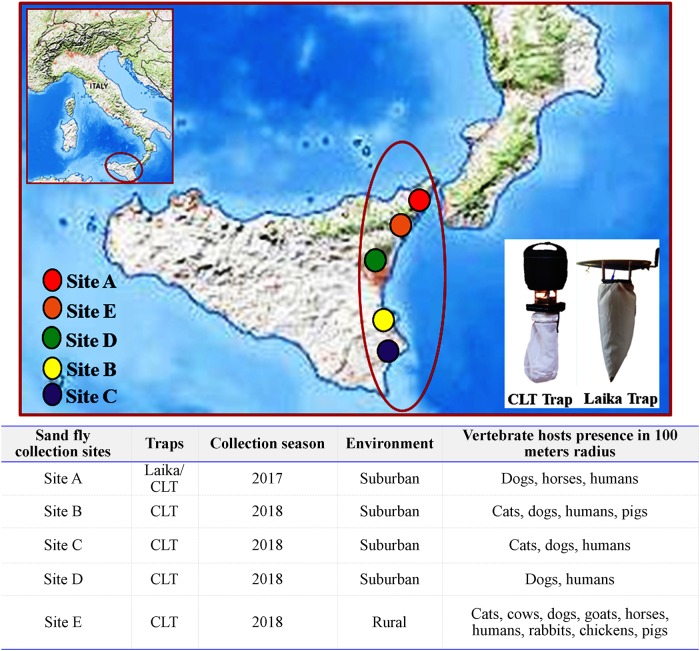
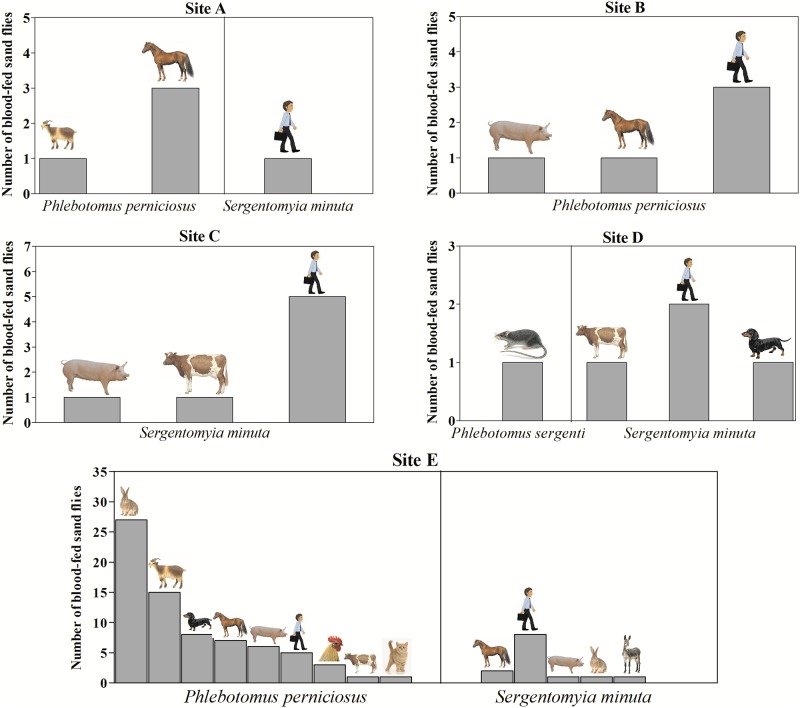
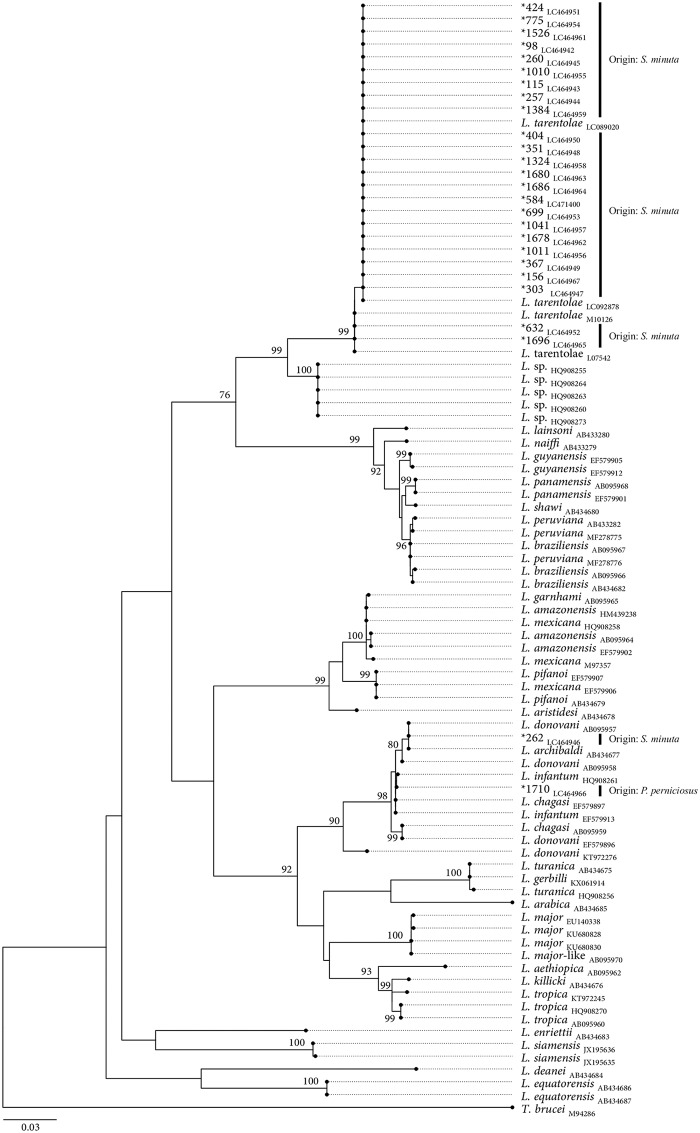
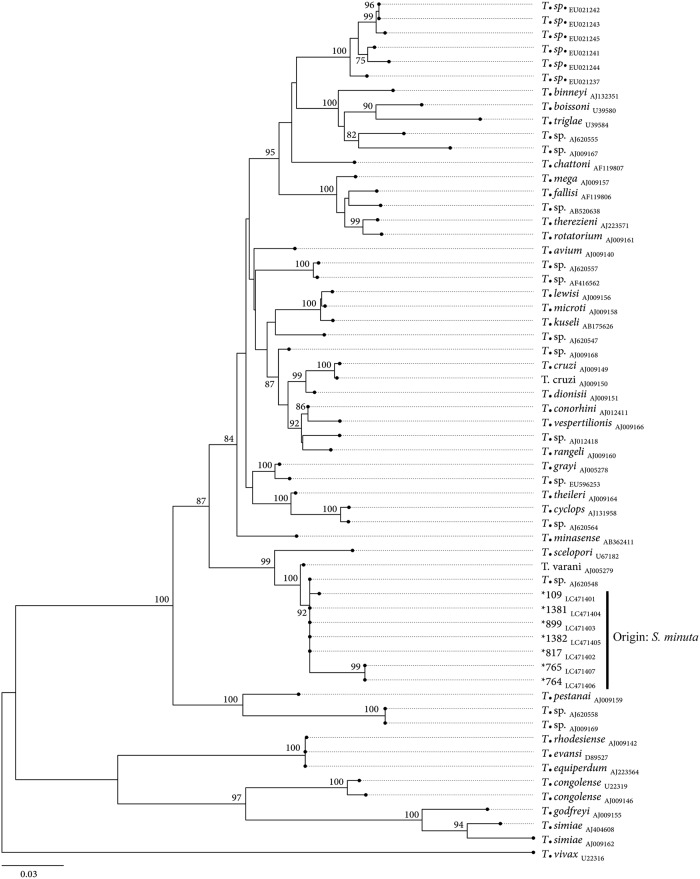
In this study, the presence of Leishmania DNA and blood feeding sources in phlebotomine sand fly species commonly present in Sicily were investigated. A total of 1,866 female sand flies including 176 blood fed specimens were sampled over two seasons in five selected sites in Sicily (southern Italy). Sergentomyia minuta (n = 1,264) and Phlebotomus perniciousus (n = 594) were the most abundant species at all the sites, while three other species from the genus Phlebotomus (i.e., P. sergenti n = 4, P. perfiliewi n = 3 and P. neglectus n = 1) were only sporadically captured. Twenty-eight out of the 1,866 (1.5%) sand flies tested positive for Leishmania spp. Leishmania tarentolae DNA was identified in 26 specimens of S. minuta, while the DNA of Leishmania donovani complex was detected in a single specimen each of S. minuta and P. perniciosus. Interestingly, seven S. minuta specimens (0.4%) tested positive for reptilian Trypanosoma sp. Blood sources were successfully identified in 108 out of 176 blood fed females. Twenty-seven out of 82 blood sources identified in fed females of P. perniciosus were represented by blood of wild rabbit, S. minuta mainly fed on humans (16/25), while the sole P. sergenti fed specimen took a blood meal on rat. Other vertebrate hosts including horse, goat, pig, dog, chicken, cow, cat and donkey were recognized as blood sources for P. perniciosus and S. minuta, and, surprisingly, no reptilian blood was identified in blood-fed S. minuta specimens. Results of this study agree with the well-known role of P. perniciosus as vector of L. infantum in the western Mediterranean; also, vector feeding preferences herein described support the hypothesis on the involvement of lagomorphs as sylvatic reservoirs of Leishmania. The detection of L. donovani complex in S. minuta, together with the anthropophilic feeding-behaviour herein observed, warrants further research to clarify the capacity of this species in the transmission of pathogens to humans and other animals.
在这项研究中,调查了西西里岛常见的嗜人血双翅目(Phlebotomine)沙蝇物种中是否存在利什曼原虫 DNA 和血液来源。在西西里岛五个选定地点的两个季节中,共采集了 1866 只雌性沙蝇,其中包括 176 只吸血标本。在所有地点,塞氏疟蚊(Sergentomyia minuta)(n = 1264)和秘鲁疟蚊(Phlebotomus perniciosus)(n = 594)是最丰富的物种,而其他三种来自疟蚊属(即 P. sergenti n = 4,P. perfiliewi n = 3 和 P. neglectus n = 1)的物种仅偶尔捕获。在 1866 只沙蝇中,有 28 只(1.5%)检测出利什曼原虫 spp. DNA。在 26 只塞氏疟蚊中鉴定出利什曼原虫 tarentolae DNA,而在 1 只塞氏疟蚊和 1 只秘鲁疟蚊中分别检测到利什曼原虫 donovani 复合体的 DNA。有趣的是,在 7 只(0.4%)塞氏疟蚊中检测出爬行动物锥虫属 sp. DNA。在 176 只吸血雌性中,有 108 只成功鉴定出血液来源。在 82 只被鉴定为吸血雌性的秘鲁疟蚊中,有 27 只代表野生兔的血液,塞氏疟蚊主要以人类为食(16/25),而唯一一只吸血的 P. sergenti 以老鼠为食。其他脊椎动物宿主包括马、山羊、猪、狗、鸡、牛、猫和驴,被认为是秘鲁疟蚊和塞氏疟蚊的血液来源,令人惊讶的是,在吸血的塞氏疟蚊中没有检测到爬行动物血液。本研究结果与秘鲁疟蚊作为西地中海地区利什曼原虫感染的载体的众所周知的作用一致;此外,本文描述的媒介物的摄食偏好支持了兔形目动物作为利什曼原虫森林储存库的假设。在塞氏疟蚊中检测到利什曼原虫复合体,以及本文观察到的嗜人血的摄食行为,需要进一步研究以澄清该物种在将病原体传播给人类和其他动物方面的能力。