Peng Yuanyuan, Xu Yan, Yue Liping, Chen Fanglei, Wang Jie, Sun Guozhen
Department of Nursing, School of International Medical Technology, Sanda University, Shanghai, People's Republic of China.
Department of Cardiology, the First Affiliated Hospital of Nanjing Medical University, Nanjing, People's Republic of China.
Psychol Res Behav Manag. 2023 Apr 6;16:1097-1107. doi: 10.2147/PRBM.S405217. eCollection 2023.
In the fight against heart failure (HF), informal caregivers are an indispensable part of the team. As a protective factor against stress, resilience can help to enhance caregivers' psychological adaptation and ultimately increase the quality of care during the HF caregiving period. Recognizing its predictors and exploring how these variables interact could promote tailored strategies to enhancing caregivers' resilience of HF patients. Thus, this study aimed to identify promoting and risk factors of resilience in informal caregivers of HF patients from the Chinese context and to understand the interactions between these factors and resilience.
This cross-sectional study was conducted from December, 2020 to March, 2022 among 210 caregivers in Nanjing, China. The General Information Questionnaire, the Connor-Davidson Resilience Scale, the General Self-Efficacy Scale, the Perceived Social Support Scale, the Positive and Negative Affect Scale, the Simplified Coping Style Questionnaire and the Family Hardiness Index were used in this survey. Data were analysed with Pearson's correlation analysis, the multiple linear regression model and the structural equation modeling (SEM).
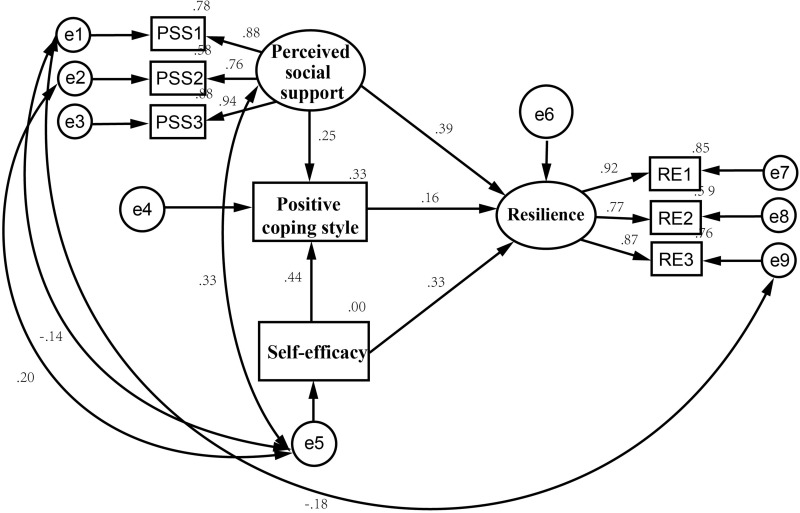
The resilience of 210 Chinese HF caregivers was at the moderate and higher level (66.40±15.08). The SEM had a good fit (root mean square error of approximation=0.047, comparative fit index=0.994, Tucker-Lewis index=0.987). Perceived social support (β=0.390, <0.001), positive coping style (β=0.159, =0.019) and self-efficacy (β=0.332, <0.001) had positive direct effects on resilience among HF caregivers, separately. Both perceived social support (β=0.04, <0.001) and self-efficacy (β=0.07, <0.001) indirectly influenced resilience through positive coping style.
We recommended that multi-dimensional and greater social support, higher self-efficacy and especially, positive coping strategies should be offered or encouraged during the caregiving period, which may contribute to enhancing HF caregivers' resilience.
在对抗心力衰竭(HF)的过程中,非正式照护者是团队中不可或缺的一部分。作为抵御压力的保护因素,心理韧性有助于增强照护者的心理适应能力,并最终提高心力衰竭照护期间的护理质量。识别心理韧性的预测因素并探索这些变量之间的相互作用,有助于制定针对性策略以增强HF患者照护者的心理韧性。因此,本研究旨在从中国背景中识别HF患者非正式照护者心理韧性的促进因素和风险因素,并了解这些因素与心理韧性之间的相互作用。
本横断面研究于2020年12月至2022年3月在中国南京的210名照护者中进行。本调查使用了一般信息问卷、康纳-戴维森心理韧性量表、一般自我效能量表、感知社会支持量表、正负性情绪量表、简易应对方式问卷和家庭坚韧性指数。数据采用Pearson相关分析、多元线性回归模型和结构方程模型(SEM)进行分析。
210名中国HF照护者的心理韧性处于中等及以上水平(66.40±15.08)。SEM拟合良好(近似均方根误差=0.047,比较拟合指数=0.994,塔克-刘易斯指数=0.987)。感知社会支持(β=0.390,<0.001)、积极应对方式(β=0.159,=0.019)和自我效能感(β=0.332,<0.001)分别对HF照护者的心理韧性有积极的直接影响。感知社会支持(β=0.04,<0.001)和自我效能感(β=0.07,<0.001)均通过积极应对方式间接影响心理韧性。
我们建议在照护期间提供或鼓励多维度且更多的社会支持、更高的自我效能感,尤其是积极的应对策略,这可能有助于增强HF照护者的心理韧性。