Hwang Chan Young, Kang Seung-Wan, Choi Suk Bong
College of Global Business, Korea University, Sejong City, Republic of Korea.
College of Business, Gachon University, Seongnam, Republic of Korea.
Front Psychol. 2023 Mar 28;14:1077594. doi: 10.3389/fpsyg.2023.1077594. eCollection 2023.
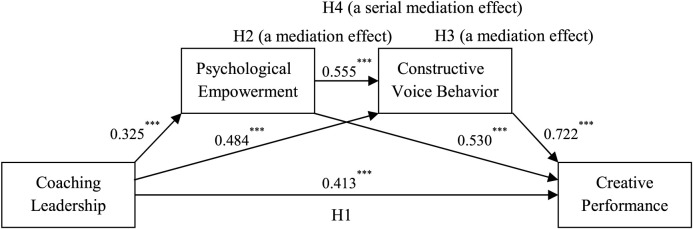
This study empirically analyzes the role of coaching leadership in enhancing an organization's creative performance, discussing and evaluating important mediating paths of coaching leadership regarding creative performance. As a result of an empirical analysis based on survey data collected from 332 employees of Korean companies, this study first confirms that coaching leadership has a positive effect on both employees' creative performance. We also found that psychological empowerment and constructive voice behavior positively mediated the relationship between coaching leadership and creative performance. Finally, the serial mediating effect of coaching leadership on creative performance was tested through psychological empowerment and constructive voice behavior and confirmed to have a positive effect. This study indicates the importance of leadership as a critical variable that promotes employees' creative performance. In addition, by confirming the serial mediating role of psychological empowerment and constructive voice behavior, this study improves understanding of key mechanism in which coaching leadership leads to creative performance.
本研究实证分析了辅导型领导在提升组织创新绩效中的作用,探讨并评估了辅导型领导与创新绩效之间重要的中介路径。基于从韩国企业332名员工收集的调查数据进行实证分析后,本研究首先证实辅导型领导对员工的创新绩效均有积极影响。我们还发现心理授权和建设性发声行为在辅导型领导与创新绩效之间起到了正向中介作用。最后,通过心理授权和建设性发声行为对辅导型领导与创新绩效之间的序列中介效应进行了检验,并证实具有积极影响。本研究表明领导作为促进员工创新绩效的关键变量的重要性。此外,通过确认心理授权和建设性发声行为的序列中介作用,本研究增进了对辅导型领导导致创新绩效的关键机制的理解。