College of Business, Gachon University, Seongnam 13120, Korea.
College of Global Business, Korea University, 2511 Sejong-ro, Sejong City 30019, Korea.
Int J Environ Res Public Health. 2021 Oct 11;18(20):10638. doi: 10.3390/ijerph182010638.
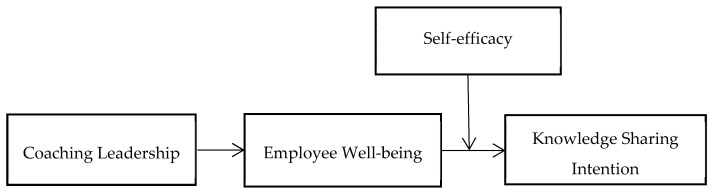
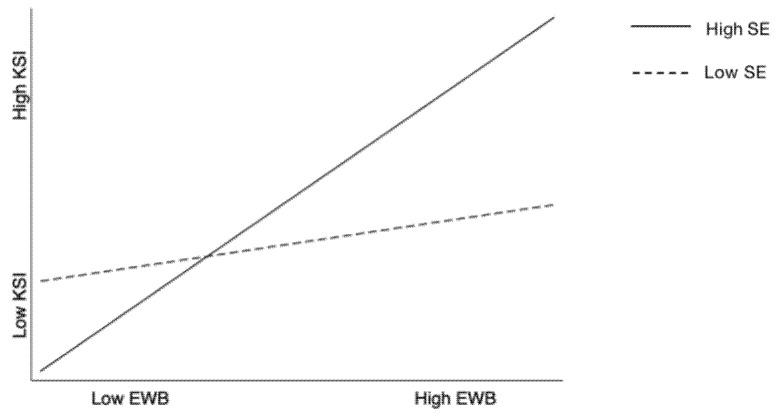
Knowledge acquisition practices are important to enterprises, particularly since market competition is intensifying. In recent years, organizations have begun to pay more attention to knowledge sharing practices. Many organizations are looking for methods to motivate their employees to actively share knowledge with other employees. This study uses the conservation of resources theory to examine coaching leadership as an antecedent-and employee well-being as a mediator-in facilitating knowledge sharing intention; it finds that self-efficacy is the boundary condition in these relations. We collected data in two waves and recruited participants online-full-time employees in the UK and US. Using a sample of 322 employees, we conducted a confirmatory factor analysis to test the validity of the results and used hierarchical multiple regression to examine the direct and interaction effects. Then, we used the bootstrapping method to test the indirect and moderated mediation effects. Our results show that coaching leadership is positively related to knowledge sharing intention, and employee well-being mediates the relationship. Moreover, self-efficacy positively moderates the direct and indirect effects. Our findings demonstrate that employee well-being is a mediating mechanism in the relationship between coaching leadership and knowledge sharing intention, with self-efficacy acting as a boundary condition.
知识获取实践对企业很重要,尤其是在市场竞争加剧的情况下。近年来,组织开始更加关注知识共享实践。许多组织正在寻找激励员工积极与其他员工分享知识的方法。本研究利用资源保存理论,考察了教练型领导作为前因变量——员工幸福感作为中介变量——对促进知识共享意愿的作用;研究发现,自我效能感是这些关系中的边界条件。我们在两个时间点收集了数据,并在线招募了英国和美国的全职员工作为参与者。通过对 322 名员工的样本进行验证性因素分析,以检验结果的有效性,并采用分层多元回归检验直接和交互效应。然后,我们使用自举法检验间接和调节中介效应。研究结果表明,教练型领导与知识共享意愿呈正相关,员工幸福感在两者之间起中介作用。此外,自我效能感正向调节直接和间接效应。我们的研究结果表明,员工幸福感是教练型领导与知识共享意愿之间关系的中介机制,自我效能感是一个边界条件。