Center for Reproductive Medicine, Department of Obstetrics and Gynecology, Peking University Third Hospital, Beijing, 100191, China.
National Clinical Research Center for Obstetrics and Gynecology, (Peking University Third Hospital), Beijing, 100191, China.
J Assist Reprod Genet. 2023 May;40(5):1089-1098. doi: 10.1007/s10815-023-02780-5. Epub 2023 Apr 14.
The aim of this study was to determine the relationship between morphological parameters and the incidence of de novo chromosomal abnormalities.
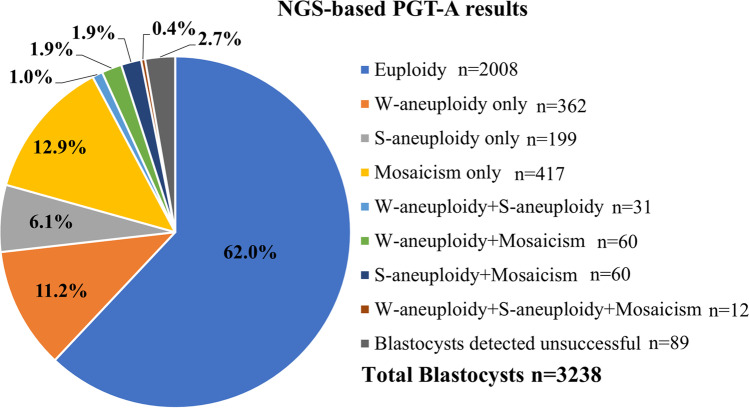
This was a retrospective cohort study of 652 patients who underwent 921 cycles with 3238 blastocysts biopsied. The embryo grades were evaluated according to Gardner and Schoolcraft's system. The incidence of euploidy, whole chromosomal aneuploidy (W-aneuploidy), segmental chromosomal aneuploidy (S-aneuploidy), and mosaicism in trophectoderm (TE) cell biopsies was analyzed.
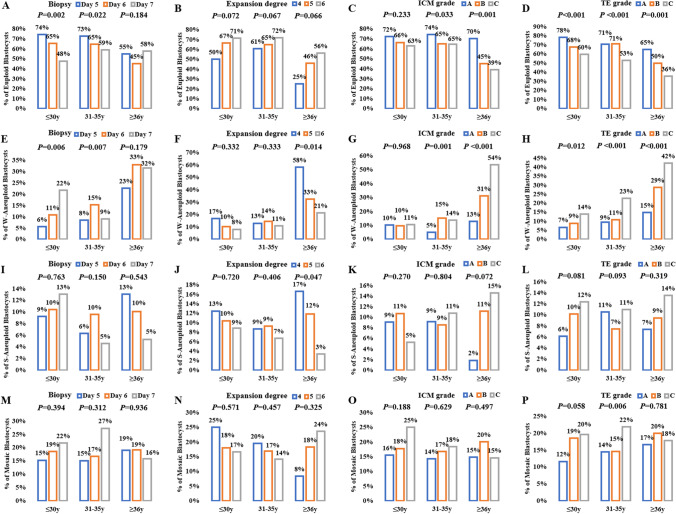
The euploidy decreased significantly with maternal age and was positively correlated biopsy day and morphological parameters. The W-aneuploidy increased significantly with maternal age and was negatively correlated biopsy day and morphological parameters. Parental age, TE biopsy day, and morphological parameters were not associated with S-aneuploidy and mosaicism, except that TE grade C blastocysts had significantly higher mosaicism than TE grade A blastocysts. Subanalysis in different female age groups showed that euploidy and W-aneuploidy had a significant correlation with TE biopsy day among women aged ≤ 30 y and 31-35 y, with expansion degree among women aged ≥ 36 y, with ICM grade among women aged ≥ 31 y, and with TE grade among all female age ranges.
Female age, embryo developmental speed and blastocyst morphological parameters are associated with euploidy and whole chromosomal aneuploidy. The predictive value of these factors varies across female age groups. Parental age, embryo developmental speed, expansion degree, and ICM grade are not associated with the incidence of segmental aneuploidy or mosaicism, but TE grade seemingly has a weak correlation with segmental aneuploidy and mosaicism in embryos.
本研究旨在确定形态参数与新发染色体异常之间的关系。
这是一项回顾性队列研究,纳入了 652 名患者的 921 个周期和 3238 个囊胚活检。胚胎评分根据 Gardner 和 Schoolcraft 系统进行评估。分析整倍体、全染色体非整倍体(W-aneuploidy)、片段染色体非整倍体(S-aneuploidy)和滋养外胚层(TE)细胞活检中的嵌合体发生率。
整倍体率随母体年龄的增加而显著降低,与活检日和形态参数呈正相关。W-aneuploidy 率随母体年龄的增加而显著增加,与活检日和形态参数呈负相关。除了 TE 级 C 囊胚的嵌合体率明显高于 TE 级 A 囊胚外,父母年龄、TE 活检日和形态参数与 S-aneuploidy 和嵌合体率均无相关性。在不同的女性年龄组中进行亚组分析显示,在年龄≤30 岁和 31-35 岁的女性中,TE 活检日与整倍体和 W-aneuploidy 有显著相关性,在年龄≥36 岁的女性中与扩展度有关,在年龄≥31 岁的女性中与 ICM 级有关,在所有女性年龄组中与 TE 级有关。
女性年龄、胚胎发育速度和囊胚形态参数与整倍体和全染色体非整倍体有关。这些因素的预测价值在不同的女性年龄组中有所不同。父母年龄、胚胎发育速度、扩展度和 ICM 级与片段性非整倍体或嵌合体的发生率无关,但 TE 级似乎与胚胎的片段性非整倍体和嵌合体有较弱的相关性。