Jiang Yan, Song Ge, Zhang Xu-Hui, Miao Sui-Bing, Wu Xiao-Hua
The Center for Reproductive Medicine and Infertility, The Fourth Hospital of Shijiazhuang, Shijiazhuang Obstetrics and Gynecology Hospital Affiliated to Hebei Medical University, Shijiazhuang, Hebei 050011, P.R. China.
Exp Ther Med. 2022 May;23(5):333. doi: 10.3892/etm.2022.11262. Epub 2022 Mar 16.
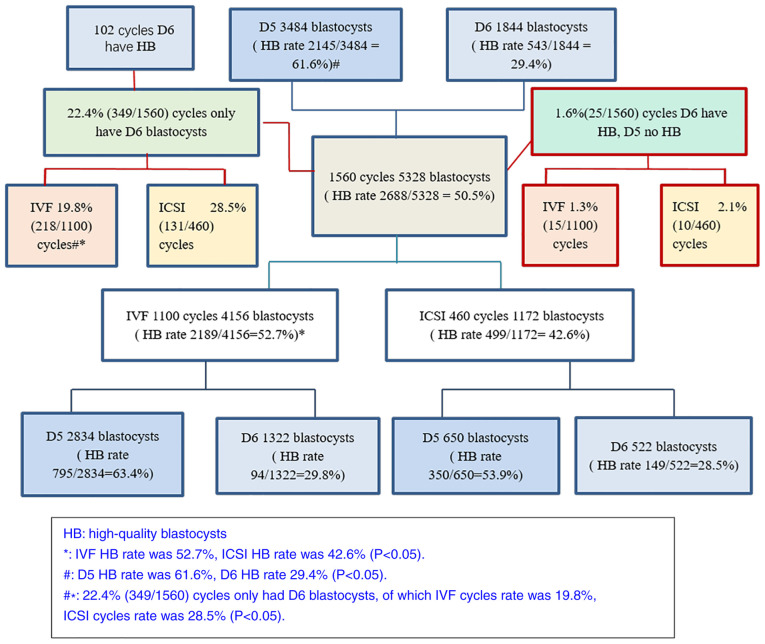
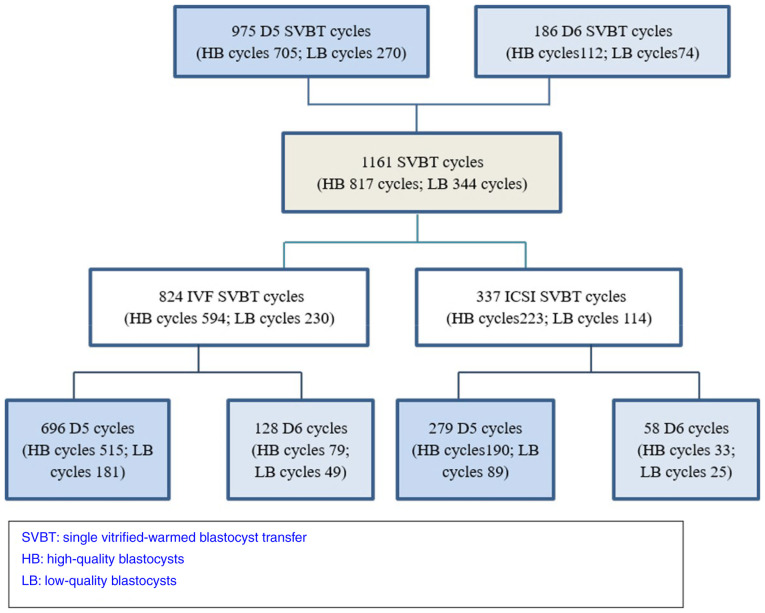
The aim of the present study was to analyze the high-quality blastocyst (HB) rate in all embryo frozen cycles and investigate the pregnancy outcomes for day 5/day 6 (D5/D6) blastocysts with respect to the blastocyst quality in programmed single vitrified-warmed blastocyst transfer (SVBT). We performed a retrospective study comparing D5/D6 HBs in fertilization/intracytoplasmic sperm injection (IVF/ICSI) for all blastocyst frozen cycles. Patients were <35 years at the oocyte collection in their first fresh cycle without fresh transfer. A total of 1,560 IVF/ICSI cycles and 5,328 blastocysts were analyzed. The IVF HB rate was higher than that of ICSI (52.7% vs. 42.6%; P<0.05). The D5 HB rate was much higher than the D6 HB rate (61.6% vs. 29.4%; P<0.05). There were 22.4% (349/1,560) cycles that only had D6 blastocysts, of which IVF cycles were lower than ICSI (19.8% vs. 28.5%; P<0.05). The clinical pregnancy rate and implantation rate in the D5 group were significantly higher than these rates in the D6 group (57.4% vs. 46.2%, 58.9% vs. 47.3%; P<0.05). However, the clinical pregnancy rate and implantation rate of the D5 HBs were not significantly different from those of the D6 HBs (60% vs. 54.5%, 62% vs. 56.3%; P>0.05). In conclusion, the fertilization method (IVF/ICSI) directly influences the HB rate and blastocyst development rates. When we controlled for patient age, transfer frequency, and endometrium on day 5, it was not the development stage (D5/D6), rather the transfer blastocyst quality that played an important role in pregnancy outcomes.
本研究的目的是分析所有胚胎冷冻周期中的优质囊胚(HB)率,并探讨在程序化单冻融囊胚移植(SVBT)中,第5天/第6天(D5/D6)囊胚的妊娠结局与囊胚质量的关系。我们进行了一项回顾性研究,比较了所有囊胚冷冻周期中体外受精/卵胞浆内单精子注射(IVF/ICSI)后的D5/D6 HB。患者在首次新鲜周期取卵时年龄小于35岁,且未进行新鲜移植。共分析了1560个IVF/ICSI周期和5328个囊胚。IVF的HB率高于ICSI(52.7%对42.6%;P<0.05)。D5的HB率远高于D6的HB率(61.6%对29.4%;P<0.05)。有22.4%(349/1560)的周期只有D6囊胚,其中IVF周期低于ICSI(19.8%对28.5%;P<0.05)。D5组的临床妊娠率和着床率显著高于D6组(57.4%对46.2%,58.9%对47.3%;P<0.05)。然而,D5 HB的临床妊娠率和着床率与D6 HB的临床妊娠率和着床率无显著差异(60%对54.5%,62%对56.3%;P>0.05)。总之,受精方式(IVF/ICSI)直接影响HB率和囊胚发育率。当我们控制患者年龄、移植频率和第5天的子宫内膜情况时,对妊娠结局起重要作用的不是发育阶段(D5/D6),而是移植囊胚的质量。