Département de Santé Publique, Hôpital Saint-Antoine, AP-HP.Sorbonne Université, F75012, Paris, France.
Unité Des Virus Emergents, UVE: Aix Marseille Univ, IRD 190, INSERM 1207, IHU Méditerranée Infection, Marseille, 13005, France.
BMC Infect Dis. 2023 Apr 14;23(1):228. doi: 10.1186/s12879-023-08162-7.
Taste or smell disorders have been reported as strongly associated with COVID-19 diagnosis. We aimed to identify subject characteristics, symptom associations, and antibody response intensity associated with taste or smell disorders.
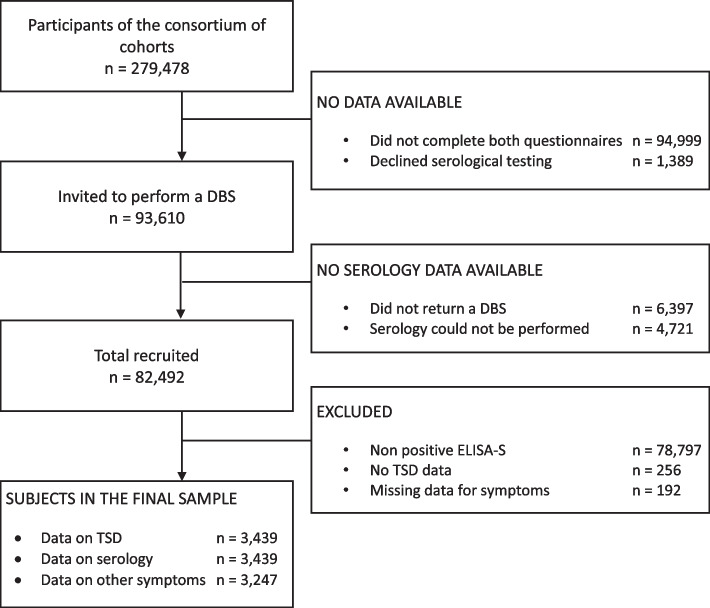
We used data from SAPRIS, a study based on a consortium of five prospective cohorts gathering 279,478 participants in the French general population. In the analysis, we selected participants who were presumably infected by SARS-CoV-2 during the first epidemic wave.
The analysis included 3,439 patients with a positive ELISA-Spike. Sex (OR = 1.28 [95% CI 1.05-1.58] for women), smoking (OR = 1.54 [95% CI 1.13-2.07]), consumption of more than 2 drinks of alcohol a day (OR = 1.37 [95% CI 1.06-1.76]) were associated with a higher probability of taste or smell disorders. The relationship between age and taste or smell disorders was non-linear. Serological titers were associated with taste or smell disorders: OR = 1.31 [95% CI 1.26-1.36], OR = 1.37 [95% CI 1.33-1.42] and OR = 1.34 [95% CI 1.29-1.39] for ELISA-Spike, ELISA-Nucleocapsid and seroneutralization, respectively. Among participants with taste or smell disorders, 90% reported a wide variety of other symptoms whereas 10% reported no other symptom or only rhinorrhea.
Among patients with a positive ELISA-Spike test, women, smokers and people drinking more than 2 drinks a day were more likely to develop taste or smell disorders. This symptom was strongly associated with an antibody response. The overwhelming majority of patients with taste or smell disorders experienced a wide variety of symptoms.
味觉或嗅觉障碍已被报道与 COVID-19 诊断密切相关。我们旨在确定与味觉或嗅觉障碍相关的受试者特征、症状关联和抗体反应强度。
我们使用了 SAPRIS 的数据,这是一项基于由五个前瞻性队列组成的联盟的研究,该联盟共招募了 279478 名法国普通人群中的参与者。在分析中,我们选择了那些在第一波疫情中可能感染 SARS-CoV-2 的参与者。
分析包括 3439 名 ELISA-Spike 阳性的患者。女性(女性的 OR=1.28[95%CI 1.05-1.58])、吸烟(OR=1.54[95%CI 1.13-2.07])、每天饮用超过 2 份酒精饮料(OR=1.37[95%CI 1.06-1.76])与味觉或嗅觉障碍的可能性更高相关。年龄与味觉或嗅觉障碍之间的关系是非线性的。血清学滴度与味觉或嗅觉障碍相关:OR=1.31[95%CI 1.26-1.36]、OR=1.37[95%CI 1.33-1.42]和 OR=1.34[95%CI 1.29-1.39],分别为 ELISA-Spike、ELISA-Nucleocapsid 和血清中和。在有味觉或嗅觉障碍的参与者中,90%报告了各种各样的其他症状,而 10%报告没有其他症状或只有鼻漏。
在 ELISA-Spike 检测阳性的患者中,女性、吸烟者和每天饮用超过 2 份酒精饮料的人更有可能出现味觉或嗅觉障碍。这种症状与抗体反应强烈相关。绝大多数有味觉或嗅觉障碍的患者经历了各种各样的症状。