College of Health Science, Korea University, Seoul, 02841, Republic of Korea.
Division of Healthcare Technology Assessment Research, National Evidence-based Healthcare Collaborating Agency, Seoul, 04933, Republic of Korea.
Environ Health. 2023 Apr 14;22(1):35. doi: 10.1186/s12940-023-00986-9.
The prevalence of age-related neurodegenerative diseases has risen in conjunction with an increase in life expectancy. Although there is emerging evidence that air pollution might accelerate or worsen dementia progression, studies on Asian regions remains limited. This study aimed to investigate the relationship between long-term exposure to PM and the risk of developing Alzheimer's disease and vascular dementia in the elderly population in South Korea.
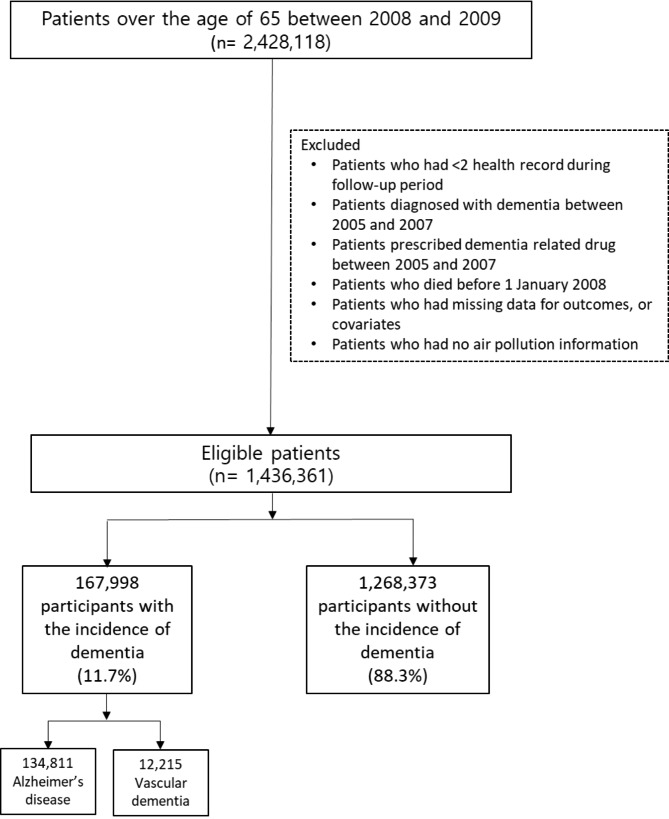
The baseline population was 1.4 million people aged 65 years and above who participated in at least one national health checkup program from the National Health Insurance Service between 2008 and 2009. A nationwide retrospective cohort study was designed, and patients were followed from the date of cohort entry (January 1, 2008) to the date of dementia occurrence, death, moving residence, or the end of the study period (December 31, 2019), whichever came first. Long-term average PM exposure variable was constructed from national monitoring data considering time-dependent exposure. Extended Cox proportional hazard models with time-varying exposure were used to estimate hazard ratios (HR) for Alzheimer's disease and vascular dementia.
A total of 1,436,361 participants were selected, of whom 167,988 were newly diagnosed with dementia (134,811 with Alzheimer's disease and 12,215 with vascular dementia). The results show that for every 10 µg/m increase in PM, the HR was 0.99 (95% CI 0.98-1.00) for Alzheimer's disease and 1.05 (95% CI 1.02-1.08) for vascular dementia. Stratified analysis according to sex and age group showed that the risk of vascular dementia was higher in men and in those under 75 years of age.
The results found that long-term PM exposure was significantly associated with the risk of developing vascular dementia but not with Alzheimer's disease. These findings suggest that the mechanism behind the PM-dementia relationship could be linked to vascular damage.
随着预期寿命的延长,与年龄相关的神经退行性疾病的患病率有所上升。尽管有越来越多的证据表明,空气污染可能会加速或加重痴呆症的发展,但亚洲地区的研究仍然有限。本研究旨在调查韩国老年人群中长期暴露于 PM 与阿尔茨海默病和血管性痴呆风险之间的关系。
基础人群为 140 万 65 岁及以上的人,他们在 2008 年至 2009 年期间至少参加了一次国家健康检查计划。设计了一项全国性回顾性队列研究,患者从队列进入日期(2008 年 1 月 1 日)开始随访,直到发生痴呆、死亡、搬离住所或研究期结束(2019 年 12 月 31 日),以先发生者为准。考虑时间依赖性暴露的国家监测数据构建了长期平均 PM 暴露变量。使用时变暴露的扩展 Cox 比例风险模型估计阿尔茨海默病和血管性痴呆的风险比(HR)。
共选择了 1436361 名参与者,其中 167988 名被新诊断为痴呆症(134811 名患有阿尔茨海默病,12215 名患有血管性痴呆)。结果表明,PM 每增加 10µg/m,阿尔茨海默病的 HR 为 0.99(95%CI 0.98-1.00),血管性痴呆的 HR 为 1.05(95%CI 1.02-1.08)。根据性别和年龄组进行分层分析表明,血管性痴呆的风险在男性和 75 岁以下人群中较高。
结果发现,长期 PM 暴露与发生血管性痴呆的风险显著相关,但与阿尔茨海默病无关。这些发现表明,PM 与痴呆症之间的关系的机制可能与血管损伤有关。