Queensland Alliance for Environmental Health Sciences, The University of Queensland, Brisbane, QLD, Australia.
Qantas Airways, Mascot, NSW, Australia.
Lancet Glob Health. 2023 May;11(5):e791-e795. doi: 10.1016/S2214-109X(23)00129-8.
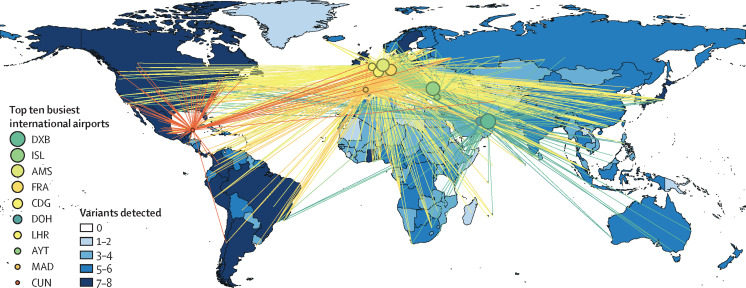
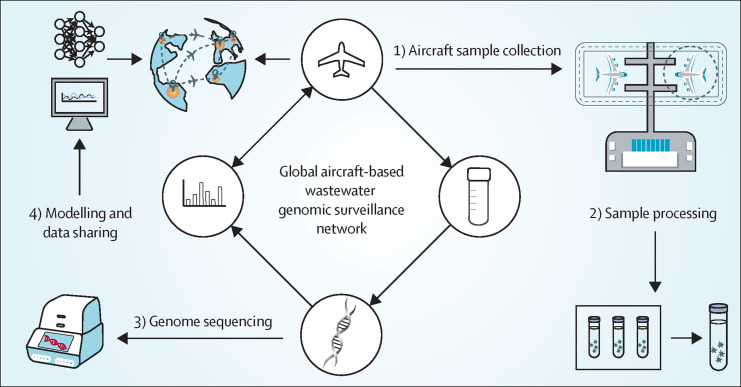
International airports can have a key role in screening, detecting, and mitigating cross-border transmission of SARS-CoV-2 and potentially other infectious diseases. With aircraft passengers representing a subpopulation of a country or region, aircraft-based wastewater surveillance can be a promising approach to effectively identifying emerging viruses, tracing their evolution, and mapping global spread with international flights. Therefore, we propose the development of a global aircraft-based wastewater genomic surveillance network, with the busiest international airports as central nodes and continuing air travel journeys as vectors. This surveillance programme requires routinely collecting aircraft wastewater samples for microbiological analysis and sequencing and linking the resulting data with associated international air traffic information. With the creation of a strong international alliance between the airline industry and health authorities, this surveillance network will potentially complement public health systems with a true early warning ability to inform decision making for new variants and future global health risks.
国际机场可以在筛查、检测和减轻 SARS-CoV-2 及潜在其他传染病的跨境传播方面发挥关键作用。由于飞机乘客代表一个国家或地区的一部分人群,基于飞机废水的监测可以成为一种很有前途的方法,能够有效地识别新出现的病毒,追踪其进化,并通过国际航班绘制其在全球的传播路径。因此,我们建议开发一个全球性的基于飞机废水的基因组监测网络,以最繁忙的国际机场作为中心节点,以国际航班作为传播载体。该监测计划需要定期收集飞机废水样本进行微生物分析和测序,并将所得数据与相关的国际航空交通信息联系起来。通过航空公司和卫生当局之间建立强大的国际联盟,该监测网络将有可能通过真正的早期预警能力来补充公共卫生系统,为新变体和未来的全球健康风险提供决策依据。