Jin Shihui, Dickens Borame L, Toh Kai Yee, Lye David Chien Boon, Lee Vernon J, Cook Alex R
Saw Swee Hock School of Public Health, National University of Singapore and National University Health System, Singapore, Singapore.
AMILI Pte Ltd, Singapore, Singapore.
PLOS Glob Public Health. 2024 Mar 13;4(3):e0003010. doi: 10.1371/journal.pgph.0003010. eCollection 2024.
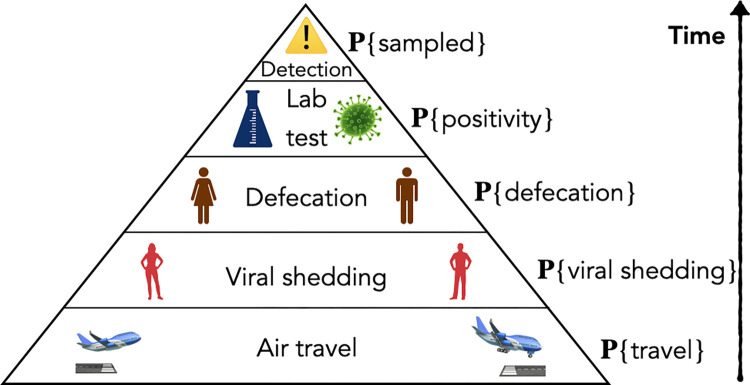
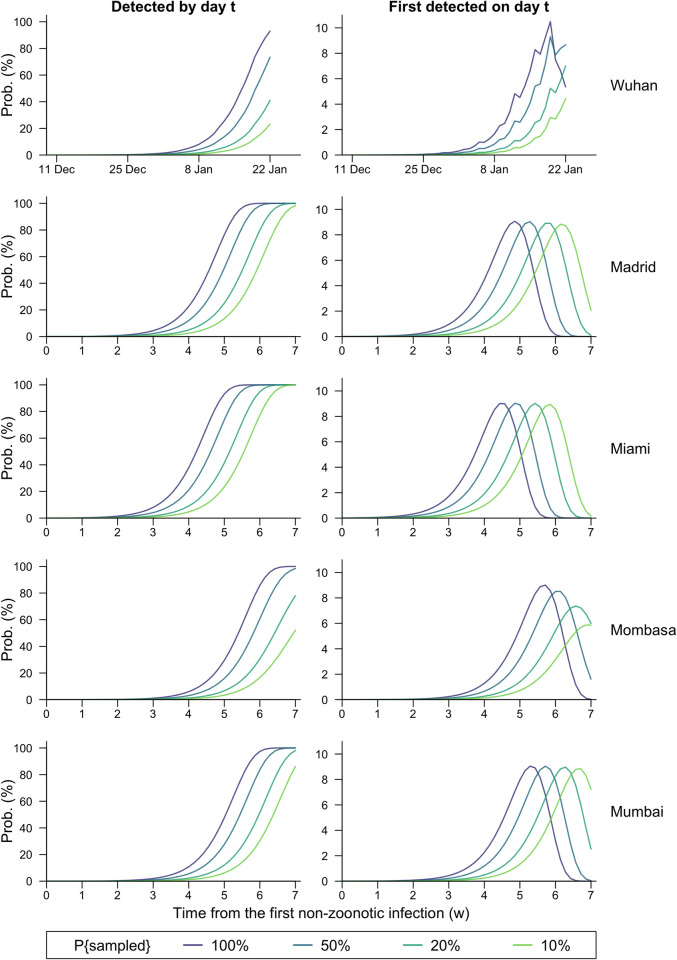
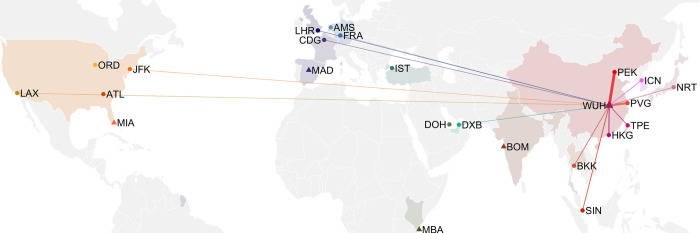
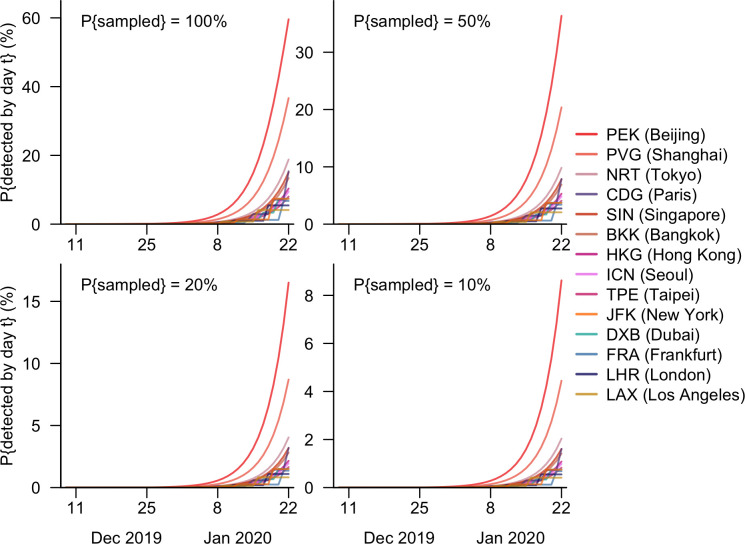
Wastewater-based surveillance has been put into practice during the pandemic. Persistence of SARS-CoV-2 in faeces of infected individuals, and high volume of passengers travelling by air, make it possible to detect virus from aircraft wastewater, lending itself to the potential identification of a novel pathogen prior to clinical diagnosis. In this study, we estimated the likelihood of detecting the virus through aircraft wastewater from the probabilities of air travel, viral shedding, defecation, testing sensitivity, and sampling. We considered various hypothetical scenarios, with diverse sampling proportions of inbound flights, surveillance airports, and sources of outbreaks. Our calculations showed that the probability of detecting SARS-CoV-2 would increase exponentially against time in the early phase of the pandemic, and would be much higher if the 20 major airports in Asia, Europe, and North America cooperated to perform aircraft wastewater surveillance. We also found other contributors to early detection, including high sampling proportion of inbound flight at destination airports, small population size of the epicentre relative to the travel volume, and large volume of outbound travelers to major airports around the globe. We concluded that routine aircraft wastewater monitoring could be a feasible approach for early identification and tracking of an emerging pathogen with high faecal shedding rates, particularly when implemented through a global surveillance network of major airports.
在疫情期间,基于废水的监测已付诸实践。严重急性呼吸综合征冠状病毒2(SARS-CoV-2)在感染者粪便中的持续存在,以及大量的航空旅客,使得从飞机废水中检测病毒成为可能,这有助于在临床诊断之前潜在地识别新型病原体。在本研究中,我们根据航空旅行、病毒脱落、排便、检测灵敏度和采样的概率,估计了通过飞机废水检测病毒的可能性。我们考虑了各种假设情景,包括入境航班、监测机场和疫情爆发源的不同采样比例。我们的计算表明,在疫情早期,检测到SARS-CoV-2的概率会随时间呈指数增长,如果亚洲、欧洲和北美的20个主要机场合作进行飞机废水监测,概率会更高。我们还发现了其他有助于早期检测的因素,包括目的地机场入境航班的高采样比例、相对于旅行量而言疫情中心的人口规模较小,以及前往全球主要机场的大量出境旅客。我们得出结论,常规的飞机废水监测可能是早期识别和追踪具有高粪便排泄率的新兴病原体的一种可行方法,特别是通过主要机场的全球监测网络实施时。