Research and Policy, Marie Curie, London, UK.
Academic Unit of Palliative Care, University of Leeds, Leeds, UK.
BMC Palliat Care. 2023 Apr 17;22(1):43. doi: 10.1186/s12904-023-01168-7.
Advance care planning (ACP) is the process supporting individuals with life-limiting illness to make informed decisions about their future healthcare. Ethnic disparities in ACP have been widely highlighted, but interpretation is challenging due to methodological heterogeneity. This review aims to examine differences in the presence of documented ACP in individuals' care records for people with advanced disease by ethnic group, and identify patient and clinician related factors contributing to this.
Mixed-methods systematic review. Keyword searches on six electronic databases were conducted (01/2000-04/2022). The primary outcome measure was statistically significant differences in the presence of ACP in patients' care records by ethnicity: quantitative data was summarised and tabulated. The secondary outcome measures were patient and clinician-based factors affecting ACP. Data was analysed qualitatively through thematic analysis; themes were developed and presented in a narrative synthesis. Feedback on themes was gained from Patient and Public Involvement (PPI) representatives. Study quality was assessed through Joanna Briggs Institute Critical Appraisal tools and Gough's Weight of Evidence.
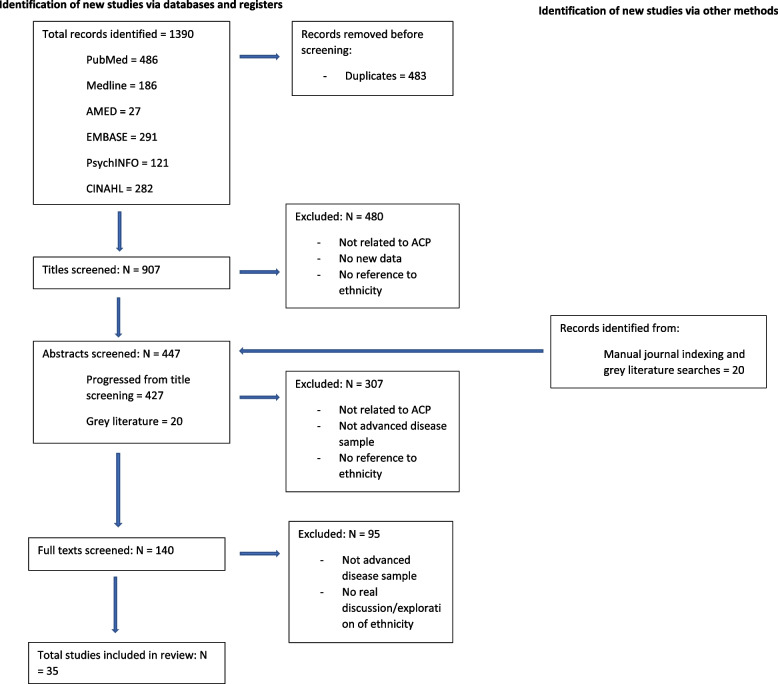
N=35 papers were included in total; all had Medium/High Weight of Evidence. Fifteen papers (comparing two or more ethnic groups) addressed the primary outcome measure. Twelve of the fifteen papers reported White patients had statistically higher rates of formally documented ACP in their care records than patients from other ethnic groups. There were no significant differences in the presence of informal ACP between ethnic groups. Nineteen papers addressed the secondary outcome measure; thirteen discussed patient-based factors impacting ACP presence with four key themes: poor awareness and understanding of ACP; financial constraints; faith and religion; and family involvement. Eight papers discussed clinician-based factors with three key themes: poor clinician confidence around cultural values and ideals; exacerbation of institutional constraints; and pre-conceived ideas of patients' wishes.
This review found differences in the presence of legal ACP across ethnic groups despite similar presence of informal end of life conversations. Factors including low clinician confidence to deliver culturally sensitive, individualised conversations around ACP, and patients reasons for not wishing to engage in ACP (including, faith, religion or family preferences) may begin to explain some documented differences.
PROSPERO-CRD42022315252.
预先医疗照护计划(ACP)是支持患有绝症的个体做出未来医疗保健决策的过程。ACP 方面的族裔差异已得到广泛强调,但由于方法学的异质性,对其进行解释具有挑战性。本综述旨在检查在记录有晚期疾病患者的医疗记录中,族裔群体之间是否存在有文件记录的 ACP,并确定促成这一差异的患者和临床医生相关因素。
混合方法系统综述。在六个电子数据库中进行了关键词搜索(2000 年 1 月至 2022 年 4 月)。主要结局指标是根据族裔群体,在患者医疗记录中存在 ACP 的统计学显著差异:对定量数据进行总结和制表。次要结局指标是影响 ACP 的患者和临床医生相关因素。通过主题分析对数据进行定性分析;开发并以叙述性综合的形式呈现主题。从患者和公众参与(PPI)代表那里获得对主题的反馈。通过 Joanna Briggs 研究所批判性评价工具和 Gough 的证据权重评估研究质量。
共纳入 35 篇论文;所有论文的证据权重均为中/高度。15 篇论文(比较两个或多个族裔群体)涉及主要结局指标。其中 12 篇论文报告称,在他们的医疗记录中,白人患者正式记录 ACP 的比率明显高于其他族裔群体的患者。不同族裔群体之间非正式 ACP 的存在没有统计学差异。19 篇论文涉及次要结局指标;其中 13 篇讨论了影响 ACP 存在的患者相关因素,有四个关键主题:对 ACP 的认识和理解不足;经济限制;信仰和宗教;以及家庭参与。8 篇论文讨论了临床医生相关因素,有三个关键主题:临床医生在文化价值观和理想方面的信心不足;加剧机构限制;以及对患者意愿的先入为主的想法。
本综述发现,尽管非正式的临终谈话相似,但不同族裔群体之间存在 ACP 存在的法律差异。包括临床医生在提供文化敏感、个体化的 ACP 对话方面信心不足,以及患者不希望参与 ACP 的原因(包括信仰、宗教或家庭偏好)等因素,可能开始解释一些有文件记录的差异。
PROSPERO-CRD42022315252。