Li Simin, Chen Yichang, Ma Ruolin, Du Ye, Han Bing
Breast Surgery Department, General Surgery Center, First Hospital of Jilin University, Changchun, China.
Front Pharmacol. 2023 Mar 31;14:1142374. doi: 10.3389/fphar.2023.1142374. eCollection 2023.
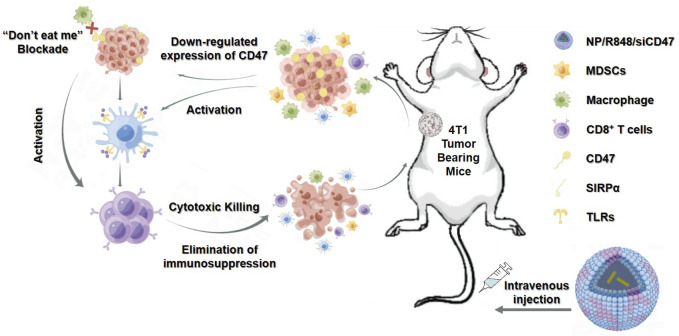
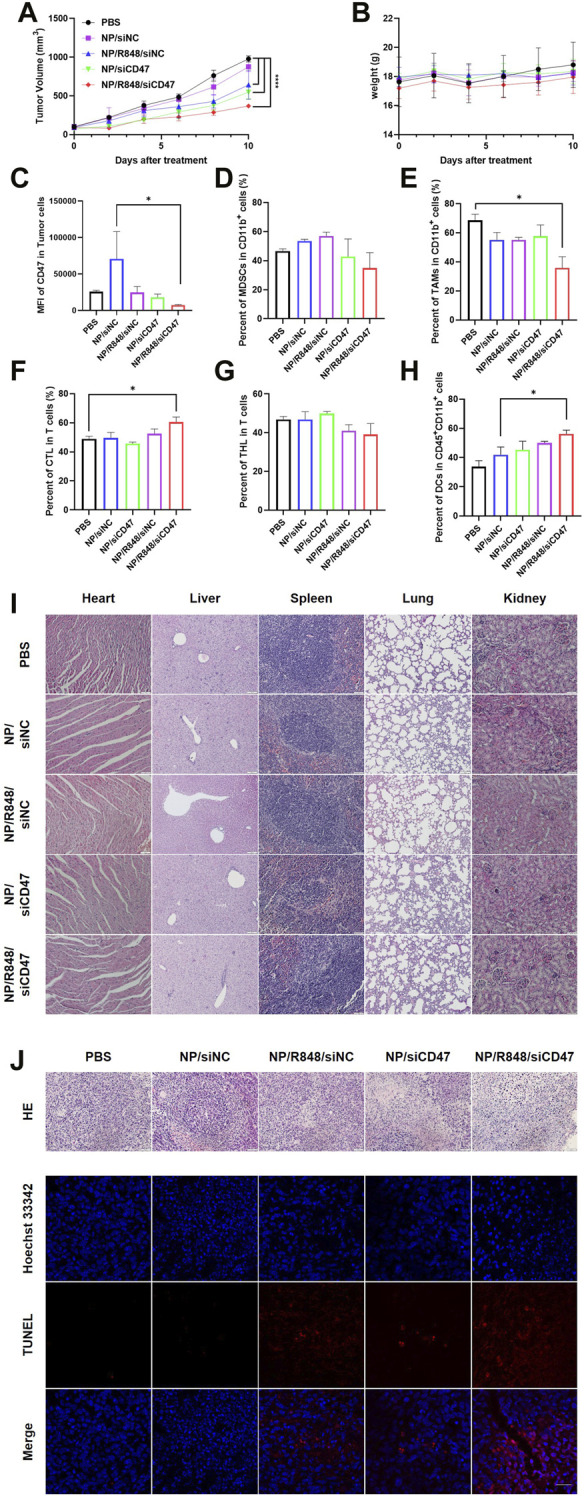
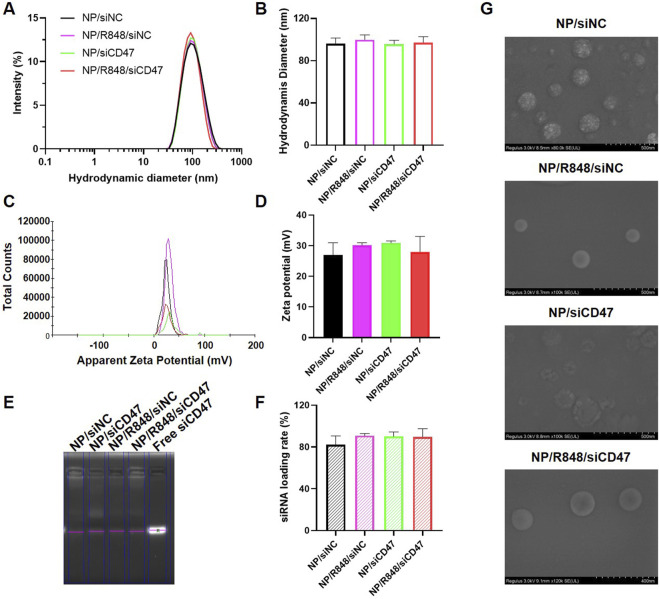
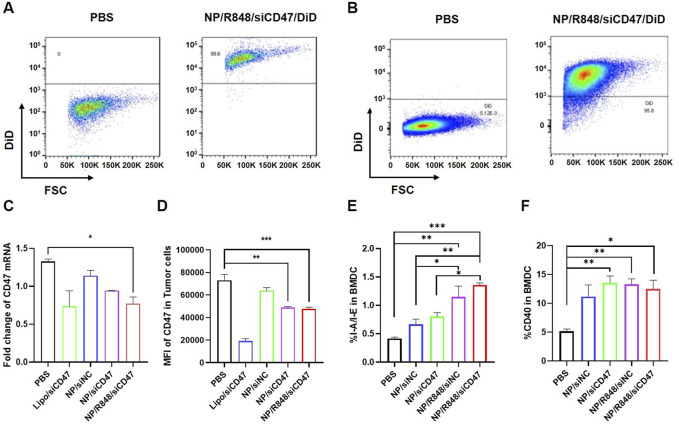
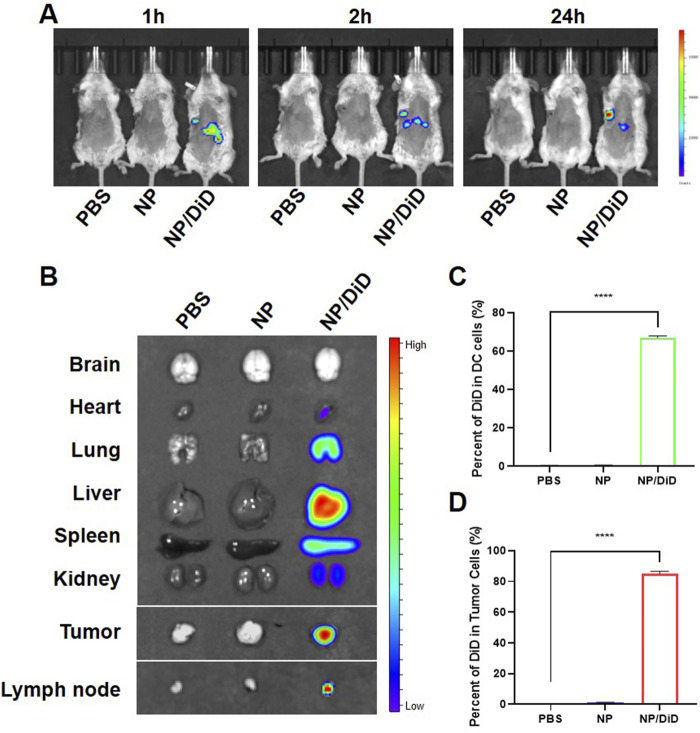
Triple-negative breast cancer (TNBC) usually has a poor prognosis. Although the immunotherapy of TNBC has achieved great progress, only a few patients can benefit from the current treatment. CD47 is widely expressed on the surface of TNBC cells and may become an immune checkpoint for TNBC treatment. Nevertheless, increasingly more attention has been paid to systemic side effects since the ubiquitous expression of CD47 on normal cells. The toll-like receptor (TLR) agonist resiquimod (R848) can activate dendritic cells (DCs) and promote the maturation of immune cells in the tumor microenvironment, which further enhances the tumor inhibition ability of the immune system and synergizes with CD47 small interfering RNA (siRNA) for TNBC therapy. However, ideal delivery platforms such as nanocarriers are still needed because its weakness of hydrophobicity. In order to improve efficacy and reduce toxicity, R848 and siCD47 were entrapped in amphiphilic PEG-PLGA nanoparticles by double emulsification and stable nanoparticles NP/R848/siCD47 were generated to investigate their anti-tumor effects in a TNBC tumor-bearing mouse model. Here, we show that PEG-PLGA nanoparticles are effective nanocarriers that can safely and effectively deliver siCD47 and R848 to tumor tissue, as demonstrated by retarded tumor growth. Mechanistically, downregulation of CD47 expression and activation of DCs took part in promoting the immune response of cytotoxic T cells (CTLs). Meanwhile, a decrease of myeloid-derived suppressor cells (MDSCs) and tumor-associated macrophages (TAMs) indicated the modulating of the tumor immune microenvironment. To our best knowledge, our study pioneered co-delivery system for hydrophilic siCD47 and hydrophobic R848. It can maximize break tumor immune escape caused by CD47 and simultaneously enhance antigen presentation by activating DCs for effector T cell killing while regulating the tumor microenvironment as expected. Not only does it conform to the reports of previous basic research, but also it can break the bottleneck of their clinical application hopefully. Collectively, our findings could lay the foundation for future therapeutic strategies of TNBC.
三阴性乳腺癌(TNBC)通常预后较差。尽管TNBC的免疫治疗取得了很大进展,但只有少数患者能从当前治疗中获益。CD47在TNBC细胞表面广泛表达,可能成为TNBC治疗的一个免疫检查点。然而,由于CD47在正常细胞中普遍表达,其全身副作用越来越受到关注。 toll样受体(TLR)激动剂瑞喹莫德(R848)可激活树突状细胞(DCs),促进肿瘤微环境中免疫细胞的成熟,进而增强免疫系统的肿瘤抑制能力,并与CD47小干扰RNA(siRNA)协同用于TNBC治疗。然而,由于其疏水性的弱点,仍需要纳米载体等理想的递送平台。为了提高疗效和降低毒性,通过双乳化法将R848和siCD47包裹在两亲性聚乙二醇-聚乳酸-羟基乙酸共聚物(PEG-PLGA)纳米颗粒中,制备出稳定的纳米颗粒NP/R848/siCD47,以研究它们在TNBC荷瘤小鼠模型中的抗肿瘤作用。在此,我们表明PEG-PLGA纳米颗粒是有效的纳米载体,能够安全有效地将siCD47和R848递送至肿瘤组织,肿瘤生长延迟证明了这一点。从机制上讲,CD47表达的下调和DCs的激活参与促进细胞毒性T细胞(CTLs)的免疫反应。同时,髓源性抑制细胞(MDSCs)和肿瘤相关巨噬细胞(TAMs)的减少表明肿瘤免疫微环境得到了调节。据我们所知,我们的研究开创了亲水性siCD47和疏水性R848的共递送系统。它可以最大限度地打破由CD47引起的肿瘤免疫逃逸,同时通过激活DCs以促进效应T细胞杀伤来增强抗原呈递,同时如预期那样调节肿瘤微环境。它不仅符合先前基础研究的报道,而且有望打破它们临床应用的瓶颈。总的来说,我们的研究结果可为TNBC未来的治疗策略奠定基础。