Simmonds Lucy, Lagrata Susie, Stubberud Anker, Cheema Sanjay, Tronvik Erling, Matharu Manjit, Kamourieh Salwa
Headache and Facial Pain Group, UCL Queen Square Institute of Neurology and National Hospital for Neurology and Neurosurgery, London, United Kingdom.
Norwegian Centre for Headache Research, Department of Neuromedicine and Movement Science, NTNU Norwegian University of Science and Technology, Trondheim, Norway.
Front Neurol. 2023 Mar 30;14:1100426. doi: 10.3389/fneur.2023.1100426. eCollection 2023.
Many patients with cluster headache (CH) are inadequately controlled by current treatment options. Non-invasive vagus nerve stimulation (nVNS) is reported to be effective in the management of CH though some studies suggest that it is ineffective.
To assess the safety and efficacy of nVNS in chronic cluster headache (CCH) patients.
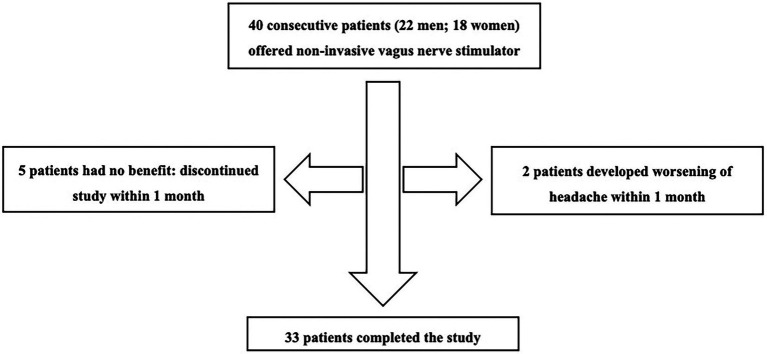
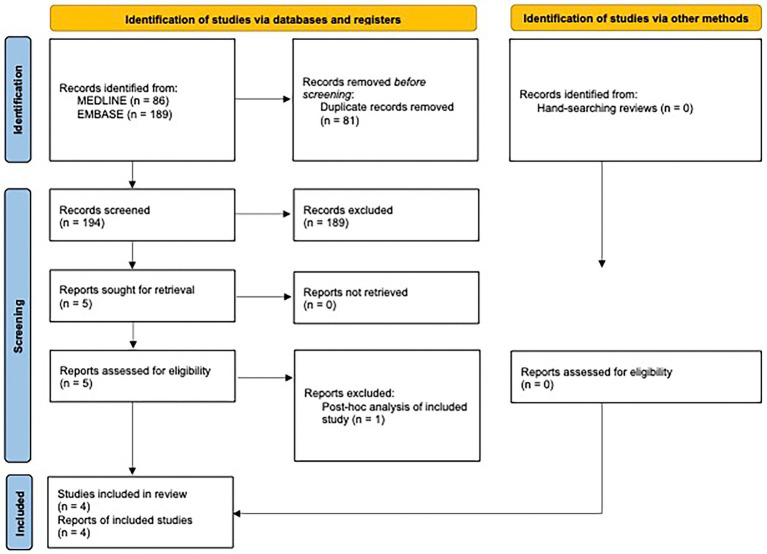
We prospectively analysed data from 40 patients with refractory CCH in this open-label, observational study. Patients were seen in tertiary headache clinics at the National Hospital for Neurology and Neurosurgery and trained to use nVNS as preventative therapy. Patients were reivewed at one month and then three-monthly from onset. The primary endpoint was number of patients achieving ≥50% reduction in attack frequency at 3 months. A meta-analysis of all published studies evaluating the efficacy of nVNS in CCH was also conducted. We searched MEDLINE and EMBASE for all studies investigating the use of nVNS as a preventive or adjunctive treatment for CCH with five or more participants. Combined mean difference and responder proportions with 95% confidence intervals (CI) were calculated from the included studies.
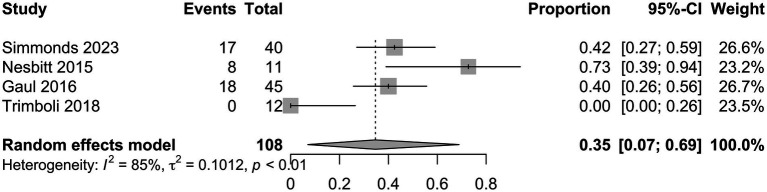
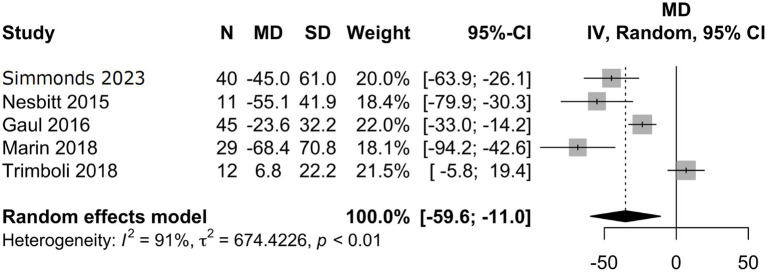
17/40 patients (43%) achieved ≥50% reduction in attack frequency at 3 months. There was a significant reduction in monthly attack frequency from a baseline of 124 (±67) attacks to 79 (±63) attacks in month 3 (mean difference 44.7; 95% CI 25.1 to 64.3; < 0.001). In month 3, there was also a 1.2-point reduction in average severity from a baseline Verbal Rating Scale of 8/10 (95% CI 0.5 to 1.9; = 0.001). Four studies, along with the present study, were deemed eligible for meta-analysis, which showed a responder proportion of 0.35 (95% CI 0.07 to 0.69, = 137) and a mean reduction in headache frequency of 35.3 attacks per month (95% CI 11.0 to 59.6, = 108), from a baseline of 105 (±22.7) attacks per month.
This study highlights the potential benefit of nVNS in CCH, with significant reductions in headache frequency and severity. To better characterise the effect, randomised sham-controlled trials are needed to confirm the beneficial response of VNS reported in some, but not all, open-label studies.
许多丛集性头痛(CH)患者目前的治疗方案无法充分控制病情。据报道,非侵入性迷走神经刺激(nVNS)对CH的治疗有效,尽管一些研究表明其无效。
评估nVNS在慢性丛集性头痛(CCH)患者中的安全性和有效性。
在这项开放标签的观察性研究中,我们前瞻性分析了40例难治性CCH患者的数据。患者在国家神经病学和神经外科医院的三级头痛诊所就诊,并接受使用nVNS作为预防性治疗的培训。从发病开始,患者在1个月时接受复查,然后每3个月复查一次。主要终点是在3个月时发作频率降低≥50%的患者数量。我们还对所有已发表的评估nVNS在CCH中疗效的研究进行了荟萃分析。我们在MEDLINE和EMBASE中搜索了所有调查使用nVNS作为CCH预防性或辅助性治疗且参与者不少于5人的研究。根据纳入研究计算合并平均差和反应者比例以及95%置信区间(CI)。
17/40例患者(43%)在3个月时发作频率降低≥50%。第3个月时,每月发作频率从基线的124(±67)次显著降至79(±63)次(平均差44.7;95%CI 25.1至64.3;<0.001)。在第3个月时,平均严重程度较基线言语评定量表8/10也降低了1.2分(95%CI 0.5至1.9;=0.001)。包括本研究在内的四项研究被认为符合荟萃分析条件,结果显示反应者比例为0.35(95%CI 0.07至0.69,=137),头痛频率从每月105(±22.7)次的基线水平平均每月降低35.3次(95%CI 11.0至59.6,=108)。
本研究突出了nVNS在CCH中的潜在益处,头痛频率和严重程度显著降低。为了更好地描述其效果,需要进行随机假对照试验来证实一些(但不是全部)开放标签研究中报道的VNS的有益反应。