School of Mathematical Sciences, The University of Nottingham, Nottingham, United Kingdom.
Wexner Medical Center, The Ohio State University, Columbus, OH, United States.
Front Public Health. 2023 Mar 30;11:1087698. doi: 10.3389/fpubh.2023.1087698. eCollection 2023.
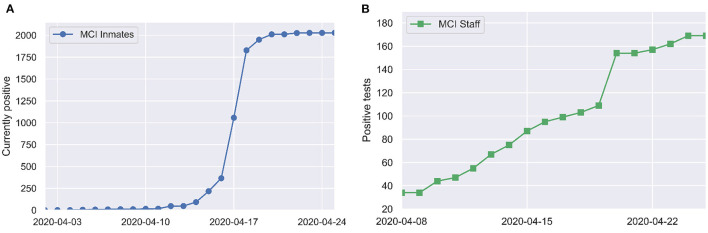
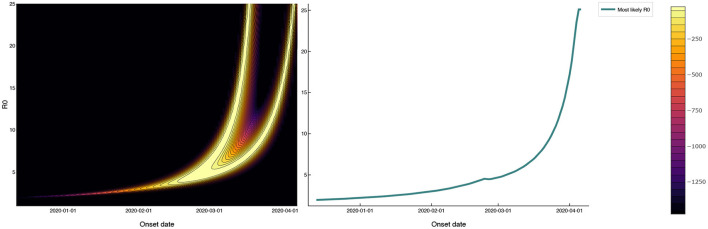
Incarcerated individuals are a highly vulnerable population for infection with severe acute respiratory syndrome coronavirus 2 (SARS-CoV-2). Understanding the transmission of respiratory infections within prisons and between prisons and surrounding communities is a crucial component of pandemic preparedness and response. Here, we use mathematical and statistical models to analyze publicly available data on the spread of SARS-CoV-2 reported by the Ohio Department of Rehabilitation and Corrections (ODRC). Results from mass testing conducted on April 16, 2020 were analyzed together with time of first reported SARS-CoV-2 infection among Marion Correctional Institution (MCI) inmates. Extremely rapid, widespread infection of MCI inmates was reported, with nearly 80% of inmates infected within 3 weeks of the first reported inmate case. The dynamical survival analysis (DSA) framework that we use allows the derivation of explicit likelihoods based on mathematical models of transmission. We find that these data are consistent with three non-exclusive possibilities: (i) a basic reproduction number >14 with a single initially infected inmate, (ii) an initial superspreading event resulting in several hundred initially infected inmates with a reproduction number of approximately three, or (iii) earlier undetected circulation of virus among inmates prior to April. All three scenarios attest to the vulnerabilities of prisoners to COVID-19, and the inability to distinguish among these possibilities highlights the need for improved infection surveillance and reporting in prisons.
被监禁者是感染严重急性呼吸综合征冠状病毒 2(SARS-CoV-2)的高脆弱人群。了解监狱内以及监狱与周围社区之间呼吸道感染的传播情况,是大流行防范和应对的重要组成部分。在这里,我们使用数学和统计模型来分析俄亥俄州康复和矫正部(ODRC)报告的关于 SARS-CoV-2 传播的公开可用数据。我们一起分析了 2020 年 4 月 16 日进行的大规模检测的结果,以及马里恩惩教所(MCI)囚犯中首次报告 SARS-CoV-2 感染的时间。据报道,MCI 囚犯的感染极其迅速且广泛,近 80%的囚犯在首次报告囚犯病例后的 3 周内被感染。我们使用的动态生存分析(DSA)框架允许根据传播的数学模型推导出明确的似然率。我们发现这些数据与三种非排他性可能性一致:(i)基本繁殖数>14,最初只有一名受感染者,(ii)最初的超级传播事件导致最初有数百名受感染者,繁殖数约为三,或(iii)在 4 月之前,病毒在囚犯中更早地未被发现传播。所有这三种情况都证明了囚犯对 COVID-19 的脆弱性,而无法区分这些可能性突显了需要改善监狱内的感染监测和报告。