Ma Huifang, Tang Yizhang, Rong Fan, Wang Kun, Wang Tengjiao, Li Peng
Frontiers Science Center for Flexible Electronics (FSCFE), Xi'an Institute of Flexible Electronics (IFE), Xi'an Institute of Biomedical Materials & Engineering (IBME), Northwestern Polytechnical University (NPU), 127 West Youyi Road, Xi'an, Shaanxi, 710072, PR China.
Bioact Mater. 2023 Mar 30;27:154-167. doi: 10.1016/j.bioactmat.2023.03.022. eCollection 2023 Sep.
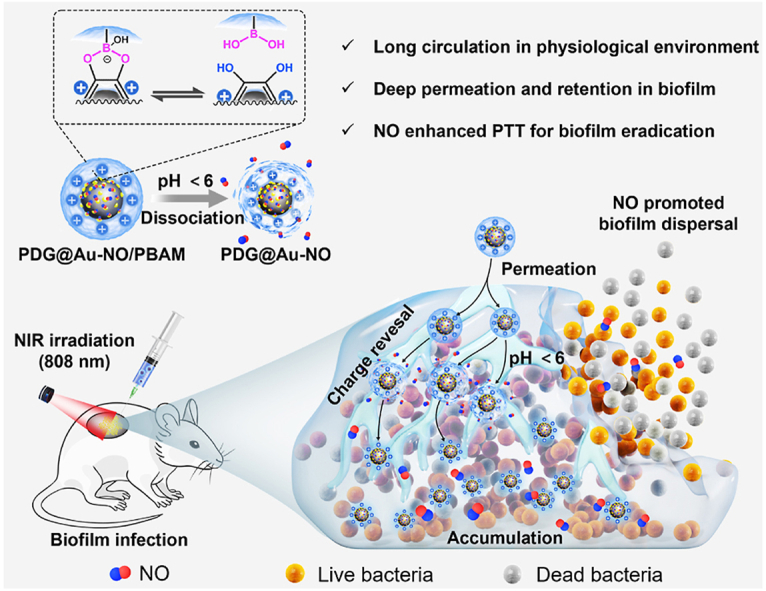
Due to protection of extracellular polymeric substances, the therapeutic efficiency of conventional antimicrobial agents is often impeded by their poor infiltration and accumulation in biofilm. Herein, one type of surface charge adaptable nitric oxide (NO) nanogenerator was developed for biofilm permeation, retention and eradication. This nanogenerator (PDG@Au-NO/PBAM) is composed of a core-shell structure: thermo-sensitive NO donor conjugated AuNPs on cationic poly(dopamine--glucosamine) nanoparticle (PDG@Au-NO) served as core, and anionic phenylboronic acid-acryloylmorpholine (PBAM) copolymer was employed as a shell. The NO nanogenerator featured long circulation and good biocompatibility. Once the nanogenerator reached acidic biofilm, its surface charge would be switched to positive after shell dissociation and cationic core exposure, which was conducive for the nanogenerator to infiltrate and accumulate in the depth of biofilm. In addition, the nanogenerator could sustainably generate NO to disturb the integrity of biofilm at physiological temperature, then generate hyperthermia and explosive NO release upon NIR irradiation to efficiently eradicate drug-resistant bacteria biofilm. Such rational design offers a promising approach for developing nanosystems against biofilm-associated infections.
由于细胞外聚合物的保护作用,传统抗菌剂在生物膜中的渗透和积累较差,常常阻碍其治疗效果。在此,开发了一种可适应表面电荷的一氧化氮(NO)纳米发生器,用于生物膜的渗透、滞留和根除。这种纳米发生器(PDG@Au-NO/PBAM)由核壳结构组成:阳离子聚(多巴胺-葡萄糖胺)纳米颗粒(PDG@Au-NO)上的热敏NO供体共轭金纳米颗粒作为核心,阴离子苯硼酸-丙烯酰吗啉(PBAM)共聚物作为外壳。该NO纳米发生器具有长循环和良好的生物相容性。一旦纳米发生器到达酸性生物膜,其表面电荷在外壳解离和阳离子核心暴露后会转变为正电荷,这有利于纳米发生器渗透并积聚在生物膜深处。此外,该纳米发生器能够在生理温度下持续产生NO以破坏生物膜的完整性,然后在近红外照射下产生热疗和爆炸性NO释放,从而有效根除耐药细菌生物膜。这种合理的设计为开发抗生物膜相关感染的纳米系统提供了一种有前景的方法。