Ribeiro Inês, Antunes Jorge T, Alexandrino Diogo A M, Tomasino Maria Paola, Almeida Eduarda, Hilário Ana, Urbatzka Ralph, Leão Pedro N, Mucha Ana P, Carvalho Maria F
CIIMAR - Interdisciplinary Centre of Marine and Environmental Research, University of Porto, Porto, Portugal.
School of Medicine and Biomedical Sciences (ICBAS), University of Porto, Porto, Portugal.
Front Microbiol. 2023 Mar 30;14:1158441. doi: 10.3389/fmicb.2023.1158441. eCollection 2023.
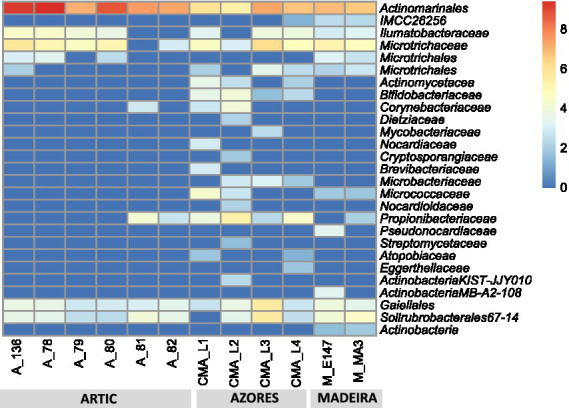
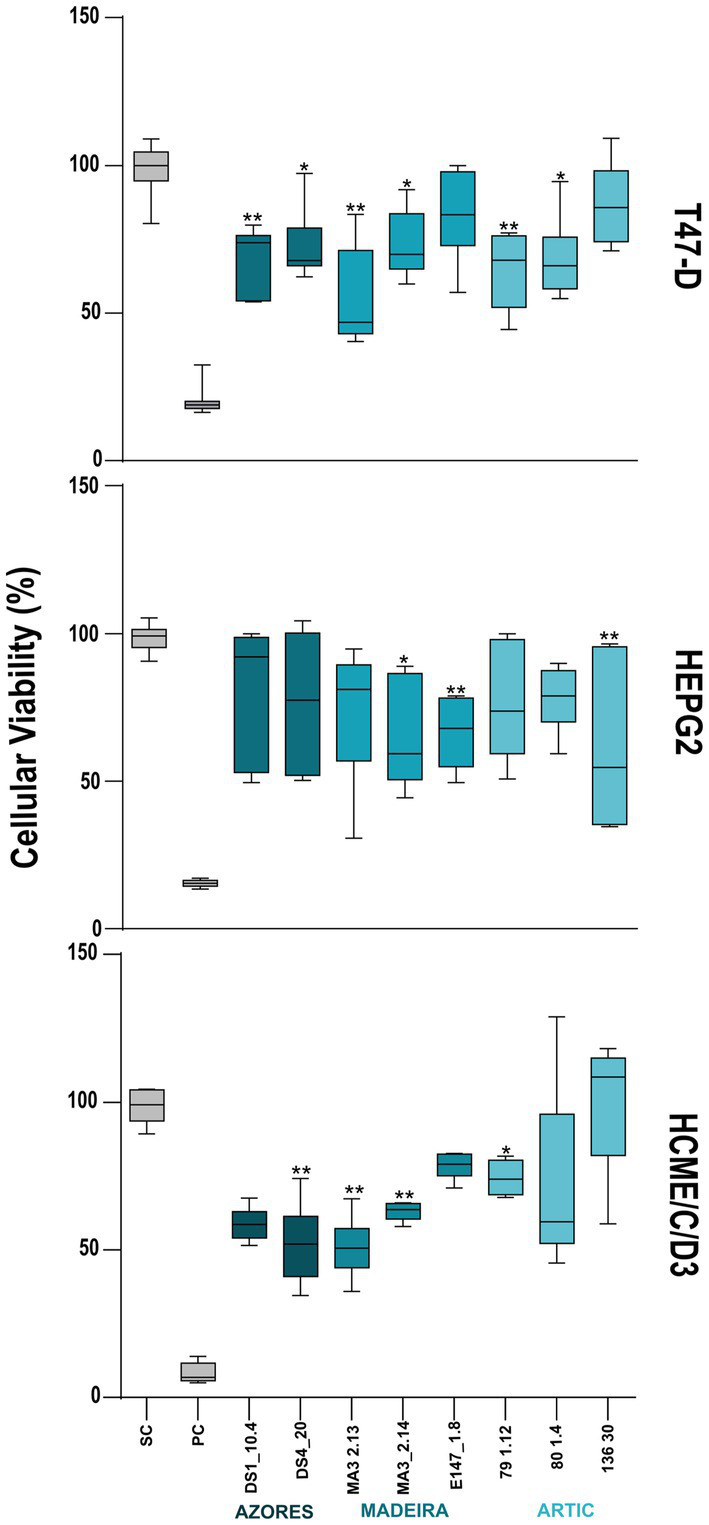
The deep-sea covers over 70% of the Earth's surface and harbors predominantly uncharacterized bacterial communities. Actinobacteria are the major prokaryotic source of bioactive natural products that find their way into drug discovery programs, and the deep-sea is a promising source of biotechnologically relevant actinobacteria. Previous studies on actinobacteria in deep-sea sediments were either regionally restricted or did not combine a community characterization with the analysis of their bioactive potential. Here we characterized the actinobacterial communities of upper layers of deep-sea sediments from the Arctic and the Atlantic (Azores and Madeira) ocean basins, employing 16S rRNA metabarcoding, and studied the biosynthetic potential of cultivable actinobacteria retrieved from those samples. Metabarcoding analysis showed that the actinobacterial composition varied between the sampled regions, with higher abundance in the Arctic samples but higher diversity in the Atlantic ones. Twenty actinobacterial genera were detected using metabarcoding, as a culture-independent method, while culture-dependent methods only allowed the identification of nine genera. Isolation of actinobacteria resulted on the retrieval of 44 isolates, mainly associated with , , and genera. Some of these isolates were only identified on a specific sampled region. Chemical extracts of the actinobacterial isolates were subsequently screened for their antimicrobial, anticancer and anti-inflammatory activities. Extracts from two strains demonstrated activity against . Additionally, eight extracts (obtained from , , , , and isolates) showed significant activity against at least one of the tested cancer cell lines (HepG2 and T-47D). Furthermore, 15 actinobacterial extracts showed anti-inflammatory potential in the RAW 264.4 cell model assay, with no concomitant cytotoxic response. Dereplication and molecular networking analysis of the bioactive actinobacterial extracts showed the presence of some metabolites associated with known natural products, but one of the analyzed clusters did not show any match with the natural products described as responsible for these bioactivities. Overall, we were able to recover taxonomically diverse actinobacteria with different bioactivities from the studied deep-sea samples. The conjugation of culture-dependent and -independent methods allows a better understanding of the actinobacterial diversity of deep-sea environments, which is important for the optimization of approaches to obtain novel chemically-rich isolates.
深海覆盖了地球表面的70%以上,主要蕴藏着尚未被充分了解的细菌群落。放线菌是生物活性天然产物的主要原核来源,这些产物已被应用于药物研发项目中,而深海是具有生物技术相关性的放线菌的一个有前景的来源。先前对深海沉积物中放线菌的研究要么局限于特定区域,要么没有将群落特征与生物活性潜力分析相结合。在这里,我们采用16S rRNA宏条形码技术对来自北极和大西洋(亚速尔群岛和马德拉群岛)海盆的深海沉积物上层的放线菌群落进行了特征分析,并研究了从这些样本中分离出的可培养放线菌的生物合成潜力。宏条形码分析表明,放线菌的组成在采样区域之间存在差异,北极样本中的丰度较高,而大西洋样本中的多样性较高。使用宏条形码这种非培养方法检测到了20个放线菌属,而依赖培养的方法仅鉴定出9个属。放线菌的分离得到了44株菌株,主要与 、 和 属相关。其中一些菌株仅在特定的采样区域被鉴定出来。随后对放线菌分离株的化学提取物进行了抗菌、抗癌和抗炎活性筛选。来自两株 菌株的提取物表现出对 的活性。此外,八种提取物(从 、 、 、 和 分离株获得)对至少一种受试癌细胞系(HepG2和T - 47D)表现出显著活性。此外,15种放线菌提取物在RAW 264.4细胞模型试验中显示出抗炎潜力,且没有伴随的细胞毒性反应。对具有生物活性的放线菌提取物进行去重复和分子网络分析表明,存在一些与已知天然产物相关的代谢物,但其中一个分析的簇与被描述为具有这些生物活性的天然产物没有任何匹配。总体而言,我们能够从研究的深海样本中回收具有不同生物活性的分类学上多样化的放线菌。依赖培养和非培养方法的结合能够更好地了解深海环境中的放线菌多样性,这对于优化获取新型化学丰富分离株的方法很重要。