Castro-Aldrete Laura, Moser Michele V, Putignano Guido, Ferretti Maria Teresa, Schumacher Dimech Annemarie, Santuccione Chadha Antonella
Women's Brain Project, Guntershausen bei Aadorf, Switzerland.
Faculty of Medicine and Health Sciences, University of Lucerne, Lucerne, Switzerland.
Front Aging Neurosci. 2023 Mar 30;15:1105620. doi: 10.3389/fnagi.2023.1105620. eCollection 2023.
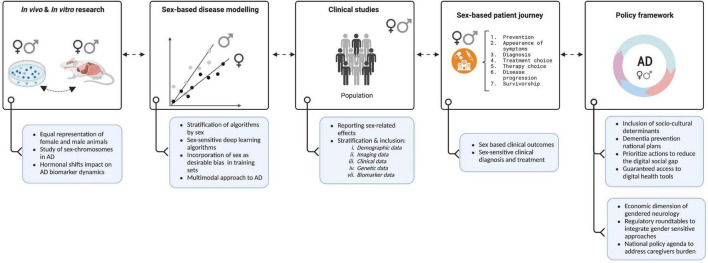
The global population is expected to have about 131.5 million people living with Alzheimer's disease (AD) and other dementias by 2050, posing a severe health crisis. Dementia is a progressive neurodegenerative condition that gradually impairs physical and cognitive functions. Dementia has a variety of causes, symptoms, and heterogeneity concerning the influence of sex on prevalence, risk factors, and outcomes. The proportion of male-to-female prevalence varies based on the type of dementia. Despite some types of dementia being more common in men, women have a greater lifetime risk of developing dementia. AD is the most common form of dementia in which approximately two-thirds of the affected persons are women. Profound sex and gender differences in physiology and pharmacokinetic and pharmacodynamic interactions have increasingly been identified. As a result, new approaches to dementia diagnosis, care, and patient journeys should be considered. In the heart of a rapidly aging worldwide population, the Women's Brain Project (WBP) was born from the necessity to address the sex and gender gap in AD. WBP is now a well-established international non-profit organization with a global multidisciplinary team of experts studying sex and gender determinants in the brain and mental health. WBP works with different stakeholders worldwide to help change perceptions and reduce sex biases in clinical and preclinical research and policy frameworks. With its strong female leadership, WBP is an example of the importance of female professionals' work in the field of dementia research. WBP-led peer-reviewed papers, articles, books, lectures, and various initiatives in the policy and advocacy space have profoundly impacted the community and driven global discussion. WBP is now in the initial phases of establishing the world's first Sex and Gender Precision Medicine Institute. This review highlights the contributions of the WBP team to the field of AD. This review aims to increase awareness of potentially important aspects of basic science, clinical outcomes, digital health, policy framework and provide the research community with potential challenges and research suggestions to leverage sex and gender differences. Finally, at the end of the review, we briefly touch upon our progress and contribution toward sex and gender inclusion beyond Alzheimer's disease.
预计到2050年,全球将有大约1.315亿人患有阿尔茨海默病(AD)和其他痴呆症,这将构成一场严重的健康危机。痴呆症是一种进行性神经退行性疾病,会逐渐损害身体和认知功能。痴呆症有多种病因、症状,并且在性别对患病率、风险因素和预后的影响方面存在异质性。男女患病率的比例因痴呆症类型而异。尽管某些类型的痴呆症在男性中更为常见,但女性一生中患痴呆症的风险更高。AD是最常见的痴呆症形式,其中约三分之二的患者为女性。生理以及药代动力学和药效学相互作用方面存在着显著的性别差异,这一点已越来越多地得到确认。因此,应考虑采用新的痴呆症诊断、护理和患者就医途径。在全球人口迅速老龄化的背景下,女性大脑项目(WBP)因需要解决AD领域的性别差距而诞生。WBP现在是一个成熟的国际非营利组织,拥有一个全球多学科专家团队,研究大脑和心理健康中的性别决定因素。WBP与全球不同的利益相关者合作,以帮助改变观念,并减少临床和临床前研究以及政策框架中的性别偏见。凭借其强大的女性领导力,WBP体现了女性专业人员在痴呆症研究领域工作的重要性。WBP主导的同行评审论文、文章、书籍、讲座以及政策和宣传领域的各种倡议,对该领域产生了深远影响,并推动了全球讨论。WBP目前正处于建立世界首个性别精准医学研究所的初始阶段。本综述强调了WBP团队对AD领域的贡献。本综述旨在提高对基础科学、临床结果、数字健康、政策框架等潜在重要方面的认识,并为研究界提供利用性别差异的潜在挑战和研究建议。最后,在综述结尾,我们简要介绍了我们在阿尔茨海默病之外的性别包容方面取得的进展和贡献。