Parvaneh Shahram, Kemény Lajos, Ghaffarinia Ameneh, Yarani Reza, Veréb Zoltán
Regenerative Medicine and Cellular Pharmacology Laboratory (HECRIN), Department of Dermatology and Allergology, University of Szeged, Koranyi fasor 6., H 6720, Szeged, Hungary.
Doctoral School of Clinical Medicine, University of Szeged, Tisza Lajos krt. 109, H 6725 Szeged, Hungary.
Int J Bioprint. 2023 Jan 9;9(2):665. doi: 10.18063/ijb.v9i2.665. eCollection 2023.
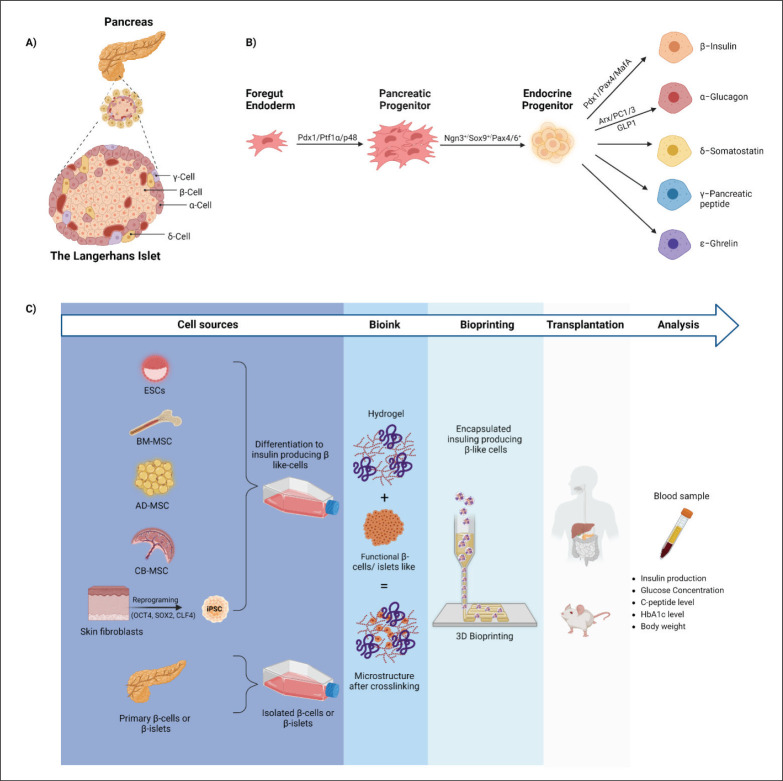
256Diabetes is an autoimmune disease that ensues when the pancreas does not deliver adequate insulin or when the body cannot react to the existing insulin. Type 1 diabetes is an autoimmune disease defined by continuous high blood sugar levels and insulin deficiency due to β-cell destruction in the islets of Langerhans (pancreatic islets). Long-term complications, such as vascular degeneration, blindness, and renal failure, result from periodic glucose-level fluctuations following exogenous insulin therapy. Nevertheless, the shortage of organ donors and the lifelong dependency on immunosuppressive drugs limit the transplantation of the entire pancreas or pancreas islet, which is the therapy for this disease. Although encapsulating pancreatic islets using multiple hydrogels creates a semi-privileged environment to prevent immune rejection, hypoxia that occurs in the core of the capsules is the main hindrance that should be solved. Bioprinting technology is an innovative process in advanced tissue engineering that allows the arranging of a wide array of cell types, biomaterials, and bioactive factors as a bioink to simulate the native tissue environment for fabricating clinically applicable bioartificial pancreatic islet tissue. Multipotent stem cells have the potential to be a possible solution for donor scarcity and can be a reliable source for generating autograft and allograft functional β-cells or even pancreatic islet-like tissue. The use of supporting cells, such as endothelial cells, regulatory T cells, and mesenchymal stem cells, in the bioprinting of pancreatic islet-like construct could enhance vasculogenesis and regulate immune activity. Moreover, scaffolds bioprinted using biomaterials that can release oxygen postprinting or enhance angiogenesis could increase the function of β-cells and the survival of pancreatic islets, which could represent a promising avenue.
256糖尿病是一种自身免疫性疾病,当胰腺无法分泌足够的胰岛素或身体无法对现有胰岛素作出反应时就会发生。1型糖尿病是一种自身免疫性疾病,其特征是由于朗格汉斯胰岛(胰腺胰岛)中的β细胞破坏导致血糖持续升高和胰岛素缺乏。长期并发症,如血管退化、失明和肾衰竭,是外源性胰岛素治疗后周期性血糖水平波动的结果。然而,器官供体的短缺以及对免疫抑制药物的终身依赖限制了全胰腺或胰岛移植,而这是该疾病的治疗方法。尽管使用多种水凝胶包裹胰岛可创造一个半特权环境以防止免疫排斥,但胶囊核心出现的缺氧是需要解决的主要障碍。生物打印技术是先进组织工程中的一种创新工艺,它允许将多种细胞类型、生物材料和生物活性因子作为生物墨水进行排列,以模拟天然组织环境来制造临床适用的生物人工胰岛组织。多能干细胞有可能成为解决供体稀缺问题的一种方案,并且可以成为生成自体移植和同种异体移植功能性β细胞甚至胰岛样组织的可靠来源。在胰岛样构建体的生物打印中使用支持细胞,如内皮细胞、调节性T细胞和间充质干细胞,可以增强血管生成并调节免疫活性。此外,使用打印后能释放氧气或增强血管生成的生物材料进行生物打印的支架,可以提高β细胞的功能和胰岛的存活率,这可能是一条有前途的途径。