School of Psychology, Center for Studies of Psychological Application, Guangdong Key Laboratory of Mental Health and Cognitive Science, Ministry of Education Key Laboratory of Brain Cognition and Educational Science, South China Normal University, Guangzhou, China.
Hum Brain Mapp. 2023 Jun 15;44(9):3744-3757. doi: 10.1002/hbm.26309. Epub 2023 Apr 17.
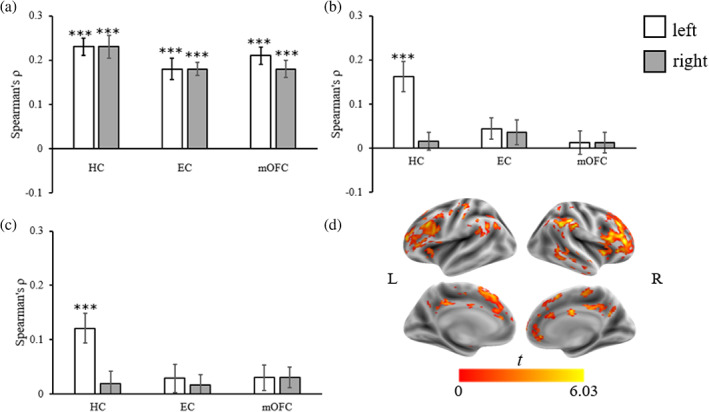
A cognitive map is an internal representation of the external world that guides flexible behavior in a complex environment. Cognitive map theory assumes that relationships between entities can be organized using Euclidean-based coordinates. Previous studies revealed that cognitive map theory can also be generalized to inferences about abstract spaces, such as social spaces. However, it is still unclear whether humans can construct a cognitive map by combining relational knowledge between discrete entities with multiple abstract dimensions in nonsocial spaces. Here we asked subjects to learn to navigate a novel object space defined by two feature dimensions, price and abstraction. The subjects first learned the rank relationships between objects in each feature dimension and then completed a transitive inferences task. We recorded brain activity using functional magnetic resonance imaging (fMRI) while they performed the transitive inference task. By analyzing the behavioral data, we found that the Euclidean distance between objects had a significant effect on response time (RT). The longer the one-dimensional rank distance and two-dimensional (2D) Euclidean distance between objects the shorter the RT. The task-fMRI data were analyzed using both univariate analysis and representational similarity analysis. We found that the hippocampus, entorhinal cortex, and medial orbitofrontal cortex were able to represent the Euclidean distance between objects in 2D space. Our findings suggest that relationship inferences between discrete objects can be made in a 2D nonsocial space and that the neural basis of this inference is related to cognitive maps.
认知地图是对外界环境的内部表示,可指导复杂环境中的灵活行为。认知地图理论假设实体之间的关系可以使用基于欧几里得的坐标来组织。先前的研究表明,认知地图理论也可以推广到对抽象空间(如社交空间)的推理。然而,目前尚不清楚人类是否可以通过将离散实体之间的关系知识与非社交空间中的多个抽象维度相结合来构建认知地图。在这里,我们要求受试者学习通过两个特征维度(价格和抽象度)来导航一个新的对象空间。受试者首先学习每个特征维度中对象之间的等级关系,然后完成传递性推理任务。我们在他们执行传递性推理任务时使用功能磁共振成像(fMRI)记录大脑活动。通过分析行为数据,我们发现对象之间的欧几里得距离对反应时间(RT)有显著影响。对象之间的一维等级距离和二维(2D)欧几里得距离越长,RT 越短。使用单变量分析和表示相似性分析对任务 fMRI 数据进行了分析。我们发现海马体、内嗅皮层和内侧眶额皮层能够表示 2D 空间中对象之间的欧几里得距离。我们的研究结果表明,离散对象之间的关系推理可以在 2D 非社交空间中进行,并且这种推理的神经基础与认知地图有关。