Neurocomputation and Neuroimaging Unit, Freie Universität Berlin, Berlin, 14195, Germany.
Berlin School of Mind and Brain, Humboldt Universität zu Berlin, Berlin, 10117, Germany.
Hum Brain Mapp. 2023 Jun 15;44(9):3644-3668. doi: 10.1002/hbm.26303. Epub 2023 Apr 17.
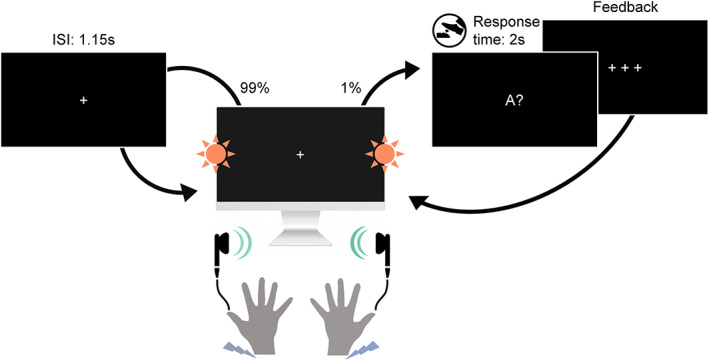
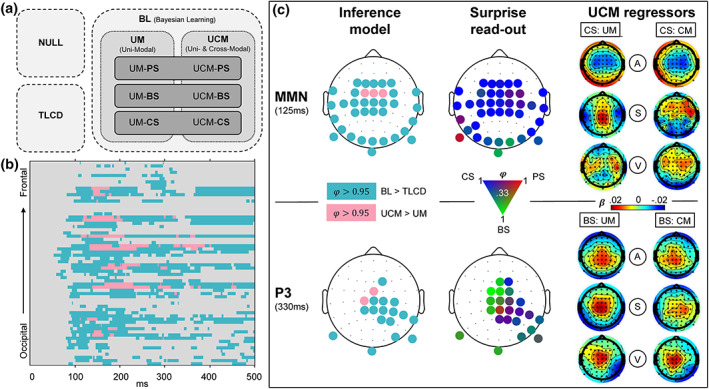
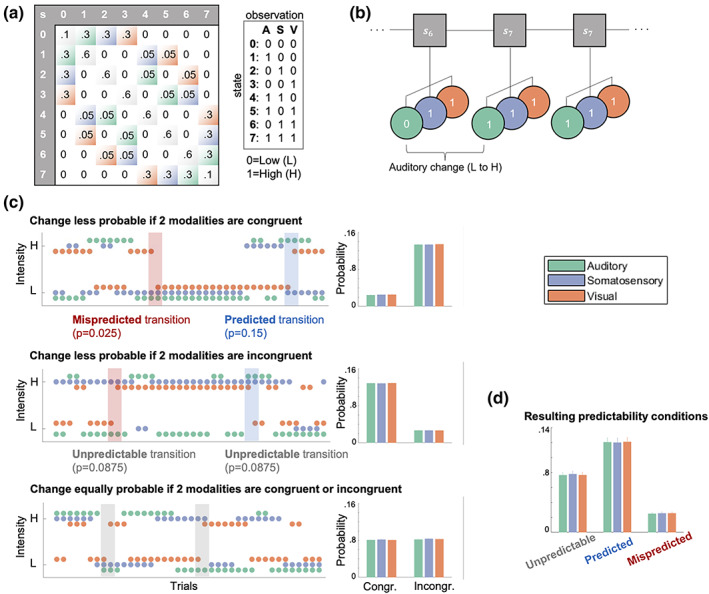
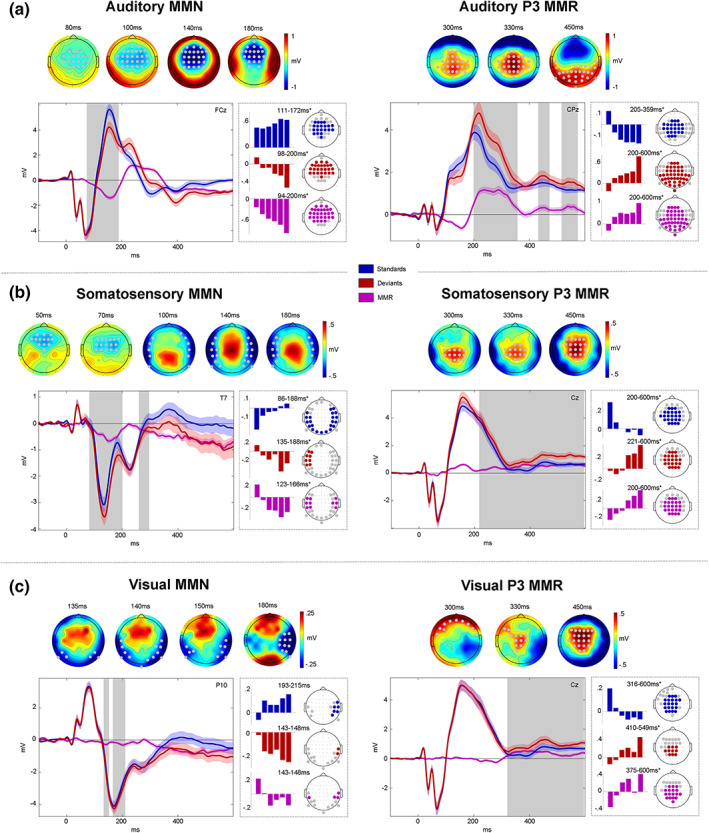
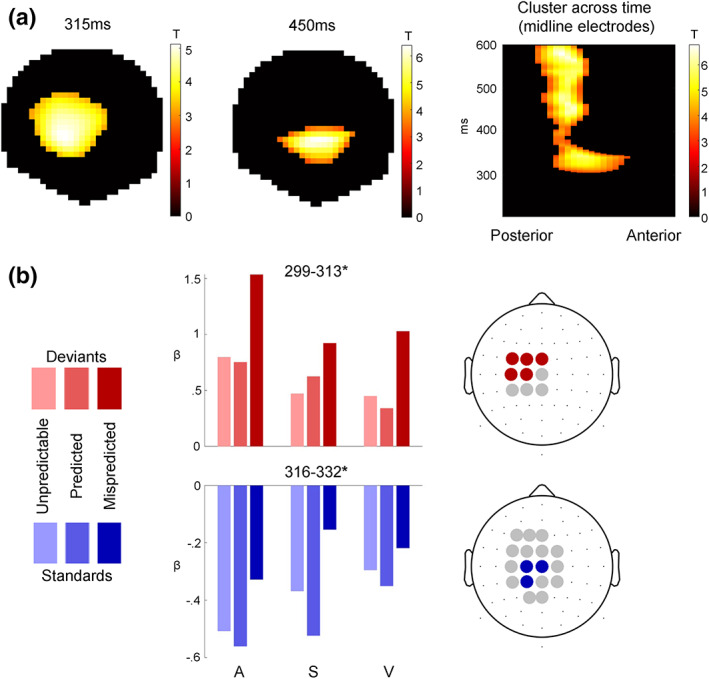
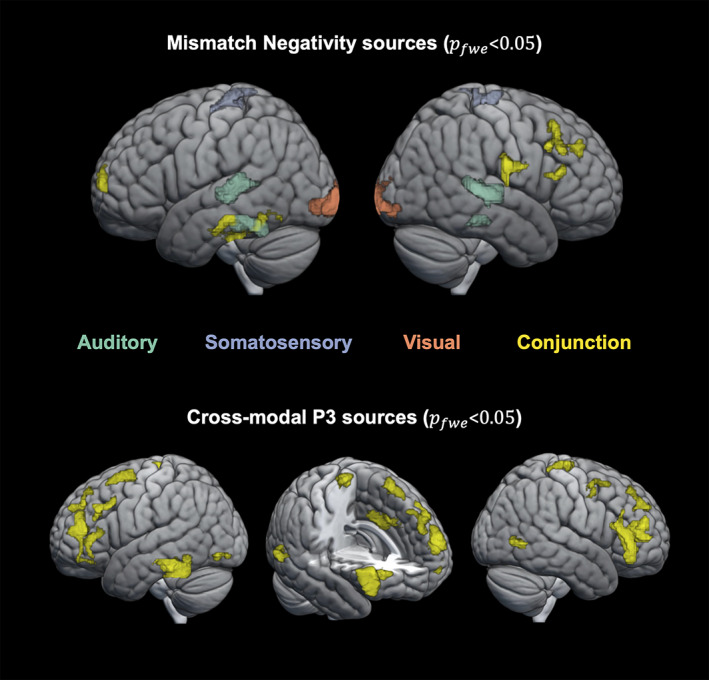
The human brain is constantly subjected to a multimodal stream of probabilistic sensory inputs. Electroencephalography (EEG) signatures, such as the mismatch negativity (MMN) and the P3, can give valuable insight into neuronal probabilistic inference. Although reported for different modalities, mismatch responses have largely been studied in isolation, with a strong focus on the auditory MMN. To investigate the extent to which early and late mismatch responses across modalities represent comparable signatures of uni- and cross-modal probabilistic inference in the hierarchically structured cortex, we recorded EEG from 32 participants undergoing a novel tri-modal roving stimulus paradigm. The employed sequences consisted of high and low intensity stimuli in the auditory, somatosensory and visual modalities and were governed by unimodal transition probabilities and cross-modal conditional dependencies. We found modality specific signatures of MMN (100-200 ms) in all three modalities, which were source localized to the respective sensory cortices and shared right lateralized prefrontal sources. Additionally, we identified a cross-modal signature of mismatch processing in the P3a time range (300-350 ms), for which a common network with frontal dominance was found. Across modalities, the mismatch responses showed highly comparable parametric effects of stimulus train length, which were driven by standard and deviant response modulations in opposite directions. Strikingly, P3a responses across modalities were increased for mispredicted stimuli with low cross-modal conditional probability, suggesting sensitivity to multimodal (global) predictive sequence properties. Finally, model comparisons indicated that the observed single trial dynamics were best captured by Bayesian learning models tracking unimodal stimulus transitions as well as cross-modal conditional dependencies.
人类大脑不断受到多模态概率感觉输入的影响。脑电图 (EEG) 特征,如失匹配负波 (MMN) 和 P3,可以为神经元概率推理提供有价值的见解。尽管在不同的模态中都有报道,但失匹配反应主要是孤立地进行研究的,并且强烈关注听觉 MMN。为了研究跨模态的早期和晚期失匹配反应在层次结构皮质中代表单一和跨模态概率推理的可比特征的程度,我们从 32 名参与者记录了 EEG,这些参与者正在经历一种新的三模态游动刺激范式。所采用的序列由听觉、躯体感觉和视觉模态中的高强度和低强度刺激组成,由单模态转换概率和跨模态条件依赖性控制。我们在所有三种模态中都发现了特定于模态的 MMN(100-200ms)特征,这些特征被定位到各自的感觉皮质,并且具有共享的右侧额前皮质源。此外,我们在 P3a 时间范围内(300-350ms)确定了一种跨模态的失匹配处理特征,发现了具有额叶优势的共同网络。在跨模态中,失匹配反应表现出高度可比的刺激序列长度参数效应,这些效应由标准和偏差响应的相反方向调制驱动。引人注目的是,对于具有低跨模态条件概率的预测错误刺激,跨模态的 P3a 反应增加,这表明对多模态(全局)预测序列特性敏感。最后,模型比较表明,观察到的单次试验动态最好由贝叶斯学习模型来捕捉,这些模型可以跟踪单模态刺激转换以及跨模态条件依赖性。