• 文献检索
  • 文档翻译
  • 深度研究
  • 学术资讯
  • Suppr Zotero 插件Zotero 插件
  • 邀请有礼
  • 套餐&价格
  • 历史记录
应用&插件
Suppr Zotero 插件Zotero 插件浏览器插件Mac 客户端Windows 客户端微信小程序
定价
高级版会员购买积分包购买API积分包
服务
文献检索文档翻译深度研究API 文档MCP 服务
关于我们
关于 Suppr公司介绍联系我们用户协议隐私条款
关注我们

Suppr 超能文献

核心技术专利:CN118964589B侵权必究
粤ICP备2023148730 号-1Suppr @ 2026

文献检索

告别复杂PubMed语法,用中文像聊天一样搜索,搜遍4000万医学文献。AI智能推荐,让科研检索更轻松。

立即免费搜索

文件翻译

保留排版,准确专业,支持PDF/Word/PPT等文件格式,支持 12+语言互译。

免费翻译文档

深度研究

AI帮你快速写综述,25分钟生成高质量综述,智能提取关键信息,辅助科研写作。

立即免费体验

烧伤在何时并非意外?

When are burns not accidental?

作者信息

Hobbs C J

出版信息

Arch Dis Child. 1986 Apr;61(4):357-61. doi: 10.1136/adc.61.4.357.

DOI:10.1136/adc.61.4.357
PMID:3707186
原文链接:https://pmc.ncbi.nlm.nih.gov/articles/PMC1777757/
Abstract

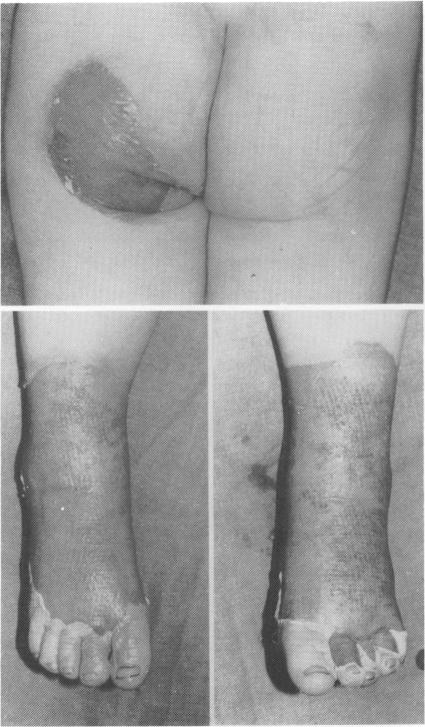
One hundred and ninety five children aged up to 6 years with burns and scalds (30 non-accidental and 165 accidental) were studied retrospectively. The history, presentation, and other typical injuries assisted the diagnosis of abuse. Scalds accounted for 81% of accidents and 25% of the cases of abuse, and burns for 17% and 44%, respectively. Scalds usually followed spillage from kitchen containers in accidents and forced tap water immersion in cases of abuse. Burns in cases of both accidents and abuse resulted from contact with a wide range of household appliances, including room heaters. Attention is drawn to the back of the hand as an important site in cases of abuse, as well as the legs, buttocks, and feet. It is speculated that the low level of reporting of this form of child abuse reflects failure of diagnosis.

摘要

对195名6岁及以下烧伤和烫伤儿童(30名非意外伤和165名意外伤)进行了回顾性研究。病史、临床表现及其他典型损伤有助于虐待的诊断。烫伤在意外伤中占81%,在虐待病例中占25%;烧伤在意外伤和虐待病例中分别占17%和44%。意外伤中的烫伤通常是厨房容器溢出所致,虐待病例中的烫伤则是强迫用自来水浸泡造成。意外伤和虐待病例中的烧伤均由接触包括取暖器在内的多种家用电器引起。手部背部以及腿部、臀部和足部被视为虐待病例中的重要部位。据推测,这种形式的儿童虐待报告率低反映出诊断失误。
https://cdn.ncbi.nlm.nih.gov/pmc/blobs/c846/1777757/09870c0db6c6/archdisch00711-0054-a.jpg
https://cdn.ncbi.nlm.nih.gov/pmc/blobs/c846/1777757/5dc0d40fbc25/archdisch00711-0053-a.jpg
https://cdn.ncbi.nlm.nih.gov/pmc/blobs/c846/1777757/ae8714386f52/archdisch00711-0053-b.jpg
https://cdn.ncbi.nlm.nih.gov/pmc/blobs/c846/1777757/09870c0db6c6/archdisch00711-0054-a.jpg
https://cdn.ncbi.nlm.nih.gov/pmc/blobs/c846/1777757/5dc0d40fbc25/archdisch00711-0053-a.jpg
https://cdn.ncbi.nlm.nih.gov/pmc/blobs/c846/1777757/ae8714386f52/archdisch00711-0053-b.jpg
https://cdn.ncbi.nlm.nih.gov/pmc/blobs/c846/1777757/09870c0db6c6/archdisch00711-0054-a.jpg

相似文献

1
When are burns not accidental?烧伤在何时并非意外?
Arch Dis Child. 1986 Apr;61(4):357-61. doi: 10.1136/adc.61.4.357.
2
Patterns of scald injuries.烫伤模式。
Arch Dis Child. 1994 Aug;71(2):156-8. doi: 10.1136/adc.71.2.156.
3
Into hot water head first: distribution of intentional and unintentional immersion burns.头先入水落入热水中:故意和非故意浸泡烧伤的分布情况
Pediatr Emerg Care. 2004 May;20(5):302-10. doi: 10.1097/01.pec.0000125658.05196.b1.
4
Accidental scald burns in sinks.水槽中的意外烫伤。
Pediatrics. 2003 Feb;111(2):E191-4. doi: 10.1542/peds.111.2.e191.
5
A systematic review of the features that indicate intentional scalds in children.对表明儿童故意烫伤的特征的系统评价。
Burns. 2008 Dec;34(8):1072-81. doi: 10.1016/j.burns.2008.02.011. Epub 2008 Jun 6.
6
ABC of child abuse. Burns and scalds.
BMJ. 1989 May 13;298(6683):1302-5. doi: 10.1136/bmj.298.6683.1302.
7
Non-accidental burns in children--are we neglecting neglect?儿童非意外烧伤——我们是否忽视了疏忽?
Burns. 2006 Mar;32(2):222-8. doi: 10.1016/j.burns.2005.08.018. Epub 2006 Jan 31.
8
Burns as a manifestation of child abuse and neglect.烧伤作为虐待和忽视儿童的一种表现形式。
Am J Dis Child. 1979 Sep;133(9):910-4. doi: 10.1001/archpedi.1979.02130090038006.
9
Scald burns in the bathroom: accidental or inflicted?
Pediatrics. 2004 Jan;113(1 Pt 1):173-4; author reply 173-4. doi: 10.1542/peds.113.1.173.
10
Incidence and characteristics of non-accidental burns in children: A systematic review.儿童非意外伤害性烧伤的发生率和特征:系统评价。
Burns. 2020 Sep;46(6):1243-1253. doi: 10.1016/j.burns.2020.01.008. Epub 2020 Feb 11.

引用本文的文献

1
A Multispecialty Approach to the Identification and Diagnosis of Nonaccidental Trauma in Children.一种用于识别和诊断儿童非意外创伤的多专科方法。
Cureus. 2022 Jul 26;14(7):e27276. doi: 10.7759/cureus.27276. eCollection 2022 Jul.
2
Are There Hallmarks of Child Abuse? II. Non-Osseous Injuries.虐待儿童有哪些特征?II. 非骨骼损伤。
Acad Forensic Pathol. 2016 Dec;6(4):591-607. doi: 10.23907/2016.057. Epub 2016 Dec 1.
3
Non-accidental trauma in pediatric patients: a review of epidemiology, pathophysiology, diagnosis and treatment.

本文引用的文献

1
A review of thermal injuries in young children.幼儿热损伤综述。
J Pediatr Surg. 1983 Feb;18(1):21-6. doi: 10.1016/s0022-3468(83)80266-8.
2
Antecedents of burns and scalds in children.儿童烧伤和烫伤的前驱因素。
Br J Med Psychol. 1970 Mar;43(1):39-47. doi: 10.1111/j.2044-8341.1970.tb02100.x.
3
Child abuse by burning.
Surg Clin North Am. 1970 Dec;50(6):1419-24. doi: 10.1016/s0039-6109(16)39298-2.
小儿非外伤性创伤:流行病学、病理生理学、诊断和治疗综述。
Transl Pediatr. 2014 Jul;3(3):195-207. doi: 10.3978/j.issn.2224-4336.2014.06.01.
4
Violence against children: further evidence suggesting a relationship between burns, scalds, and the additional injuries.儿童暴力:进一步的证据表明烧伤、烫伤与其他伤害之间存在关系。
Int J Legal Med. 2010 Jan;124(1):49-54. doi: 10.1007/s00414-009-0347-6. Epub 2009 Apr 28.
5
Contact burns from hair straighteners: a new hazard in the home.直发器导致的接触性烧伤:家庭中的一种新危害。
Emerg Med J. 2006 Mar;23(3):e21. doi: 10.1136/emj.2005.027094.
6
Diagnosing physical child abuse: the way forward.诊断儿童身体虐待:前进的道路。
Postgrad Med J. 2000 Dec;76(902):743-9. doi: 10.1136/pmj.76.902.743.
7
Patterns of scald injuries.烫伤模式。
Arch Dis Child. 1994 Aug;71(2):156-8. doi: 10.1136/adc.71.2.156.
8
Mistakes in diagnosing non-accidental injury: 10 years' experience.非意外伤害诊断中的失误:十年经验
Br Med J (Clin Res Ed). 1988 Apr 30;296(6631):1233-6. doi: 10.1136/bmj.296.6631.1233.
4
134 battered children: a medical and psychological study.134名受虐儿童:一项医学与心理学研究。
Br Med J. 1974 Sep 14;3(5932):666-70. doi: 10.1136/bmj.3.5932.666.
5
Inflicted burns and scalds in children.儿童受虐烧伤和烫伤
Br Med J. 1975 Nov 1;4(5991):268-9. doi: 10.1136/bmj.4.5991.268.
6
Specific patterns of inflicted burn injuries.特定模式的非意外烧伤损伤。
J Trauma. 1977 Nov;17(11):842-6. doi: 10.1097/00005373-197711000-00004.
7
Inflicted burns in children. Recognition and treatment.
JAMA. 1979 Aug 10;242(6):517-20.