Community Medicine Department, Alexandria University Faculty of Medicine, Alexandria, Egypt.
Behavioural Insights Unit, World Health Organization, Geneve, Switzerland.
BMJ Open. 2023 Apr 19;13(4):e070454. doi: 10.1136/bmjopen-2022-070454.
To explore the behavioural drivers of fear of litigation among healthcare providers influencing caesarean section (CS) rates.
Scoping review.
We searched MEDLINE, Scopus and WHO Global Index (1 January 2001 to 9 March 2022).
Data were extracted using a form specifically designed for this review and we conducted content analysis using textual coding for relevant themes. We used the WHO principles for the adoption of a behavioural science perspective in public health developed by the WHO Technical Advisory Group for Behavioural Sciences and Insights to organise and analyse the findings. We used a narrative approach to summarise the findings.
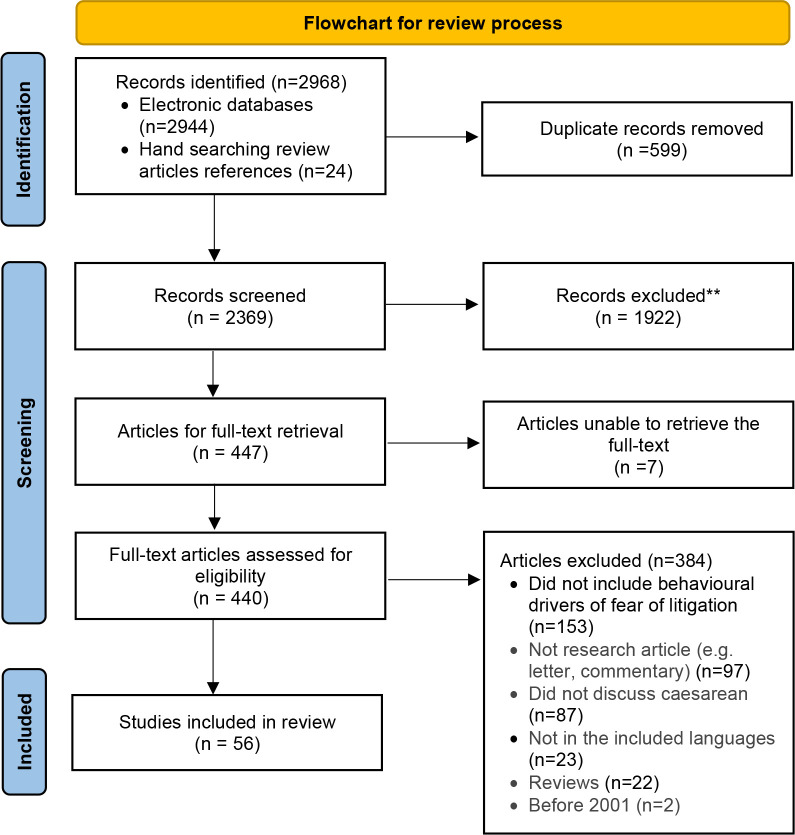
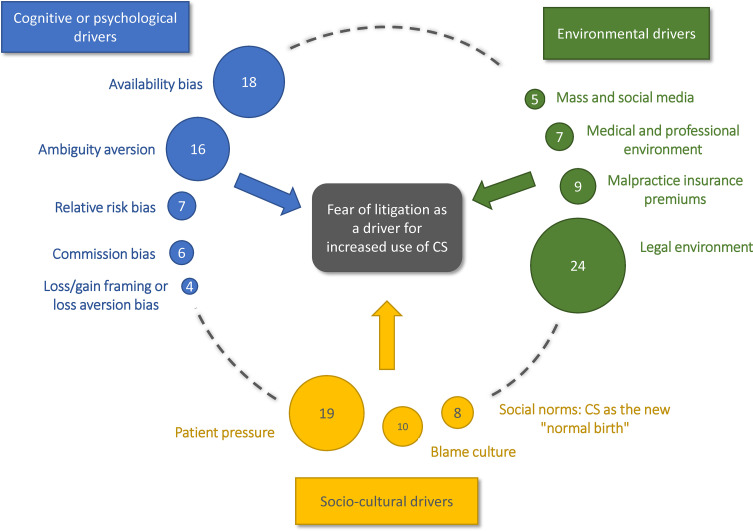
We screened 2968 citations and 56 were included. Reviewed articles did not use a standard measure of influence of fear of litigation on provider's behaviour. None of the studies used a clear theoretical framework to discuss the behavioural drivers of fear of litigation. We identified 12 drivers under the three domains of the WHO principles: (1) cognitive drivers: availability bias, ambiguity aversion, relative risk bias, commission bias and loss aversion bias; (2) social and cultural drivers: patient pressure, social norms and blame culture and (3) environmental drivers: legal, insurance, medical and professional, and media. Cognitive biases were the most discussed drivers of fear of litigation, followed by legal environment and patient pressure.
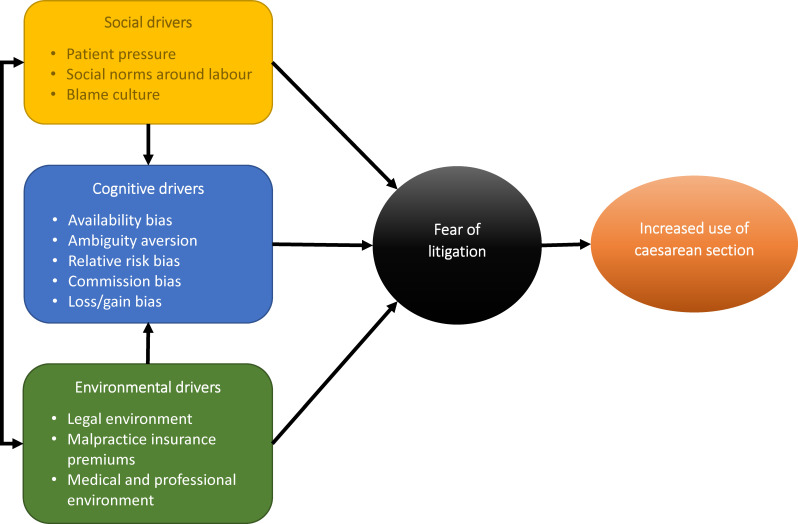
Despite the lack of consensus on a definition or measurement, we found that fear of litigation as a driver for rising CS rates results from a complex interaction between cognitive, social and environmental drivers. Many of our findings were transferable across geographical and practice settings. Behavioural interventions that consider these drivers are crucial to address the fear of litigation as part of strategies to reduce CS.
探索影响剖宫产率的医疗保健提供者对诉讼恐惧的行为驱动因素。
范围综述。
我们检索了 MEDLINE、Scopus 和世卫组织全球索引(2001 年 1 月 1 日至 2022 年 3 月 9 日)。
使用专门为此综述设计的表格提取数据,并使用文本编码进行内容分析以提取相关主题。我们使用世卫组织行为科学和洞察技术咨询小组制定的世卫组织采用行为科学观点的原则来组织和分析研究结果。我们使用叙述方法来总结研究结果。
我们筛选了 2968 条引文,其中 56 条被纳入。综述文章没有使用衡量诉讼恐惧对提供者行为影响的标准措施。没有一项研究使用明确的理论框架来讨论诉讼恐惧的行为驱动因素。我们确定了三个世卫组织原则领域下的 12 个驱动因素:(1)认知驱动因素:可得性偏差、歧义厌恶、相对风险偏差、委托偏差和损失厌恶偏差;(2)社会和文化驱动因素:患者压力、社会规范和指责文化;(3)环境驱动因素:法律、保险、医疗和专业以及媒体。认知偏差是讨论最多的诉讼恐惧驱动因素,其次是法律环境和患者压力。
尽管对定义或衡量标准缺乏共识,但我们发现,作为剖宫产率上升的驱动因素之一,诉讼恐惧是认知、社会和环境驱动因素之间复杂相互作用的结果。我们的许多发现可以在地理和实践环境中转移。考虑这些驱动因素的行为干预措施对于解决诉讼恐惧至关重要,是减少剖宫产率策略的一部分。