Global Health Research Center, Duke Kunshan University, Kunshan, Jiangsu Province, China.
School of Community Health and Midwifery, University of Central Lancashire, Preston, United Kingdom.
PLoS Med. 2018 Oct 16;15(10):e1002672. doi: 10.1371/journal.pmed.1002672. eCollection 2018 Oct.
China has witnessed a rapid increase of cesarean section (CS) rates in recent years. Several non-clinical factors have been cited as contributing to this trend including maternal request and perceived convenience. We aimed to assess preferences for mode of delivery and reasons for preferences for CS in China to inform the development of future interventions to mitigate unnecessary CSs, which are those performed in the absence of medical indications.
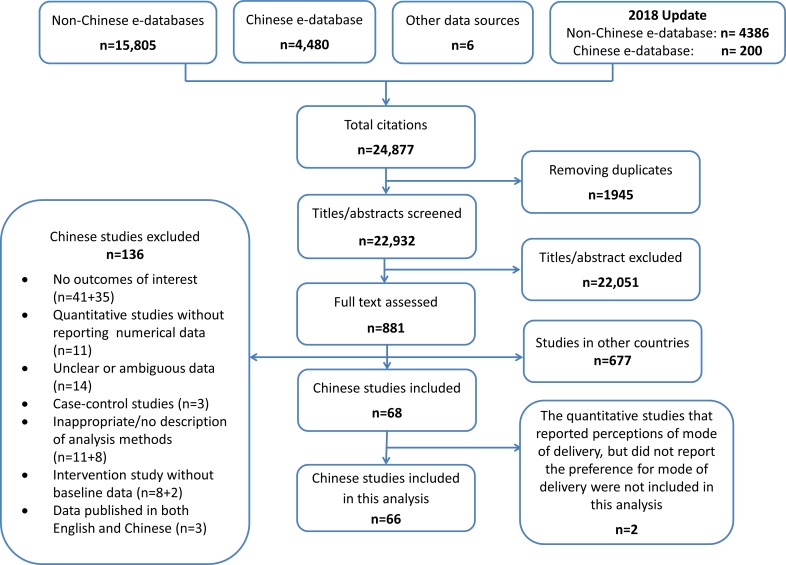
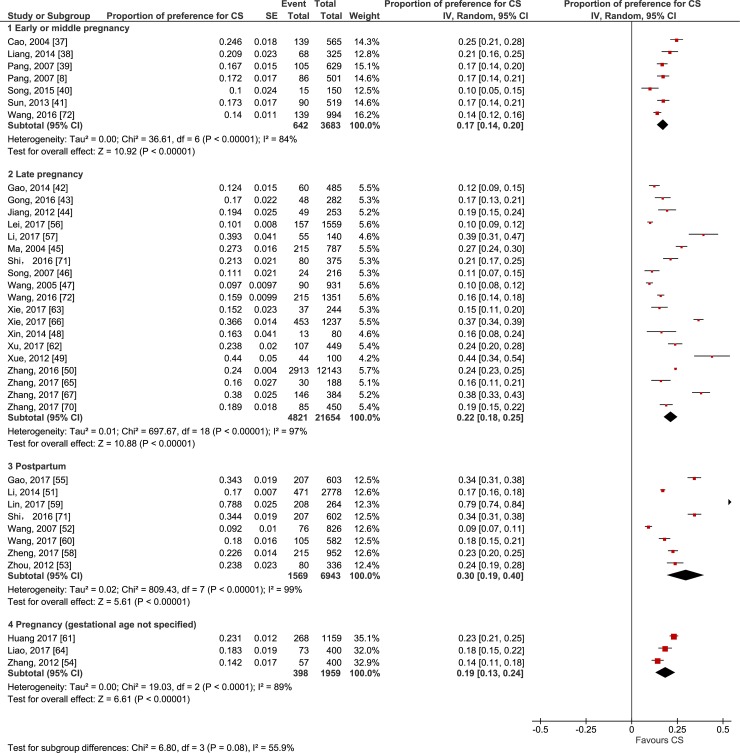
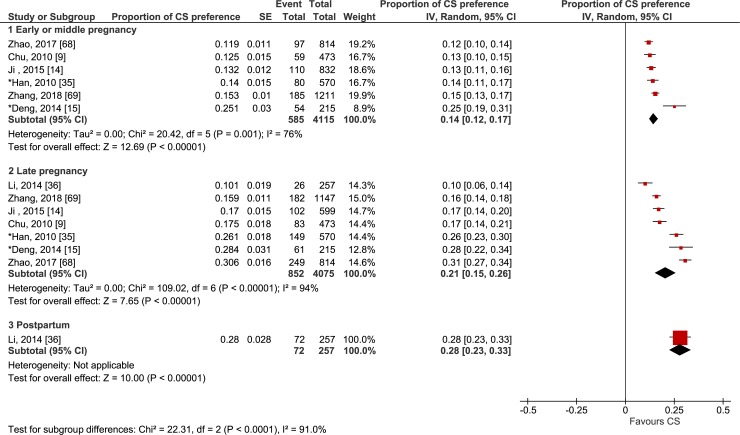
We conducted a mixed-methods systematic review and included longitudinal, cross-sectional, and qualitative studies in mainland China, Hong Kong, and Taiwan that investigated preferences for mode of delivery among women and family members and health professionals, and the reasons underlying such preferences. We searched MEDLINE/PubMed, Embase, CINAHL, POPLINE, PsycINFO, Global Health Library, and one Chinese database (CNKI) using a combination of the key terms 'caesarean section', 'preference', 'choice', 'knowledge', 'attitude', 'culture', 'non-clinical factors', and 'health professionals-patient relations' between 1990 and 2018 without language restriction. Meta-analysis of quantitative studies and meta-synthesis of qualitative studies were applied. We included 66 studies in this analysis: 47 quantitative and 19 qualitative. For the index pregnancy, the pooled proportions of preference for CS reported by women in longitudinal studies were 14% in early or middle pregnancy (95% CI 12%-17%) and 21% in late pregnancy (95% CI 15%-26%). In cross-sectional studies, the proportions were 17% in early or middle pregnancy (95% CI 14%-20%), 22% in late pregnancy (95% CI 18%-25%), and 30% postpartum (95% CI 19%-40%). Women's preferences for CS were found to rise as pregnancy progressed (preference change across longitudinal studies: mean difference 7%, 95% CI 1%-13%). One longitudinal study reported that the preference for CS among women's partners increased from 8% in late pregnancy to 17% in the immediate postpartum period. In addition, 18 quantitative studies revealed that some pregnant women, ranging from 4% to 34%, did not have a straightforward preference for a mode of delivery, even in late pregnancy. The qualitative meta-synthesis found that women's perceptions of CS as preferable were based on prioritising the baby's and woman's health and appeared to intensify through interactions with the health system. Women valued the convenience of bypassing labour because of fear of pain, antagonistic relations with providers, and beliefs of deteriorating quality of care during labour and vaginal birth, fostering the feeling that CS was the safest option. Health professionals' preference for CS was influenced by financial drivers and malpractice fears. This review has some limitations, including high heterogeneity (despite subgroup and sensitivity analysis) in the quantitative analysis, and the potential for over-reporting of women's preferences for CS in the qualitative synthesis (due to some included studies only including women who requested CS).
Despite a minority of women expressing a preference for CS, individual, health system, and socio-cultural factors converge, contributing to a high CS rate in mainland China, Hong Kong, and Taiwan. In order to reduce unnecessary CSs, interventions need to address all these non-clinical factors and concerns.
Prospero CRD42016036596.
近年来,中国的剖宫产率迅速上升。有几个非临床因素被认为是导致这一趋势的原因,包括产妇的要求和认为的方便。我们旨在评估中国产妇对分娩方式的偏好以及对剖宫产偏好的原因,以便为未来减轻不必要的剖宫产提供信息,这些剖宫产是指在没有医学指征的情况下进行的剖宫产。
我们进行了一项混合方法系统评价,纳入了中国大陆、香港和台湾的纵向、横断面和定性研究,这些研究调查了女性和家庭成员以及卫生专业人员对分娩方式的偏好及其背后的原因。我们使用了“剖宫产”、“偏好”、“选择”、“知识”、“态度”、“文化”、“非临床因素”和“卫生专业人员-患者关系”等关键词,在 1990 年至 2018 年期间,在 MEDLINE/PubMed、Embase、CINAHL、POPLINE、PsycINFO、全球卫生图书馆和一个中文数据库(CNKI)中进行了无语言限制的组合搜索。对定量研究进行了荟萃分析,对定性研究进行了荟萃综合分析。我们分析了 66 项研究:47 项定量研究和 19 项定性研究。对于索引妊娠,纵向研究中报告的女性对剖宫产的偏好比例为早期或中期妊娠 14%(95%CI 12%-17%),晚期妊娠 21%(95%CI 15%-26%)。横断面研究中,比例分别为早期或中期妊娠 17%(95%CI 14%-20%)、晚期妊娠 22%(95%CI 18%-25%)和产后 30%(95%CI 19%-40%)。随着妊娠的进展,女性对剖宫产的偏好被发现有所增加(纵向研究中偏好的变化:平均差异 7%,95%CI 1%-13%)。一项纵向研究报告称,女性伴侣对剖宫产的偏好从妊娠晚期的 8%增加到产后即刻的 17%。此外,18 项定量研究显示,一些孕妇(比例从 4%到 34%)即使在妊娠晚期也没有明确的分娩方式偏好。定性荟萃综合分析发现,女性认为剖宫产更可取的原因是优先考虑婴儿和女性的健康,并且似乎通过与卫生系统的互动而加剧。女性重视避免分娩的便利性,因为害怕疼痛、与提供者的对抗关系,以及对分娩和阴道分娩期间护理质量恶化的信念,这助长了剖宫产是最安全选择的感觉。卫生专业人员对剖宫产的偏好受到经济驱动因素和医疗事故担忧的影响。
尽管少数女性对剖宫产表示偏好,但个人、卫生系统和社会文化因素的综合作用导致了中国大陆、香港和台湾剖宫产率的居高不下。为了减少不必要的剖宫产,干预措施需要解决所有这些非临床因素和问题。
Prospero CRD42016036596。