Zhou Chaoyu, Lin Zixiang, Li Xinqiu, Zhang Di, Song Peijia
Department of Veterinary Clinical Science, College of Veterinary Medicine, China Agricultural University, Beijing, China.
Front Vet Sci. 2023 Mar 30;10:1129756. doi: 10.3389/fvets.2023.1129756. eCollection 2023.
Canine mammary tumors are the most common tumor disease of female dogs, and adjuvant chemotherapy often results in multi-drug resistance. Currently, the mechanisms underlying the development of tumor multi-drug resistance are unclear. The translation of research applications that can be used to effectively overcome tumor resistance is similarly hampered. Therefore, it is urgent to construct multi-drug resistance models of canine mammary tumors that can be used for research, to explore the mechanisms and means of overcoming resistance.
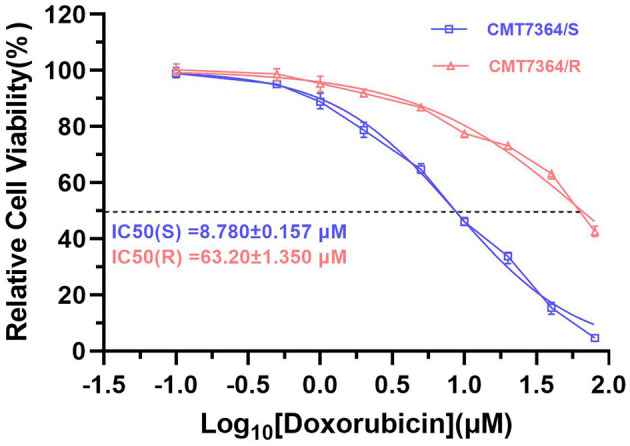
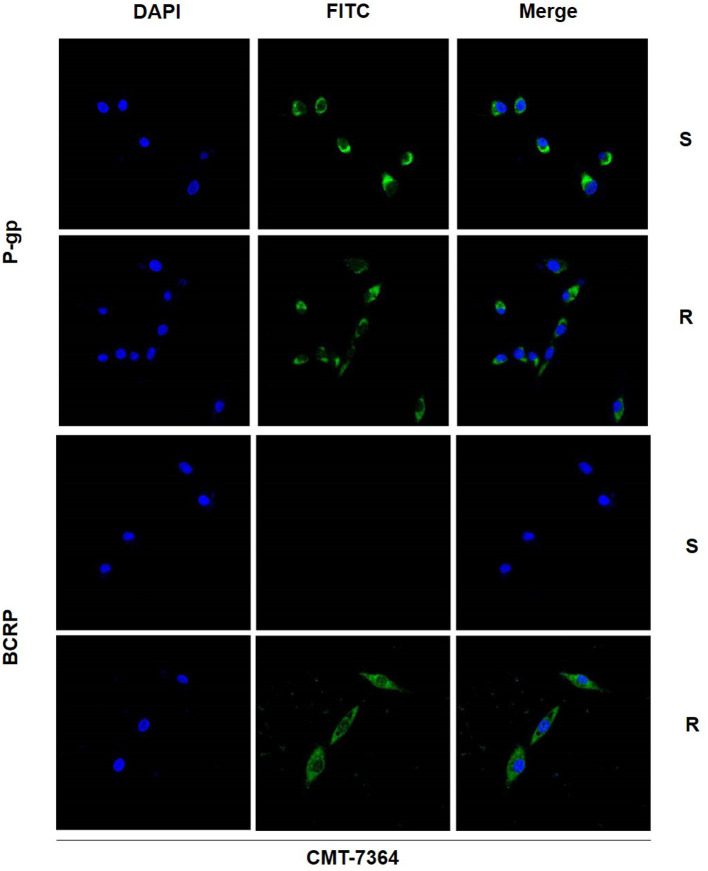
In this study, the canine triple negative breast cancer cell line CMT-7364 was induced to develop multidrug resistance using doxorubicin by high-dose drug pulse method. The drug resistance and the expression of drug transport pumps of the cells was verified by CCK8 assay, immunoblotting, qPCR and immunofluorescence. Next, we used scratch assay and Transwell invasion assay to compare the migration and invasion abilities of the two cell lines and examined the expression of EMT-related proteins in both using immunoblotting. The differences of transcriptome between parental and drug-resistant cell lines were detected by RNA-seq sequencing. Finally, mouse xenograft models of drug-resistant and parental cell lines were constructed to evaluate the tumorigenic ability.
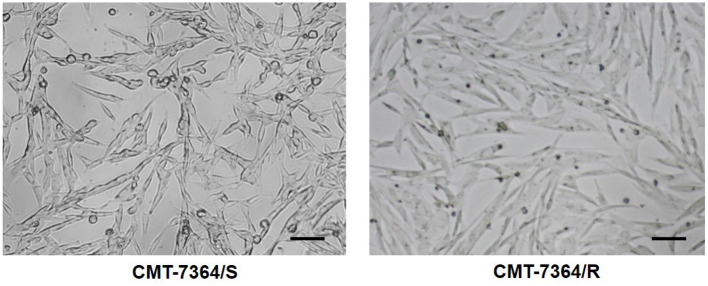
After more than 50 generations of continuous passages stimulated by high-dose drug pulse method, the morphology of drug-resistant cell line CMT-7364/R tended to be mesenchymal-like and heterogeneous under light microscopy compared with the parental cell line CMT-7364/S, and developed resistance to doxorubicin and other commonly used chemotherapeutic drugs. In CMT-7364/R, BCRP was expressed at higher levels at both transcriptional and protein levels, while P-glycoprotein was not significantly different. Secondly, the migration and invasion ability of CMT-7364/R was significantly enhanced, with decreased expression of E-cadherin and increased expression of vimentin and mucin 1-N terminus. Finally, mouse xenograft models were constructed, while there was no significant difference in the volume of masses formed at 21 days.
In summary, by using the canine mammary tumor cell line CMT-7364/S as the parental cell line, we successfully constructed a multidrug-resistant CMT-7364/R with high-dose drug pulse methods. Compared to its parental cell line, CMT-7364/R has decreased growth rate, overexpression of BCRP and increased migration and invasion ability due to EMT. The results of this study showed that CMT-7364/R might serve as a model for future studies on tumor drug resistance.
犬乳腺肿瘤是雌性犬最常见的肿瘤疾病,辅助化疗常导致多药耐药。目前,肿瘤多药耐药发生的机制尚不清楚。同样,可用于有效克服肿瘤耐药性的研究应用的转化也受到阻碍。因此,迫切需要构建可用于研究的犬乳腺肿瘤多药耐药模型,以探索克服耐药性的机制和方法。
在本研究中,采用高剂量药物脉冲法用阿霉素诱导犬三阴性乳腺癌细胞系CMT-7364产生多药耐药。通过CCK8法、免疫印迹、qPCR和免疫荧光验证细胞的耐药性和药物转运泵的表达。接下来,我们使用划痕试验和Transwell侵袭试验比较两种细胞系的迁移和侵袭能力,并通过免疫印迹检测两者中EMT相关蛋白的表达。通过RNA-seq测序检测亲本细胞系和耐药细胞系之间的转录组差异。最后,构建耐药细胞系和亲本细胞系的小鼠异种移植模型以评估致瘤能力。
经高剂量药物脉冲法连续传代50余代后,耐药细胞系CMT-7364/R在光学显微镜下与亲本细胞系CMT-7364/S相比,形态趋于间充质样且异质性增强,并对阿霉素和其他常用化疗药物产生耐药。在CMT-7364/R中,BCRP在转录和蛋白水平均高表达,而P-糖蛋白无明显差异。其次,CMT-群7364/R的迁移和侵袭能力显著增强,E-钙黏蛋白表达降低,波形蛋白和黏蛋白1-N端表达增加。最后,构建小鼠异种移植模型,21天时形成的肿块体积无显著差异。
综上所述,以犬乳腺肿瘤细胞系CMT-7364/S为亲本细胞系,我们成功地用高剂量药物脉冲法构建了多药耐药的CMT-7364/R。与亲本细胞系相比,CMT-7364/R生长速率降低,BCRP过表达,因EMT导致迁移和侵袭能力增强。本研究结果表明,CMT-7364/R可能作为未来肿瘤耐药性研究的模型。