ICBAS-Instituto de Ciências Biomédicas Abel Salazar, University of Porto, Rua Jorge Viterbo Ferreira 228, 4050-313, Porto, Portugal.
CIIMAR - Interdisciplinary Centre of Marine and Environmental Research, University of Porto, Novo Edifício do Terminal de Cruzeiros do Porto de Leixões, Avenida General Norton de Matos, S/N, 4450-208, Matosinhos, Portugal.
Eur J Nutr. 2023 Aug;62(5):2245-2256. doi: 10.1007/s00394-023-03149-1. Epub 2023 Apr 20.
Iodine deficiency disorder (IDD) is an ongoing worldwide recognized problem with over two billion individuals having insufficient iodine intake. School-aged children and pregnant women are often target groups for epidemiological studies, but there is a lack of knowledge on the general adult population. The aim of this study was to assess the iodine status among a Portuguese public university staff as a proxy for the adult working population.
The population study covered 103 adults within the iMC Salt randomized clinical trial, aged 24-69 years. Urinary iodine concentration was measured spectrophotometrically using the Sandell-Kolthoff reaction. Iodine food intake was assessed using a 24-h dietary recall. The contribution of discretionary salt to the iodine daily intake was assessed through 24-h urinary sodium excretion (UIE) and potentiometric iodine determination of household salt.
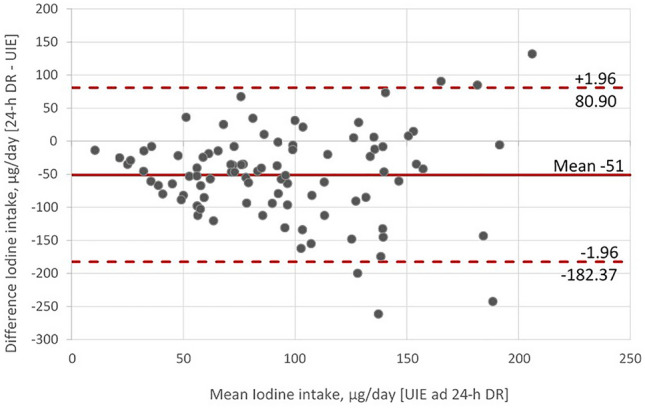
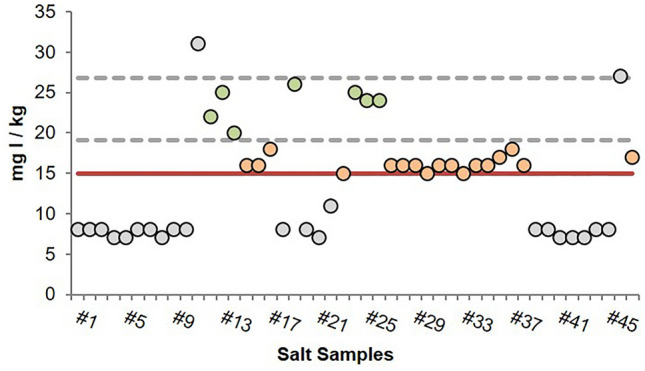
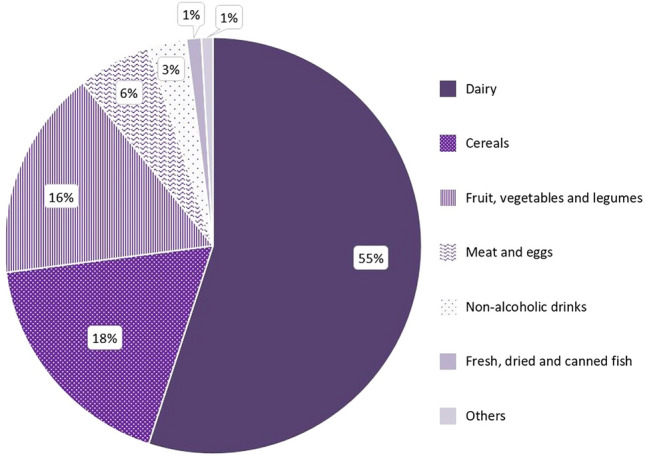
The mean urine volume in 24 h was 1.5 L. The median daily iodine intake estimated from 24-h UIE was 113 µg/day, being lower among women (p < 0.05). Only 22% of participants showed iodine intake above the WHO-recommended cutoff (150 µg/day). The median daily iodine intake estimated from the 24-h dietary recall was 58 µg/day (51 and 68 µg/day in women and men, respectively). Dairy, including yoghurt and milk products, were the primary dietary iodine source (55%). Iodine intake estimated from 24-h UIE and 24-h dietary recall was moderately correlated (Spearman rank correlation coefficient r = 0.34, p < 0.05). The average iodine concentration in household salt was 14 mg I/kg, with 45% of the samples below the minimum threshold preconized by WHO (15 mg I/kg). The contribution of discretionary salt to the daily iodine intake was around 38%.
This study contributes new knowledge about iodine status in Portuguese working adults. The results revealed moderate iodine deficiency, particularly in women. Public health strategies and monitoring programs are needed to ensure iodine adequacy in all population groups.
碘缺乏症(IDD)是一个全球性的问题,全球有超过 20 亿人碘摄入量不足。学龄儿童和孕妇通常是流行病学研究的目标人群,但对于普通成年人群的了解还很缺乏。本研究旨在评估葡萄牙一所公立大学工作人员的碘状况,以此代表成年工作人群。
这项人群研究涵盖了 iMC Salt 随机临床试验中的 103 名成年人,年龄在 24-69 岁之间。使用 Sandell-Kolthoff 反应分光光度法测量尿碘浓度。通过 24 小时膳食回忆评估碘的食物摄入量。通过 24 小时尿钠排泄量(UIE)和家庭盐的电位碘测定来评估可随意添加的盐对每日碘摄入量的贡献。
24 小时平均尿量为 1.5 升。通过 24 小时 UIE 估计的日均碘摄入量为 113µg/天,女性的摄入量较低(p<0.05)。只有 22%的参与者的碘摄入量高于世界卫生组织(WHO)推荐的摄入量(150µg/天)。通过 24 小时膳食回忆估计的日均碘摄入量为 58µg/天(女性和男性分别为 51 和 68µg/天)。乳制品,包括酸奶和奶制品,是主要的饮食碘来源(55%)。通过 24 小时 UIE 和 24 小时膳食回忆估计的碘摄入量中度相关(Spearman 秩相关系数 r=0.34,p<0.05)。家庭盐的平均碘浓度为 14mg I/kg,45%的样本低于世界卫生组织(WHO)推荐的最低阈值(15mg I/kg)。可随意添加的盐对每日碘摄入量的贡献约为 38%。
本研究提供了葡萄牙成年工作人群碘状况的新知识。结果显示,碘缺乏较为普遍,特别是在女性中。需要采取公共卫生策略和监测计划,以确保所有人群的碘摄入充足。