Department of Infectious Disease Epidemiology, School of Public Health, Imperial College London, London, United Kingdom.
Medical Research Council Centre for Global Infectious Disease Analysis, and NIHR Health Protection Research Unit in Modelling and Health Economics, School of Public Health, Imperial College London, London, United Kingdom.
J Infect Dis. 2023 Nov 2;228(9):1198-1207. doi: 10.1093/infdis/jiad113.
Herpes simplex virus type 2 (HSV-2) is an incurable sexually transmitted infection associated with increased risk of acquiring and transmitting human immunodeficiency virus (HIV). HSV-2 is highly prevalent in sub-Saharan Africa, but population-level estimates of incidence are sparse.
We measured HSV-2 prevalence from cross-sectional serological data among adults aged 18-49 years in 2 south-central Uganda communities (fishing, inland). We identified risk factors for seropositivity, then inferred age patterns of HSV-2 with a Bayesian catalytic model.
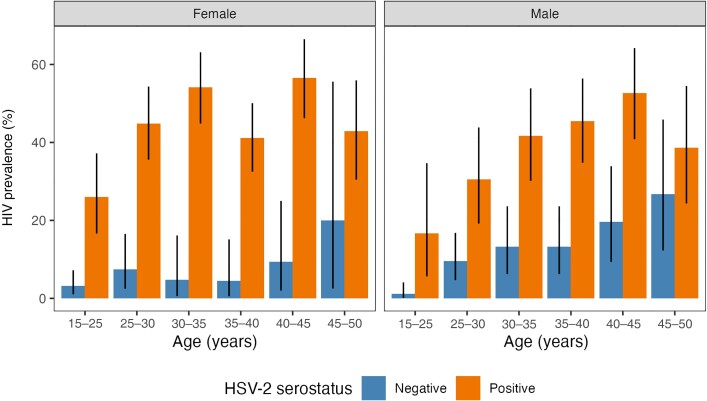
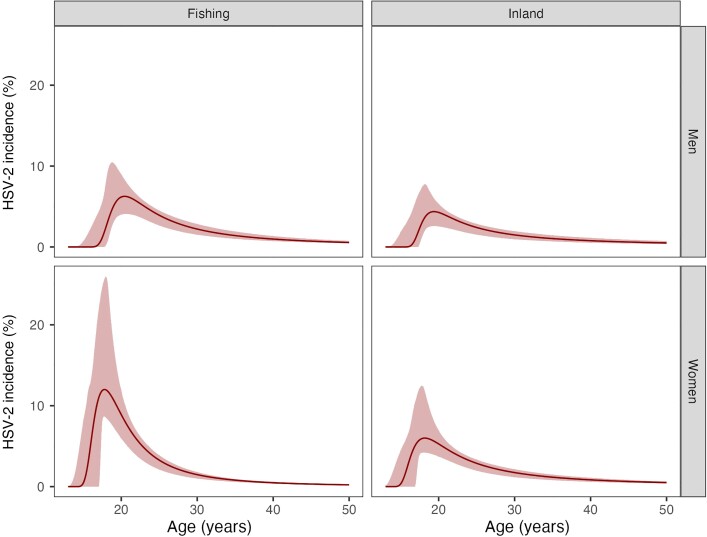
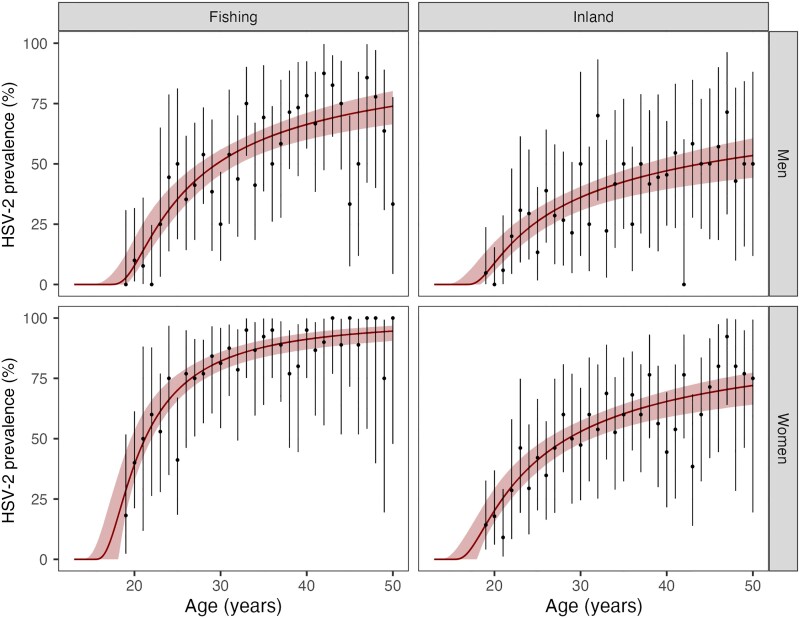
HSV-2 prevalence was 53.6% (n = 975/1819; 95% confidence interval, 51.3%-55.9%). Prevalence increased with age, was higher in the fishing community, and among women, reaching 93.6% (95% credible interval, 90.2%-96.6%) by age 49 years. Factors associated with HSV-2 seropositivity included more lifetime sexual partners, HIV positive status, and lower education. HSV-2 incidence peakied at age 18 years for women and 19-20 years for men. HIV prevalence was up to 10-fold higher in HSV-2-positive individuals.
HSV-2 prevalence and incidence were extremely high, with most infections occurring in late adolescence. Interventions against HSV-2, such as future vaccines or therapeutics, must target young populations. Remarkably higher HIV prevalence among HSV-2-positive individuals underscores this population as a priority for HIV prevention.
单纯疱疹病毒 2 型(HSV-2)是一种无法治愈的性传播感染,与人类免疫缺陷病毒(HIV)感染和传播风险增加有关。HSV-2 在撒哈拉以南非洲地区高度流行,但人群水平的发病率估计很少。
我们通过对乌干达中南部两个社区(渔业社区、内陆社区)18-49 岁成年人的横断面血清学数据测量 HSV-2 的流行率。我们确定了血清阳性的危险因素,然后使用贝叶斯催化模型推断 HSV-2 的年龄模式。
HSV-2 的流行率为 53.6%(975/1819;95%置信区间,51.3%-55.9%)。流行率随年龄增加而增加,在渔业社区和女性中更高,在 49 岁时达到 93.6%(95%可信区间,90.2%-96.6%)。与 HSV-2 血清阳性相关的因素包括更多的性伴侣、HIV 阳性状态和较低的教育程度。HSV-2 的发病率在女性中在 18 岁和男性中在 19-20 岁达到峰值。在 HSV-2 阳性个体中,HIV 的流行率高达 10 倍。
HSV-2 的流行率和发病率极高,大多数感染发生在青春期后期。针对 HSV-2 的干预措施,如未来的疫苗或疗法,必须针对年轻人群。HSV-2 阳性个体中 HIV 流行率显著更高,这凸显了该人群是 HIV 预防的重点。