Douglas Research Centre, Department of Psychiatry, McGill University, Montreal, Canada.
Montreal Neurological Institute, McGill University, Montreal, Canada.
PLoS Biol. 2023 Apr 20;21(4):e3002058. doi: 10.1371/journal.pbio.3002058. eCollection 2023 Apr.
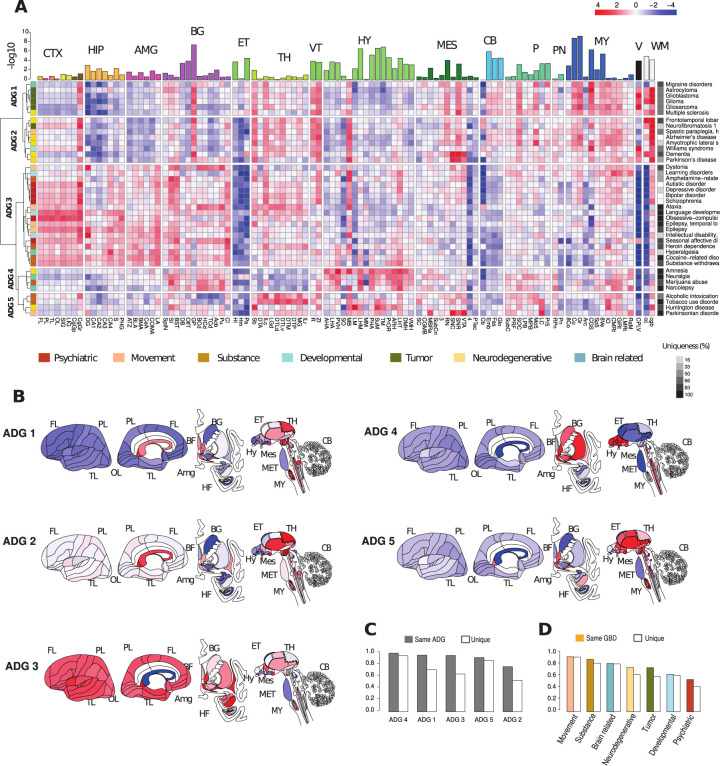
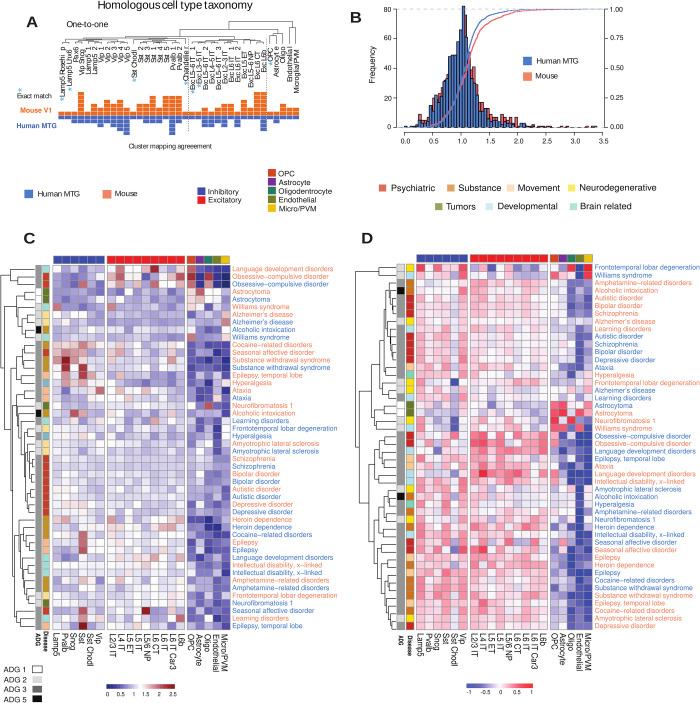
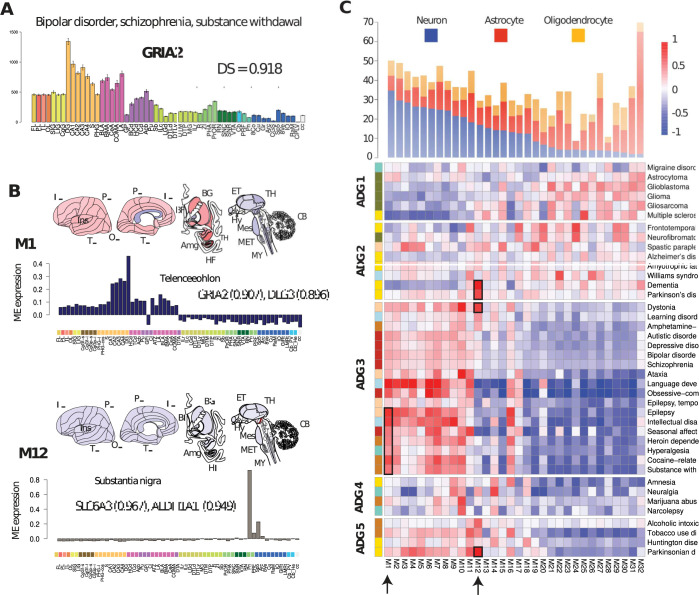
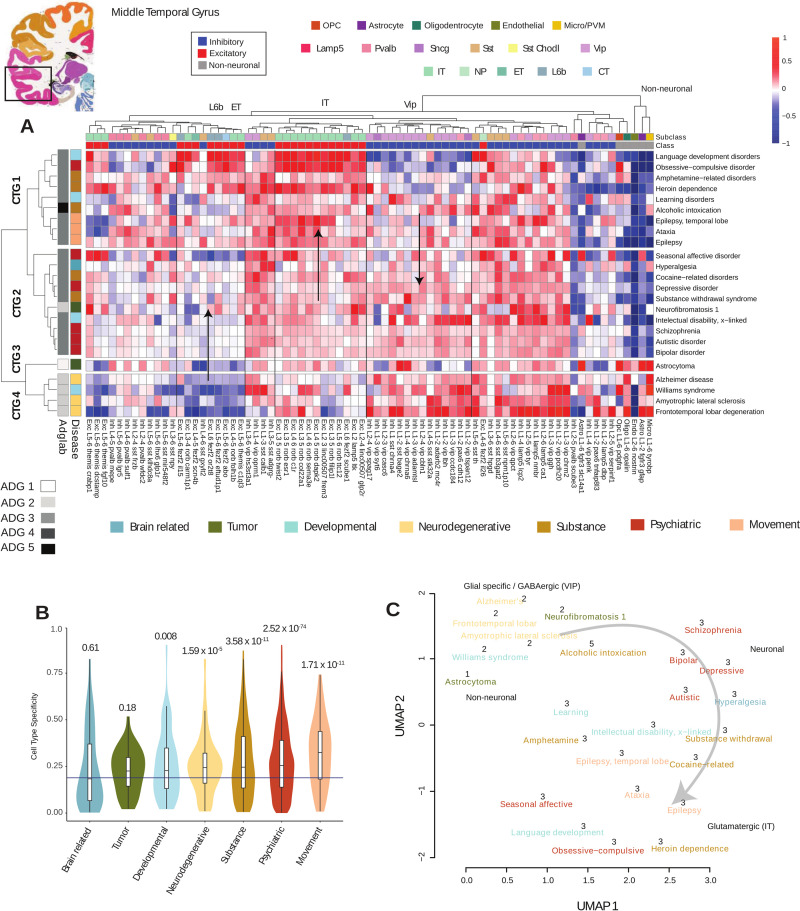
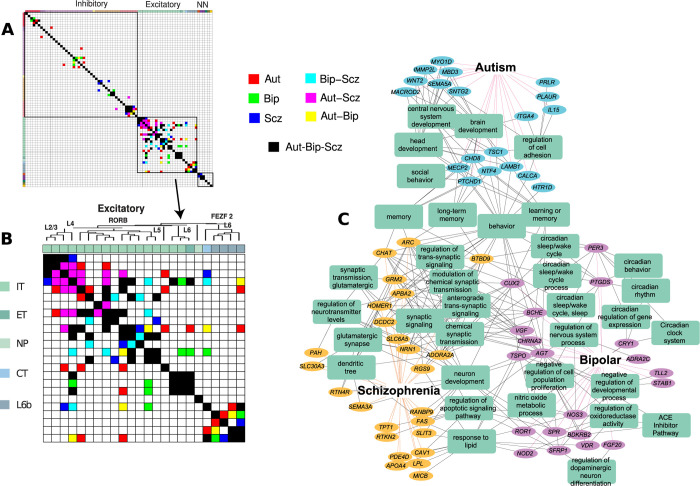
Genes associated with risk for brain disease exhibit characteristic expression patterns that reflect both anatomical and cell type relationships. Brain-wide transcriptomic patterns of disease risk genes provide a molecular-based signature, based on differential co-expression, that is often unique to that disease. Brain diseases can be compared and aggregated based on the similarity of their signatures which often associates diseases from diverse phenotypic classes. Analysis of 40 common human brain diseases identifies 5 major transcriptional patterns, representing tumor-related, neurodegenerative, psychiatric and substance abuse, and 2 mixed groups of diseases affecting basal ganglia and hypothalamus. Further, for diseases with enriched expression in cortex, single-nucleus data in the middle temporal gyrus (MTG) exhibits a cell type expression gradient separating neurodegenerative, psychiatric, and substance abuse diseases, with unique excitatory cell type expression differentiating psychiatric diseases. Through mapping of homologous cell types between mouse and human, most disease risk genes are found to act in common cell types, while having species-specific expression in those types and preserving similar phenotypic classification within species. These results describe structural and cellular transcriptomic relationships of disease risk genes in the adult brain and provide a molecular-based strategy for classifying and comparing diseases, potentially identifying novel disease relationships.
与脑疾病风险相关的基因表现出特征性的表达模式,反映了解剖和细胞类型的关系。疾病风险基因的全脑转录组模式提供了一种基于差异共表达的分子特征,通常是该疾病所特有的。可以根据其特征的相似性对脑疾病进行比较和分类,这些特征通常将来自不同表型类别的疾病联系起来。对 40 种常见人类脑疾病的分析确定了 5 种主要的转录模式,代表与肿瘤相关、神经退行性、精神和物质滥用以及影响基底神经节和下丘脑的 2 种混合疾病组。此外,对于在皮质中表达丰富的疾病,在中颞回 (MTG) 的单核数据表现出一种细胞类型表达梯度,将神经退行性、精神和物质滥用疾病分开,独特的兴奋性细胞类型表达将精神疾病区分开来。通过在小鼠和人类之间映射同源细胞类型,发现大多数疾病风险基因在共同的细胞类型中起作用,而在这些类型中具有物种特异性表达,并在物种内保持相似的表型分类。这些结果描述了成人脑中疾病风险基因的结构和细胞转录组关系,并提供了一种基于分子的疾病分类和比较策略,可能识别新的疾病关系。