Stoks Job, Bear Laura R, Vijgen Johan, Dendale Paul, Peeters Ralf, Volders Paul G A, Cluitmans Matthijs J M
Department of Cardiology, CARIM, Maastricht University Medical Center+, Maastricht, Netherlands.
Department of Advanced Computing Sciences, Maastricht University, Maastricht, Netherlands.
Front Physiol. 2023 Apr 7;14:1158003. doi: 10.3389/fphys.2023.1158003. eCollection 2023.
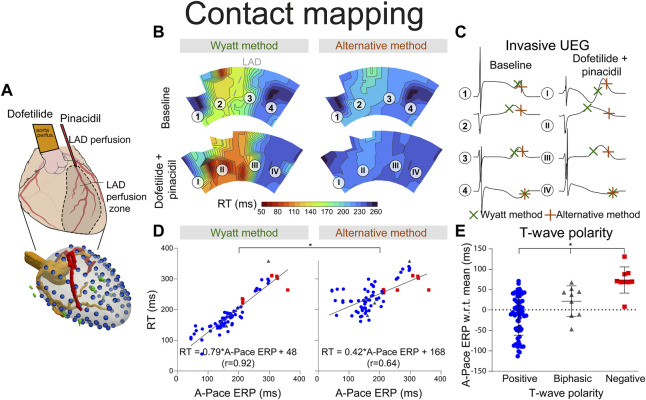
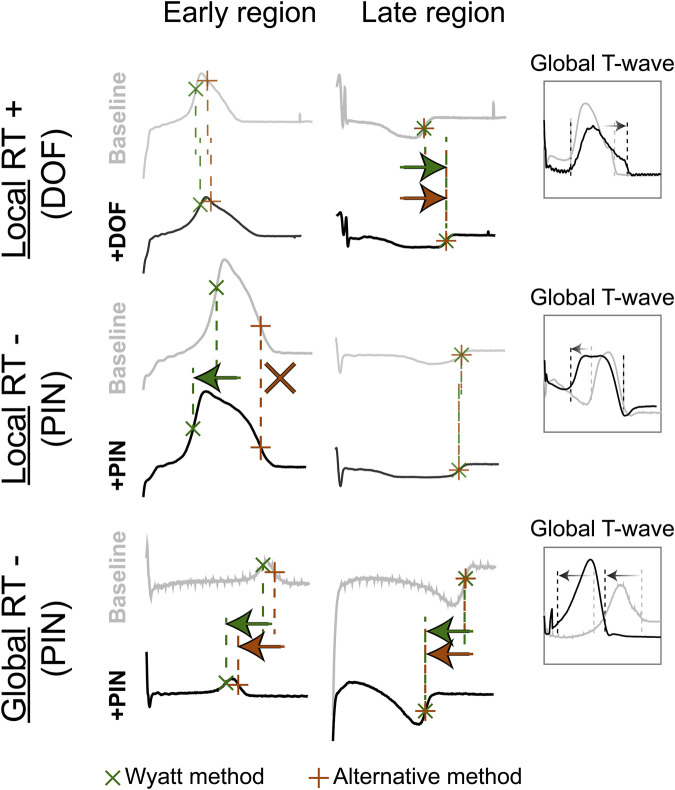
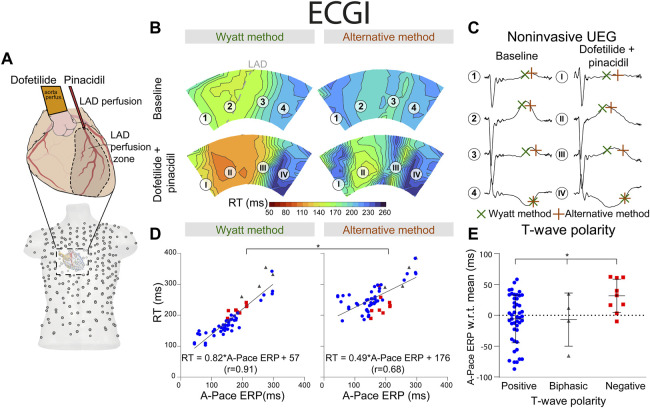
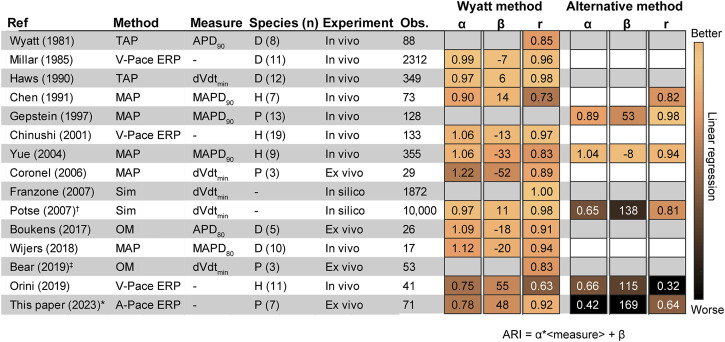
The optimal way to determine repolarization time (RT) from the intracardiac unipolar electrogram (UEG) has been a topic of debate for decades. RT is typically determined by either the Wyatt method or the "alternative method," which both consider UEG T-wave slope, but differently. To determine the optimal method to measure RT on the UEG. Seven pig hearts surrounded by an epicardial sock with 100 electrodes were Langendorff-perfused with selective cannulation of the left anterior descending (LAD) coronary artery and submersed in a torso-shaped tank containing 256 electrodes on the torso surface. Repolarization was prolonged in the non-LAD-regions by infusing dofetilide and shortened in the LAD-region using pinacidil. RT was determined by the Wyatt (t) and alternative (t) methods, in both invasive (recorded with epicardial electrodes) and in non-invasive UEGs (reconstructed with electrocardiographic imaging). t and t were compared to local effective refractory period (ERP). With contact mapping, mean absolute error (MAE) of t and t vs. ERP were 21 ms and 71 ms, respectively. Positive T-waves typically had an earlier ERP than negative T-waves, in line with theory. t -but not t-shortened by local infusion of pinacidil. Similar results were found for the non-invasive UEGs (MAE of t and t vs. ERP were 30 ms and 92 ms, respectively). The Wyatt method is the most accurate to determine RT from (non) invasive UEGs, based on novel and historical analyses. Using it to determine RT could unify and facilitate repolarization assessment and amplify its role in cardiac electrophysiology.
几十年来,从心腔内单极电图(UEG)确定复极时间(RT)的最佳方法一直是一个争论的话题。RT通常通过怀亚特方法或“替代方法”来确定,这两种方法都考虑UEG T波斜率,但方式不同。为了确定测量UEG上RT的最佳方法,对七个被带有100个电极的心外膜套包围的猪心脏进行Langendorff灌注,选择性插管左前降支(LAD)冠状动脉,并将其浸入躯干表面有256个电极的躯干形水箱中。通过输注多非利特使非LAD区域的复极延长,使用吡那地尔使LAD区域的复极缩短。RT通过怀亚特(t)方法和替代(t)方法在有创(用心外膜电极记录)和无创UEG(用心电图成像重建)中确定。将t和t与局部有效不应期(ERP)进行比较。通过接触式标测,t和t与ERP的平均绝对误差(MAE)分别为21毫秒和71毫秒。与理论一致,正向T波的ERP通常比负向T波更早。局部输注吡那地尔使t缩短,但t未缩短。无创UEG也得到了类似的结果(t和t与ERP的MAE分别为30毫秒和92毫秒)。基于新的和历史分析,怀亚特方法是从(非)侵入性UEG确定RT最准确的方法。使用它来确定RT可以统一并促进复极评估,并扩大其在心脏电生理学中的作用。