Mays Cancer Center at UT Health San Antonio, San Antonio, Texas.
Department of Population Health Sciences, Mays Cancer Center, University of Texas Health Science Center at San Antonio, San Antonio, Texas.
Clin Cancer Res. 2023 Jul 5;29(13):2419-2425. doi: 10.1158/1078-0432.CCR-22-2807.
Glioblastoma represents the most common primary brain tumor. Although antiangiogenics are used in the recurrent setting, they do not prolong survival. Glioblastoma is known to upregulate fatty acid synthase (FASN) to facilitate lipid biosynthesis. TVB-2640, a FASN inhibitor, impairs this activity.
We conducted a prospective, single-center, open-label, unblinded, phase II study of TVB-2640 plus bevacizumab in patients with recurrent high-grade astrocytoma. Patients were randomly assigned to TVB-2640 (100 mg/m2 oral daily) plus bevacizumab (10 mg/kg i.v., D1 and D15) or bevacizumab monotherapy for cycle 1 only (28 days) for biomarker analysis. Thereafter, all patients received TVB-2640 plus bevacizumab until treatment-related toxicity or progressive disease (PD). The primary endpoint was progression-free survival (PFS).
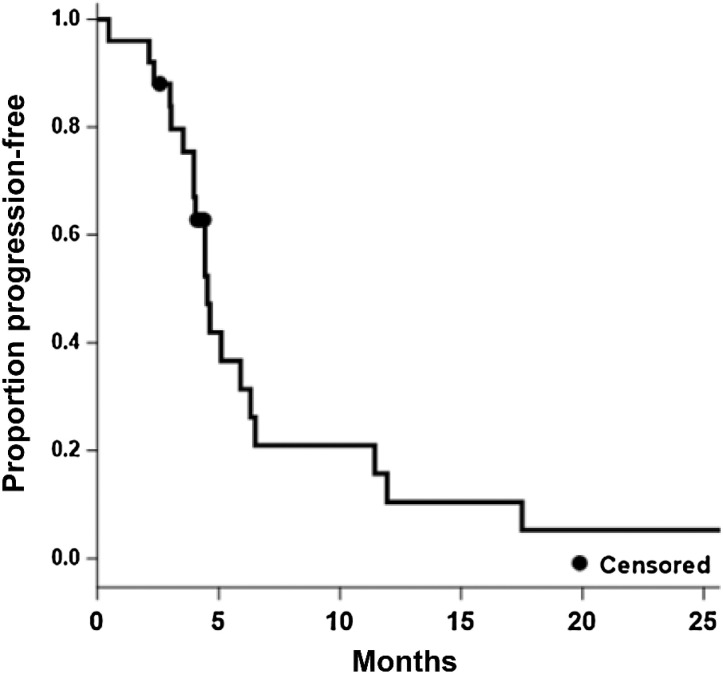
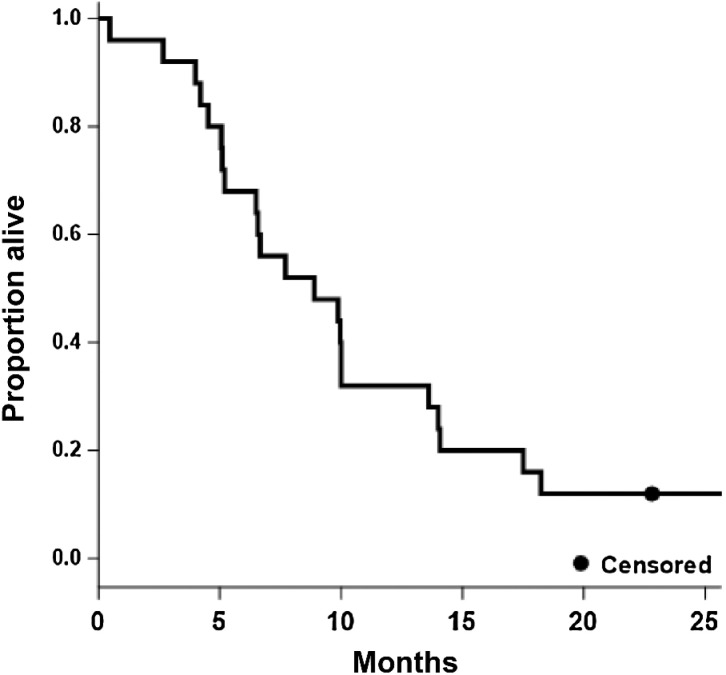
A total of 25 patients were enrolled. The most frequently reported adverse events (AE) were palmar-plantar erythrodysesthesia, hypertension, mucositis, dry eye, fatigue, and skin infection. Most were grade 1 or 2 in intensity. The overall response rate (ORR) for TVB-2640 plus bevacizumab was 56% (complete response, 17%; partial response, 39%). PFS6 for TVB-2640 plus bevacizumab was 31.4%. This represented a statistically significant improvement in PFS6 over historical bevacizumab monotherapy (BELOB 16%; P = 0.008) and met the primary study endpoint. The observed OS6 was 68%, with survival not reaching significance by log-rank test (P = 0.56).
In this phase II study of relapsed high-grade astrocytoma, TVB-2640 was found to be a well-tolerated oral drug that could be safely combined with bevacizumab. The favorable safety profile and response signals support the initiation of a larger multicenter trial of TVB-2640 plus bevacizumab in astrocytoma.
胶质母细胞瘤是最常见的原发性脑肿瘤。尽管抗血管生成药物在复发性疾病中使用,但它们并不能延长生存期。已知胶质母细胞瘤上调脂肪酸合酶(FASN)以促进脂质生物合成。TVB-2640 是一种 FASN 抑制剂,可破坏这种活性。
我们进行了一项前瞻性、单中心、开放标签、非盲、II 期 TVB-2640 联合贝伐珠单抗治疗复发性高级别星形细胞瘤患者的研究。患者随机分配至 TVB-2640(100mg/m2 口服,每日 1 次)联合贝伐珠单抗(10mg/kg,静脉输注,第 1 天和第 15 天)或贝伐珠单抗单药治疗(仅第 1 周期,28 天)进行生物标志物分析。此后,所有患者均接受 TVB-2640 联合贝伐珠单抗治疗,直至出现与治疗相关的毒性或疾病进展(PD)。主要终点为无进展生存期(PFS)。
共纳入 25 例患者。最常见的不良事件(AE)为掌跖红斑感觉迟钝、高血压、黏膜炎、干眼、疲劳和皮肤感染。大多数为 1 级或 2 级。TVB-2640 联合贝伐珠单抗的总缓解率(ORR)为 56%(完全缓解率,17%;部分缓解率,39%)。TVB-2640 联合贝伐珠单抗的 PFS6 为 31.4%。与历史贝伐珠单抗单药治疗(BELOB,16%;P=0.008)相比,这代表了 PFS6 的统计学显著改善,达到了主要研究终点。观察到的 OS6 为 68%,但对数秩检验未达到显著性(P=0.56)。
在这项复发性高级别星形细胞瘤的 II 期研究中,TVB-2640 被发现是一种耐受性良好的口服药物,可与贝伐珠单抗安全联合使用。其良好的安全性和缓解信号支持启动更大规模的 TVB-2640 联合贝伐珠单抗治疗星形细胞瘤的多中心试验。