Medical BioSciences, Radboud university medical center, Nijmegen, The Netherlands.
Oncode Institute, Nijmegen, The Netherlands.
Nat Commun. 2023 Apr 24;14(1):2348. doi: 10.1038/s41467-023-37933-8.
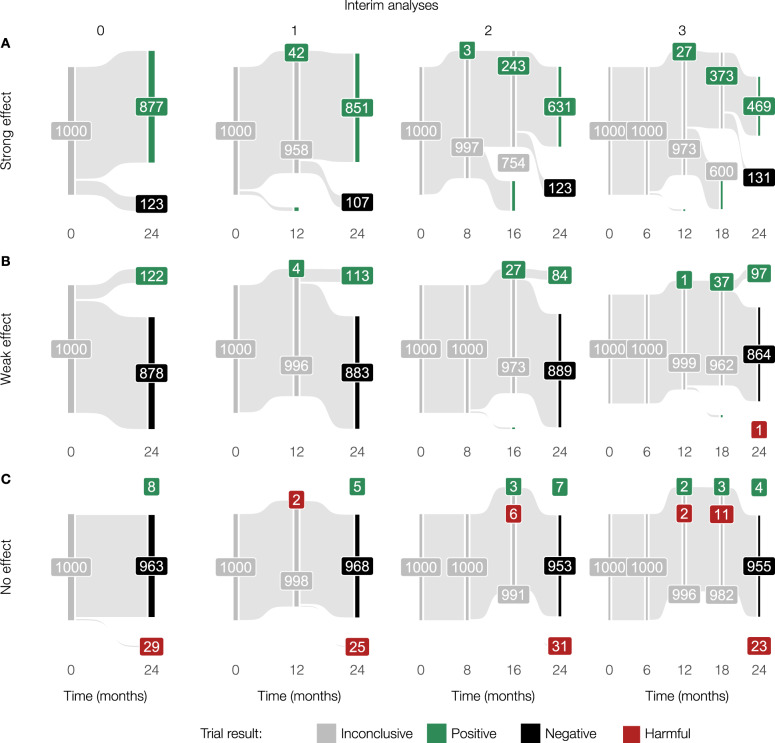
Late-stage cancer immunotherapy trials often lead to unusual survival curve shapes, like delayed curve separation or a plateauing curve in the treatment arm. It is critical for trial success to anticipate such effects in advance and adjust the design accordingly. Here, we use in silico cancer immunotherapy trials - simulated trials based on three different mathematical models - to assemble virtual patient cohorts undergoing late-stage immunotherapy, chemotherapy, or combination therapies. We find that all three simulation models predict the distinctive survival curve shapes commonly associated with immunotherapies. Considering four aspects of clinical trial design - sample size, endpoint, randomization rate, and interim analyses - we demonstrate how, by simulating various possible scenarios, the robustness of trial design choices can be scrutinized, and possible pitfalls can be identified in advance. We provide readily usable, web-based implementations of our three trial simulation models to facilitate their use by biomedical researchers, doctors, and trialists.
晚期癌症免疫疗法试验通常会导致不寻常的生存曲线形状,例如治疗组的曲线延迟分离或平台化。预先预测此类影响并相应调整设计对于试验成功至关重要。在这里,我们使用计算机模拟癌症免疫疗法试验 - 基于三种不同数学模型的模拟试验 - 来组合接受晚期免疫疗法、化疗或联合疗法的虚拟患者队列。我们发现,所有三种模拟模型都预测了与免疫疗法相关的独特生存曲线形状。考虑到临床试验设计的四个方面 - 样本量、终点、随机化率和中期分析 - 我们展示了如何通过模拟各种可能的情况,仔细审查试验设计选择的稳健性,并提前识别可能的陷阱。我们提供了我们的三个试验模拟模型的易于使用的基于网络的实现,以方便生物医学研究人员、医生和试验人员使用。