Fritz Cassandra D L, Obuobi Shirlene, Peek Monica E, Vela Monica B
Division of Gastroenterology, Diversity, Equity, and Inclusion for Internal Medicine Residency Program, Department of Medicine, Washington University School of Medicine, St. Louis, Missouri, USA.
Division of Cardiology, Department of Medicine, The University of Chicago, Chicago, Illinois, USA.
Health Equity. 2023 Apr 12;7(1):218-222. doi: 10.1089/heq.2022.0024. eCollection 2023.
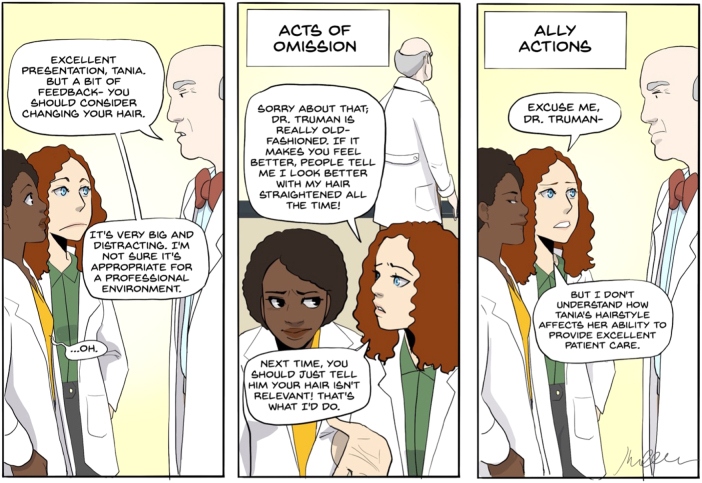
Racial microaggressions, racially based remarks, or actions that negatively impact marginalized physicians of color (Black, Latino/a/x, and American Indian/Alaskan Natives) often go unaddressed. This article provides four strategies for how individuals and institutions can engage in anti-racism allyship: (1) be an upstander during microaggressions, (2) be a sponsor and advocate for physicians of color, (3) acknowledge academic titles and accomplishments, and (4) challenge the idea of a "standard fit" for academic faculty and research. Skills in academic allyship should be taught to physicians throughout the educational continuum to mitigate feelings of isolation that racialized minority physicians frequently experience.
种族微侵犯、基于种族的言论或行为,对边缘化的有色人种医生(黑人、拉丁裔/拉丁美洲裔/拉丁裔、美国印第安人/阿拉斯加原住民)产生负面影响的情况往往得不到解决。本文提供了个人和机构如何参与反种族主义盟友关系的四种策略:(1)在微侵犯行为发生时挺身而出,(2)成为有色人种医生的支持者和倡导者,(3)认可学术头衔和成就,(4)挑战学术教员和研究“标准契合”的观念。应在整个教育过程中向医生传授学术盟友关系的技能,以减轻少数族裔医生经常感受到的孤立感。