Division of Endocrinology and Metabolism, Department of Internal Medicine, University of lowa - EUA.
Carver College of Medicine, University of Iowa - EUA.
Arq Bras Cardiol. 2023 Mar;120(4):e20220277. doi: 10.36660/abc.20220277.
Angiotensin receptor blockers (ARB) and angiotensin-converting enzyme inhibitors (ACEI) increase the expression of ACE2, which is a receptor for entry of SARS-CoV-2 into cells. Though evidence suggests that ARB/ACEI are safe among the general population with COVID-19, their safety in patients with overweight/obesity-related hypertension deserves further evaluation.
We assessed the association between ARB/ACEI use and COVID-19 severity in patients with overweight/obesity-related hypertension.
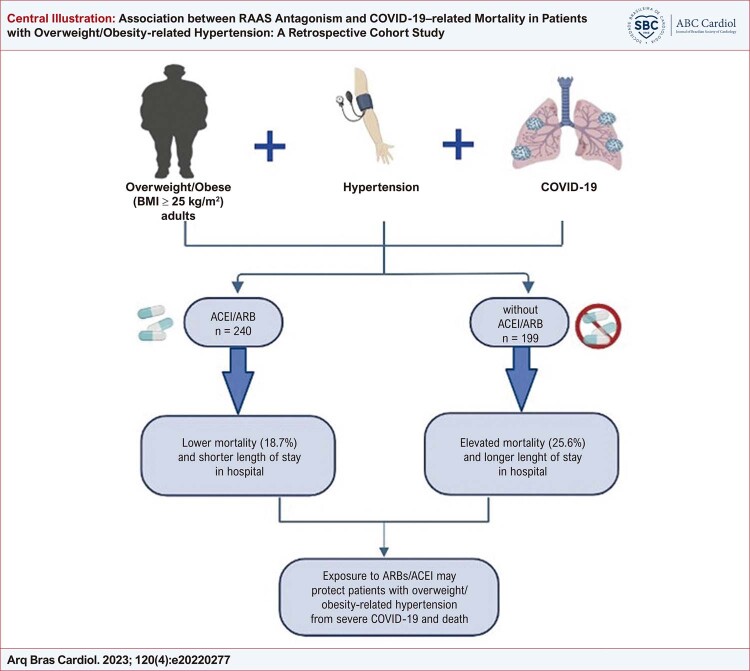
This study included 439 adult patients with overweight/obesity (body mass index ≥ 25 kg/m2) and hypertension, diagnosed with COVID-19 and admitted to University of Iowa Hospitals and Clinic from March 1 to December 7, 2020. Mortality and severity of COVID-19 were evaluated based on length of stay in hospital, intensive care unit admission, use of supplemental oxygen, mechanical ventilation, and vasopressors. Multivariable logistic regression was used to examine the associations of ARB/ACEI use with mortality and other markers of COVID-19 severity, with a two-sided alpha set at 0.05.
Exposure to ARB (n = 91) and ACEI (n = 149) before hospitalization was significantly associated with lower mortality (odds ratio [OR] = 0.362, 95% confidence interval [CI] 0.149 to 0.880, p = 0.025) and a shorter length of stay (95% CI -0.217 to -0.025, p = 0.015). Additionally, patients using ARB/ACEI showed a non-significant trend toward lower intensive care unit admission (OR = 0.727, 95% CI 0.485 to 1.090, p = 0.123), use of supplemental oxygen (OR = 0.929, 95% CI 0.608 to 1.421, p = 0.734), mechanical ventilation (OR = 0.728, 95% CI 0.457 to 1.161, p = 0.182), and vasopressors (OR = 0.677, 95% CI 0.430 to 1.067, p = 0.093).
Results suggest that hospitalized patients with COVID-19 and overweight/obesity-related hypertension who were prescribed ARB/ACEI before admission to the hospital exhibit lower mortality and less severe COVID-19 than those who were not taking ARB/ACEI. The results also suggest that exposure to ARB/ACEI may protect patients with overweight/obesity-related hypertension from severe COVID-19 and death.
血管紧张素受体阻滞剂(ARB)和血管紧张素转换酶抑制剂(ACEI)可增加 SARS-CoV-2 进入细胞的受体 ACE2 的表达。虽然有证据表明 ARB/ACEI 在 COVID-19 一般人群中是安全的,但它们在超重/肥胖相关高血压患者中的安全性值得进一步评估。
我们评估了 ARB/ACEI 治疗与超重/肥胖相关高血压患者 COVID-19 严重程度之间的关系。
本研究纳入了 2020 年 3 月 1 日至 12 月 7 日期间因 COVID-19 入住爱荷华大学医院和诊所的 439 名超重/肥胖(体重指数≥25kg/m2)合并高血压的成年患者。根据住院时间、入住重症监护病房、使用补充氧气、机械通气和血管加压药的情况评估 COVID-19 的严重程度和死亡率。采用多变量逻辑回归分析 ARB/ACEI 使用与死亡率和 COVID-19 严重程度的其他标志物之间的关系,双侧α值设为 0.05。
住院前使用 ARB(n=91)和 ACEI(n=149)与死亡率降低显著相关(比值比[OR] = 0.362,95%置信区间[CI] 0.149 至 0.880,p = 0.025)和住院时间缩短(95%CI -0.217 至 -0.025,p = 0.015)。此外,使用 ARB/ACEI 的患者入住重症监护病房的比例呈下降趋势(OR = 0.727,95%CI 0.485 至 1.090,p = 0.123)、使用补充氧气(OR = 0.929,95%CI 0.608 至 1.421,p = 0.734)、机械通气(OR = 0.728,95%CI 0.457 至 1.161,p = 0.182)和血管加压药(OR = 0.677,95%CI 0.430 至 1.067,p = 0.093)的可能性也降低。
结果表明,与未使用 ARB/ACEI 的患者相比,入院前接受 ARB/ACEI 治疗的 COVID-19 合并超重/肥胖相关高血压患者死亡率较低,COVID-19 严重程度较轻。结果还表明,ARB/ACEI 的暴露可能使超重/肥胖相关高血压患者免受 COVID-19 的严重影响和死亡。