Ma Yan, Fu Hua, Li Yang, Bao Zheng-Rong, Dong Wen-Bin, Lei Xiao-Ping
Division of Neonatology, Department of Pediatrics, The Affiliated Hospital of Southwest Medical University, Xiaoping Lei, 8 Kangcheng Road, Luzhou, 646000, China.
Department of Perinatology, The Affiliated Hospital of Southwest Medical University, Luzhou, China.
World J Pediatr. 2023 Dec;19(12):1155-1161. doi: 10.1007/s12519-023-00728-4. Epub 2023 Apr 26.
After the implementation of the universal two-child policy in China, it was more frequent to have long interpregnancy intervals (IPIs) and advanced maternal age. However, the interactions between long IPIs and advanced maternal age on neonatal outcomes are unknown.
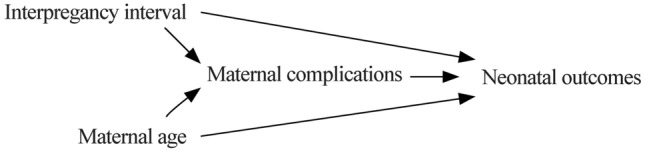
The study subjects of this historical cohort study were multiparas with singleton live births between October 1st, 2015, and October 31st, 2020. IPI was defined as the interval between delivery and conception of the subsequent pregnancy. Logistic regression models were used to calculate adjusted odds ratios (aORs) and 95% confidence intervals (CIs) of the risks of preterm birth (PTB), low birth weight (LBW), small for gestation age, and 1-min Apgar score ≤ 7 in different IPI groups. Relative excess risk due to interaction (RERI) was used to evaluate the additive interaction between long IPIs and advanced maternal age.
Compared with the 24 ≤ IPI ≤ 59 months group, the long IPI group (IPI ≥ 60 months) was associated with a higher risk of PTB (aOR, 1.27; 95% CI: 1.07-1.50), LBW (aOR, 1.32; 95% CI 1.08-1.61), and one-minute Apgar score ≤ 7 (aOR, 1.46; 95% CI 1.07-1.98). Negative additive interactions (all RERIs < 0) existed between long IPIs and advanced maternal age for these neonatal outcomes. Meanwhile, IPI < 12 months was also associated with PTB (aOR, 1.51; 95% CI 1.13-2.01), LBW (aOR, 1.50; 95% CI 1.09-2.07), and 1-min Apgar score ≤ 7 (aOR, 1.93; 95% CI 1.23-3.04).
Both short and long IPIs are associated with an increased risk of adverse neonatal outcomes. Appropriate IPI should be recommended to women planning to become pregnant again. In addition, better antenatal care might be taken to balance the inferiority of advanced maternal age and to improve neonatal outcomes.
中国实施全面二孩政策后,妊娠间隔期延长和孕产妇年龄增大的情况更为常见。然而,妊娠间隔期延长与孕产妇年龄增大对新生儿结局的相互作用尚不清楚。
本历史性队列研究的研究对象为2015年10月1日至2020年10月31日期间单胎活产的经产妇。妊娠间隔期定义为上次分娩与下次怀孕受孕之间的间隔时间。采用逻辑回归模型计算不同妊娠间隔期组早产、低出生体重、小于胎龄儿和1分钟Apgar评分≤7的风险的调整比值比(aOR)和95%置信区间(CI)。用交互作用所致相对超额危险度(RERI)评估妊娠间隔期延长与孕产妇年龄增大之间的相加交互作用。
与妊娠间隔期24≤IPI≤59个月组相比,妊娠间隔期延长组(IPI≥60个月)早产风险更高(aOR,1.27;95%CI:1.07-1.50)、低出生体重风险更高(aOR,1.32;95%CI 1.08-1.61)、1分钟Apgar评分≤7的风险更高(aOR,1.46;95%CI 1.07-1.98)。对于这些新生儿结局,妊娠间隔期延长与孕产妇年龄增大之间存在负相加交互作用(所有RERI<0)。同时,妊娠间隔期<12个月也与早产(aOR,1.51;95%CI 1.13-2.01)、低出生体重(aOR,1.50;95%CI 1.09-2.07)和1分钟Apgar评分≤7(aOR,1.93;95%CI 1.23-3.04)相关。
妊娠间隔期过短和过长均与不良新生儿结局风险增加相关。对于计划再次怀孕的女性,应建议其保持合适的妊娠间隔期。此外,可加强产前保健,以平衡孕产妇年龄增大的劣势并改善新生儿结局。