Badger Athletic Performance Program, University of Wisconsin-Madison, Madison, WI.
Med Sci Sports Exerc. 2023 Sep 1;55(9):1540-1547. doi: 10.1249/MSS.0000000000003186. Epub 2023 Apr 27.
Reduced bone mineral density of the distal femur (BMD DF ) can persist long term after anterior cruciate ligament reconstruction (ACLR), even in athletes who return to high levels of competition. These deficits may have implications for the onset and progression of knee osteoarthritis. It is unknown if clinically modifiable factors are associated with losses in BMD DF . This study evaluated the potential influence of knee extensor peak torque (PT), rate of torque development (RTD), as well as peak knee flexion (PKF) angle and peak knee extensor moment (PKEM) during running, on longitudinal changes in BMD DF post-ACLR.
After ACLR, 57 Division I collegiate athletes underwent serial whole-body dual-energy x-ray absorptiometry (DXA) scans between 3 and 24 months post-ACLR. Of these, 43 athletes also had isometric knee extensor testing (21 female, 105 observations), and 54 had running analyses (26 female, 141 observations). Linear mixed-effects models, controlling for sex, assessed the influence of surgical limb quadriceps performance (PT and RTD), running mechanics (PKF and PKEM), and time post-ACLR on BMD DF (5% and 15% of femur length). Simple slope analyses were used to explore interactions.
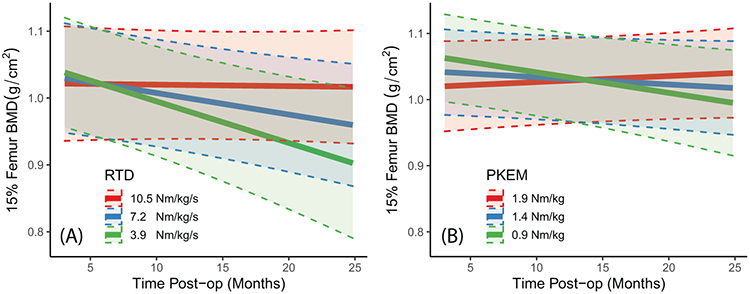
Athletes with RTD less than 7.20 (N·m)·kg -1 ·s -1 (mean) at 9.3 months post-ACLR demonstrated significant decreases in 15% BMD DF over time ( P = 0.03). Athletes with PKEM during running less than 0.92 (N·m)·kg -1 (-1 SD below mean) at 9.8 months post-ACLR demonstrated significant decreases in 15% BMD DF over time ( P = 0.02). Significant slopes were not detected at -1 SD below the mean for PT (1.75 (N·m)·kg -1 , P = 0.07) and PKF (31.3°, P = 0.08).
Worse quadriceps RTD and running PKEM were associated with a greater loss of BMD DF between 3 and 24 months post-ACLR.
即使在重返高水平比赛的运动员中,前交叉韧带重建(ACLR)后远端股骨(DF)的骨密度(BMD)也会长期持续下降。这些缺陷可能与膝关节骨关节炎的发病和进展有关。目前尚不清楚临床可改变的因素是否与 DF 的 BMD 丧失有关。本研究评估了膝关节伸肌峰值扭矩(PT)、扭矩发展率(RTD)以及跑步过程中的最大膝关节屈曲(PKF)角度和最大膝关节伸肌力矩(PKEM)对 ACLR 后 DF 纵向变化的潜在影响。
ACLR 后,57 名一级大学运动员在 ACLR 后 3 至 24 个月内进行了系列全身双能 X 射线吸收法(DXA)扫描。其中 43 名运动员还进行了等速膝关节伸肌测试(21 名女性,105 次观察),54 名运动员进行了跑步分析(26 名女性,141 次观察)。线性混合效应模型,控制性别,评估手术肢体股四头肌性能(PT 和 RTD)、跑步力学(PKF 和 PKEM)以及 ACLR 后时间对 DF (股骨长度的 5%和 15%)的影响。简单斜率分析用于探索相互作用。
ACLR 后 9.3 个月 RTD 小于 7.20(N·m)·kg -1 ·s -1(平均值)的运动员随时间推移,15%DF 的 BMD 显著下降(P = 0.03)。ACLR 后 9.8 个月跑步时 PKEM 小于 0.92(N·m)·kg -1 (低于平均值-1 SD)的运动员随时间推移,15%DF 的 BMD 显著下降(P = 0.02)。在平均值-1 SD 以下,未检测到 PT(1.75(N·m)·kg -1 ,P = 0.07)和 PKF(31.3°,P = 0.08)的显著斜率。
较差的股四头肌 RTD 和跑步时的 PKEM 与 ACLR 后 3 至 24 个月之间 DF 的 BMD 更大丧失有关。