Portier Hugues, Benaitreau Delphine, Pallu Stéphane
Laboratoire de Biologie Bioingénierie et Bioimagerie Ostéo-Articulaire (B3OA), Université Paris, UMR CNRS 7052, INSERM U1273, 10 Av de Verdun, 75010 Paris, France.
Collegium Science & Technique, 2 allée du château, Université d'Orléans. 45100 Orléans, France.
Life (Basel). 2020 Sep 23;10(10):217. doi: 10.3390/life10100217.
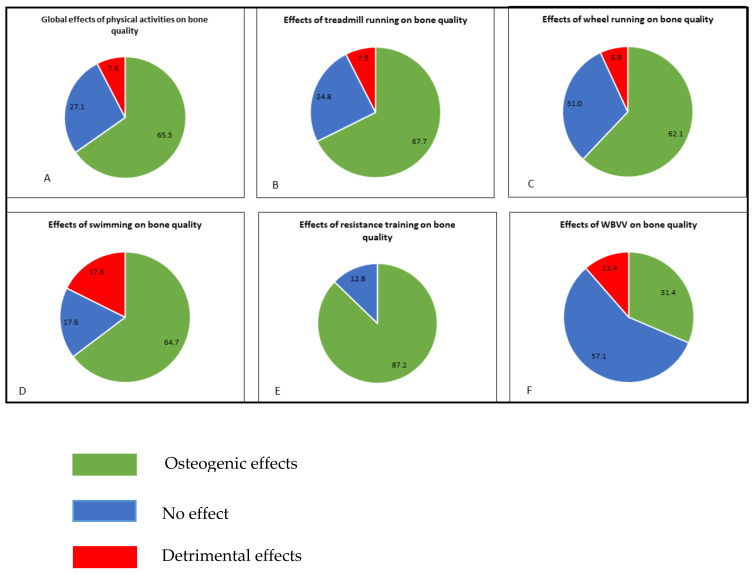
For decades, the osteogenic effect from different physical activities on bone in rodents remained uncertain. This literature review presents for the first time the effects on five exercise models (treadmill running, wheel running, swimming, resistance training and vibration modes) in three different experimental rat groups (males, females, osteopenic) on bone quality. The bone parameters presented are bone mineral density, micro-architectural and mechanical properties, and osteoblast/osteocyte and osteoclast parameters. This review shows that physical activities have a positive effect (65% of the results) on bone status, but we clearly observed a difference amongst the different protocols. Even if treadmill running is the most used protocol, the resistance training constitutes the first exercise model in term of osteogenic effects (87% of the whole results obtained on this model). The less osteogenic model is the vibration mode procedure (31%). It clearly appears that the gender plays a role on the bone response to swimming and wheel running exercises. Besides, we did not observe negative results in the osteopenic population with impact training, wheel running and vibration activities. Moreover, about osteoblast/osteocyte parameters, we conclude that high impact and resistance exercise (such jumps and tower climbing) seems to increase bone formation more than running or aerobic exercise. Among the different protocols, literature has shown that the treadmill running procedure mainly induces osteogenic effects on the viability of the osteocyte lineage in both males and females or ovariectomized rats; running in voluntary wheels contributes to a negative effect on bone metabolism in older male models; whole-body vertical vibration is not an osteogenic exercise in female and ovariectomized rats; whereas swimming provides controversial results in female models. For osteoclast parameters only, running in a voluntary wheel for old males, the treadmill running program at high intensity in ovariectomized rats, and the swimming program in a specific ovariectomy condition have detrimental consequences.
几十年来,不同体育活动对啮齿动物骨骼的成骨作用一直不明确。这篇文献综述首次展示了三种不同实验大鼠组(雄性、雌性、骨质疏松组)的五种运动模式(跑步机跑步、转轮跑步、游泳、阻力训练和振动模式)对骨骼质量的影响。所呈现的骨骼参数包括骨密度、微观结构和力学性能,以及成骨细胞/骨细胞和破骨细胞参数。这篇综述表明,体育活动对骨骼状态有积极影响(65%的结果),但我们清楚地观察到不同方案之间存在差异。即使跑步机跑步是最常用的方案,但就成骨作用而言,阻力训练是第一种运动模式(该模式获得的全部结果中有87%)。成骨作用最小的模式是振动模式程序(31%)。显然,性别在骨骼对游泳和转轮跑步运动的反应中起作用。此外,我们在骨质疏松人群中进行冲击训练、转轮跑步和振动活动时未观察到负面结果。此外,关于成骨细胞/骨细胞参数,我们得出结论,高冲击和阻力运动(如跳跃和爬塔)似乎比跑步或有氧运动更能增加骨形成。在不同方案中,文献表明跑步机跑步程序主要对雄性、雌性或去卵巢大鼠骨细胞谱系的活力产生成骨作用;在自愿转轮中跑步对老年雄性模型的骨代谢有负面影响;全身垂直振动在雌性和去卵巢大鼠中不是一种成骨运动;而游泳在雌性模型中提供了有争议的结果。仅就破骨细胞参数而言,老年雄性在自愿转轮中跑步、去卵巢大鼠进行高强度跑步机跑步程序以及在特定去卵巢条件下的游泳程序会产生有害后果。