Shaikh Nazneen Fatima, Shen Chan, LeMasters Traci, Dwibedi Nilanjana, Ladani Amit, Sambamoorthi Usha
Department of Pharmaceutical Systems and Policy, West Virginia University School of Pharmacy, Morgantown, WV, USA.
Department of Surgery, College of Medicine, The Pennsylvania State University, Hershey, PA, USA.
Cancer Inform. 2023 Apr 18;22:11769351231165161. doi: 10.1177/11769351231165161. eCollection 2023.
This study examined prescription NSAIDs as one of the leading predictors of incident depression and assessed the direction of the association among older cancer survivors with osteoarthritis.
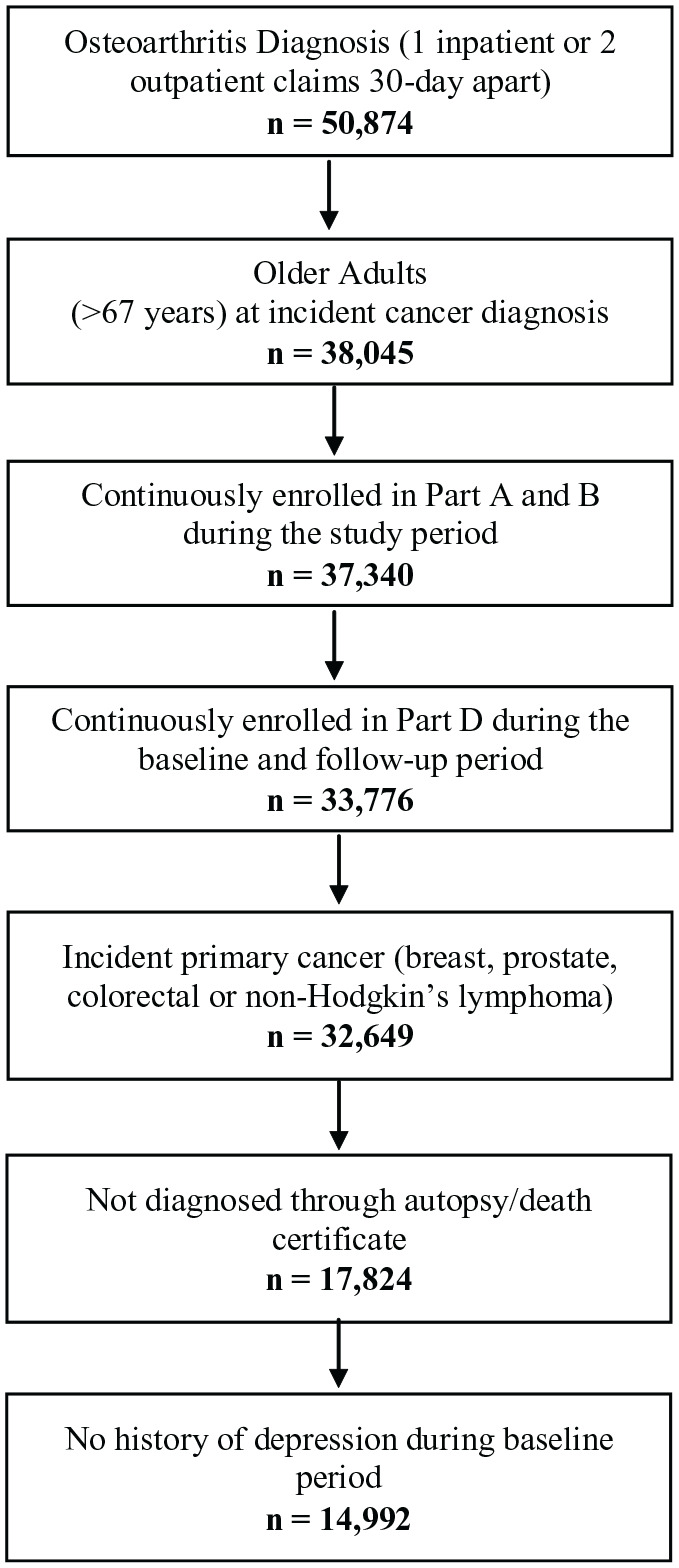
This study used a retrospective cohort (N = 14, 992) of older adults with incident cancer (breast, prostate, colorectal cancers, or non-Hodgkin's lymphoma) and osteoarthritis. We used the longitudinal data from the linked Surveillance, Epidemiology, and End Results -Medicare data for the study period from 2006 through 2016, with a 12-month baseline and 12-month follow-up period. Cumulative NSAIDs days was assessed during the baseline period and incident depression was assessed during the follow-up period. An eXtreme Gradient Boosting (XGBoost) model was built with 10-fold repeated stratified cross-validation and hyperparameter tuning using the training dataset. The final model selected from the training data demonstrated high performance (Accuracy: 0.82, Recall: 0.75, Precision: 0.75) when applied to the test data. SHapley Additive exPlanations (SHAP) was used to interpret the output from the XGBoost model.
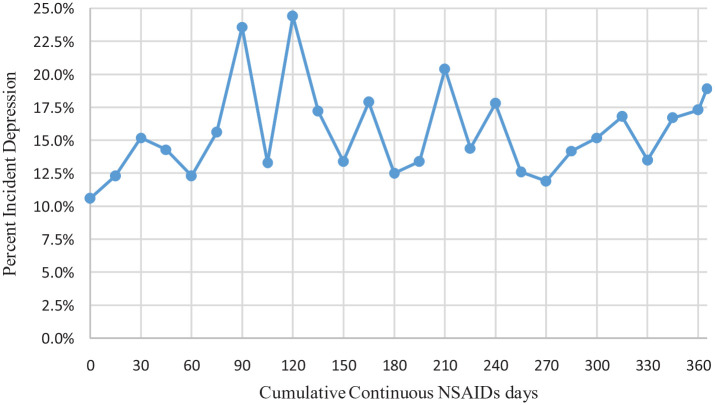
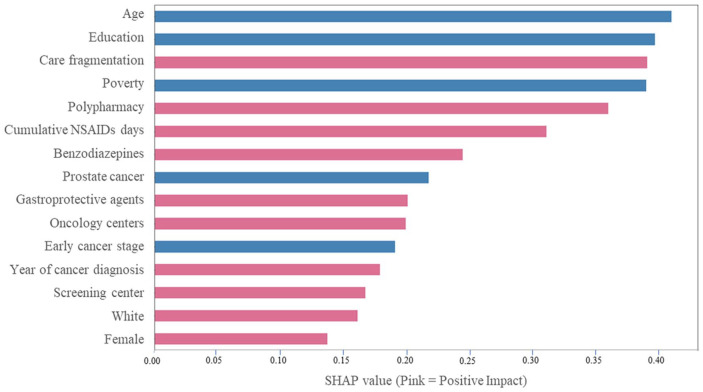
Over 50% of the study cohort had at least one prescption of NSAIDs. Nearly 13% of the cohort were diagnosed with incident depression, with the rates ranging between 7.4% for prostate cancer and 17.0% for colorectal cancer. The highest incident depression rate of 25% was observed at 90 and 120 cumulative NSAIDs days thresholds. Cumulative NSAIDs days was the sixth leading predictor of incident depression among older adults with OA and cancer. Age, education, care fragmentation, polypharmacy, and zip code level poverty were the top 5 predictors of incident depression.
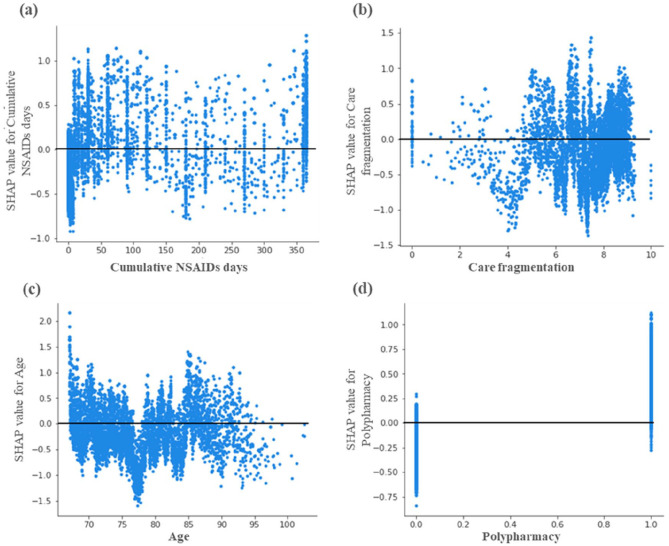
Overall, 1 in 8 older adults with cancer and OA were diagnosed with incident depression. Cumulative NSAIDs days was the sixth leading predictor with an overall positive association with incident depression. However, the association was complex and varied by the cumulative NSAIDs days.
本研究将处方非甾体抗炎药作为新发抑郁症的主要预测因素之一进行了研究,并评估了老年骨关节炎癌症幸存者之间关联的方向。
本研究采用回顾性队列研究(N = 14992),研究对象为患有新发癌症(乳腺癌、前列腺癌、结直肠癌或非霍奇金淋巴瘤)和骨关节炎的老年人。我们使用了2006年至2016年研究期间与监测、流行病学和最终结果 - 医疗保险数据相链接的纵向数据,基线期为12个月,随访期为12个月。在基线期评估非甾体抗炎药的累积使用天数,在随访期评估新发抑郁症情况。使用训练数据集构建了一个极端梯度提升(XGBoost)模型,并进行10倍重复分层交叉验证和超参数调整。从训练数据中选择的最终模型在应用于测试数据时表现出高性能(准确率:0.82,召回率:0.75,精确率:0.75)。使用夏普利值加法解释(SHAP)来解释XGBoost模型的输出。
超过50%的研究队列至少有一次非甾体抗炎药处方。近13%的队列被诊断为新发抑郁症,发病率在前列腺癌的7.4%至结直肠癌的17.0%之间。在非甾体抗炎药累积使用天数阈值为90天和120天时,观察到最高的新发抑郁症发病率为25%。在患有骨关节炎和癌症的老年人中,非甾体抗炎药累积使用天数是新发抑郁症的第六大主要预测因素。年龄、教育程度、护理碎片化、多种药物治疗和邮政编码水平的贫困是新发抑郁症的前五大预测因素。
总体而言,每8名患有癌症和骨关节炎的老年人中就有1人被诊断为新发抑郁症。非甾体抗炎药累积使用天数是第六大主要预测因素,与新发抑郁症总体呈正相关。然而,这种关联很复杂,并且因非甾体抗炎药累积使用天数而异。