• 文献检索
  • 文档翻译
  • 深度研究
  • 学术资讯
  • Suppr Zotero 插件Zotero 插件
  • 邀请有礼
  • 套餐&价格
  • 历史记录
应用&插件
Suppr Zotero 插件Zotero 插件浏览器插件Mac 客户端Windows 客户端微信小程序
定价
高级版会员购买积分包购买API积分包
服务
文献检索文档翻译深度研究API 文档MCP 服务
关于我们
关于 Suppr公司介绍联系我们用户协议隐私条款
关注我们

Suppr 超能文献

核心技术专利:CN118964589B侵权必究
粤ICP备2023148730 号-1Suppr @ 2026

文献检索

告别复杂PubMed语法,用中文像聊天一样搜索,搜遍4000万医学文献。AI智能推荐,让科研检索更轻松。

立即免费搜索

文件翻译

保留排版,准确专业,支持PDF/Word/PPT等文件格式,支持 12+语言互译。

免费翻译文档

深度研究

AI帮你快速写综述,25分钟生成高质量综述,智能提取关键信息,辅助科研写作。

立即免费体验

预测腰椎手术后患者报告的结局:多变量预测模型的开发和外部验证。

Predicting patient-reported outcomes following lumbar spine surgery: development and external validation of multivariable prediction models.

机构信息

Department of Psychology, University of Liverpool, Liverpool, UK.

Department of Neurosurgery, The Walton Centre NHS Foundation Trust, Liverpool, UK.

出版信息

BMC Musculoskelet Disord. 2023 Apr 27;24(1):333. doi: 10.1186/s12891-023-06446-2.

DOI:10.1186/s12891-023-06446-2
PMID:37106435
原文链接:https://pmc.ncbi.nlm.nih.gov/articles/PMC10134672/
Abstract

BACKGROUND

This study aimed to develop and externally validate prediction models of spinal surgery outcomes based on a retrospective review of a prospective clinical database, uniquely comparing multivariate regression and random forest (machine learning) approaches, and identifying the most important predictors.

METHODS

Outcomes were change in back and leg pain intensity and Core Outcome Measures Index (COMI) from baseline to the last available postoperative follow-up (3-24 months), defined as minimal clinically important change (MCID) and continuous change score. Eligible patients underwent lumbar spine surgery for degenerative pathology between 2011 and 2021. Data were split by surgery date into development (N = 2691) and validation (N = 1616) sets for temporal external validation. Multivariate logistic and linear regression, and random forest classification and regression models, were fit to the development data and validated on the external data.

RESULTS

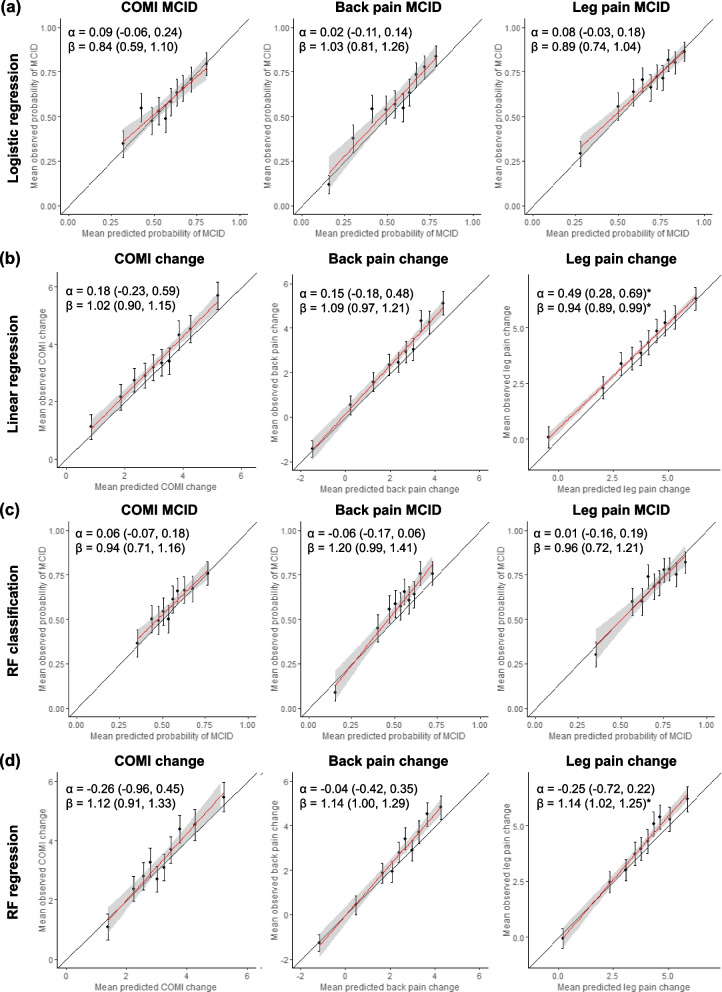
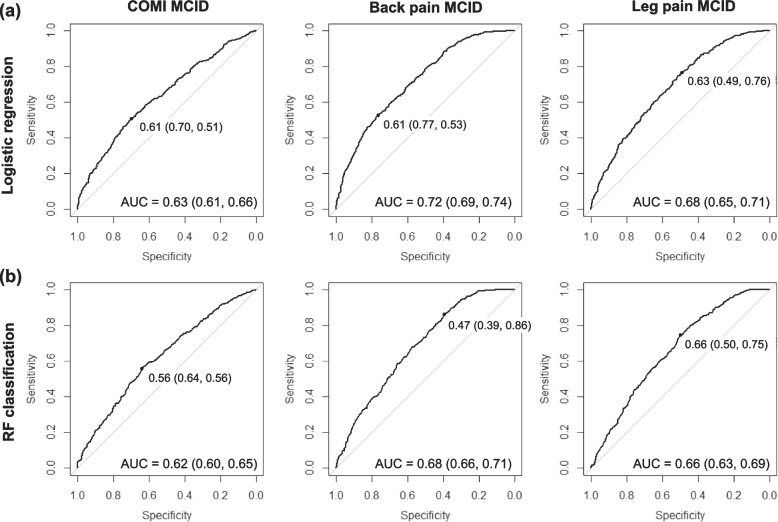
All models demonstrated good calibration in the validation data. Discrimination ability (area under the curve) for MCID ranged from 0.63 (COMI) to 0.72 (back pain) in regression, and from 0.62 (COMI) to 0.68 (back pain) in random forests. The explained variation in continuous change scores spanned 16%-28% in linear, and 15%-25% in random forests regression. The most important predictors included age, baseline scores on the respective outcome measures, type of degenerative pathology, previous spinal surgeries, smoking status, morbidity, and duration of hospital stay.

CONCLUSIONS

The developed models appear robust and generalisable across different outcomes and modelling approaches but produced only borderline acceptable discrimination ability, suggesting the need to assess further prognostic factors. External validation showed no advantage of the random forest approach.

摘要

背景

本研究旨在基于前瞻性临床数据库的回顾性分析,开发和外部验证脊柱手术结果的预测模型,特别比较多元回归和随机森林(机器学习)方法,并确定最重要的预测因素。

方法

结局是从基线到最后一次可获得的术后随访(3-24 个月)时背部和腿部疼痛强度以及核心结局测量指标(COMI)的变化,定义为最小临床重要变化(MCID)和连续变化评分。符合条件的患者在 2011 年至 2021 年间因退行性病变接受腰椎手术。根据手术日期将数据分为开发(N=2691)和验证(N=1616)数据集,进行时间外部验证。多元逻辑和线性回归以及随机森林分类和回归模型拟合于开发数据,并在外部数据上进行验证。

结果

所有模型在验证数据中均表现出良好的校准能力。MCID 的判别能力(曲线下面积)在回归分析中从 COMI 的 0.63 到背痛的 0.72,在随机森林中从 COMI 的 0.62 到背痛的 0.68。线性模型中连续变化评分的解释方差为 16%-28%,随机森林回归模型为 15%-25%。最重要的预测因素包括年龄、各自结局测量的基线评分、退行性病变类型、以前的脊柱手术、吸烟状况、发病率和住院时间。

结论

开发的模型似乎在不同的结局和建模方法中具有稳健性和可推广性,但产生的判别能力仅为边缘可接受,这表明需要进一步评估预后因素。外部验证表明随机森林方法没有优势。
https://cdn.ncbi.nlm.nih.gov/pmc/blobs/f670/10134672/1005917a5602/12891_2023_6446_Fig2_HTML.jpg
https://cdn.ncbi.nlm.nih.gov/pmc/blobs/f670/10134672/f3f34b5a51f8/12891_2023_6446_Fig1_HTML.jpg
https://cdn.ncbi.nlm.nih.gov/pmc/blobs/f670/10134672/1005917a5602/12891_2023_6446_Fig2_HTML.jpg
https://cdn.ncbi.nlm.nih.gov/pmc/blobs/f670/10134672/f3f34b5a51f8/12891_2023_6446_Fig1_HTML.jpg
https://cdn.ncbi.nlm.nih.gov/pmc/blobs/f670/10134672/1005917a5602/12891_2023_6446_Fig2_HTML.jpg

相似文献

1
Predicting patient-reported outcomes following lumbar spine surgery: development and external validation of multivariable prediction models.预测腰椎手术后患者报告的结局:多变量预测模型的开发和外部验证。
BMC Musculoskelet Disord. 2023 Apr 27;24(1):333. doi: 10.1186/s12891-023-06446-2.
2
An analysis from the Quality Outcomes Database, Part 1. Disability, quality of life, and pain outcomes following lumbar spine surgery: predicting likely individual patient outcomes for shared decision-making.来自质量结果数据库的分析,第1部分。腰椎手术后的残疾、生活质量和疼痛结果:为共同决策预测可能的个体患者结果。
J Neurosurg Spine. 2017 Oct;27(4):357-369. doi: 10.3171/2016.11.SPINE16526. Epub 2017 May 12.
3
Development and Validation of a Prediction Model for Pain and Functional Outcomes After Lumbar Spine Surgery.腰椎手术后疼痛和功能结局预测模型的建立和验证。
JAMA Surg. 2018 Jul 1;153(7):634-642. doi: 10.1001/jamasurg.2018.0072.
4
Development of a machine-learning based model for predicting multidimensional outcome after surgery for degenerative disorders of the spine.基于机器学习的方法预测退行性脊柱疾病术后多维结局的模型构建。
Eur Spine J. 2022 Aug;31(8):2125-2136. doi: 10.1007/s00586-022-07306-8. Epub 2022 Jul 14.
5
Patient-reported outcome of surgical treatment for lumbar spinal epidural lipomatosis.腰椎硬膜外脂肪增多症手术治疗的患者报告结局
Spine J. 2016 Nov;16(11):1333-1341. doi: 10.1016/j.spinee.2016.06.022. Epub 2016 Jun 27.
6
FUSE-ML: development and external validation of a clinical prediction model for mid-term outcomes after lumbar spinal fusion for degenerative disease.FUSE-ML:用于退行性疾病腰椎融合术后中期结局的临床预测模型的开发和外部验证。
Eur Spine J. 2022 Oct;31(10):2629-2638. doi: 10.1007/s00586-022-07135-9. Epub 2022 Feb 21.
7
Association between muscle health and patient-reported outcomes after lumbar microdiscectomy: early results.腰椎间盘切除术后肌肉健康与患者报告结果的关系:早期结果。
Spine J. 2022 Oct;22(10):1677-1686. doi: 10.1016/j.spinee.2022.05.013. Epub 2022 Jun 6.
8
Do measures of surgical effectiveness at 1 year after lumbar spine surgery accurately predict 2-year outcomes?腰椎手术后1年的手术效果指标能否准确预测2年的预后?
J Neurosurg Spine. 2016 Dec;25(6):689-696. doi: 10.3171/2015.8.SPINE15476. Epub 2016 Jan 1.
9
What level of pain are patients happy to live with after surgery for lumbar degenerative disorders?腰椎退行性疾病手术后,患者愿意忍受何种程度的疼痛?
Spine J. 2016 Apr;16(4 Suppl):S12-8. doi: 10.1016/j.spinee.2016.01.180. Epub 2016 Feb 2.
10
Measuring clinically relevant improvement after lumbar spine surgery: is it time for something new?测量腰椎手术后临床相关的改善:是否需要新的方法?
Spine J. 2020 Jun;20(6):847-856. doi: 10.1016/j.spinee.2020.01.010. Epub 2020 Jan 28.

引用本文的文献

1
External validation of a prediction model for disability and pain after lumbar disc herniation surgery: a prospective international registry-based cohort study.腰椎间盘突出症手术后残疾和疼痛预测模型的外部验证:一项基于国际前瞻性注册队列研究。
Acta Orthop. 2025 Jul 7;96:512-520. doi: 10.2340/17453674.2025.44251.
2
The Core Outcome Measures Index (COMI) comes of age: 18 years of efficient and effective patient-reported outcome measurement in the field of spinal disorders. Part 1. Development of the COMI, interpretation of scores, and use in research.核心结局指标指数(COMI)步入成年:脊柱疾病领域18年高效且有效的患者报告结局测量。第1部分。COMI的发展、分数解读及在研究中的应用。
Eur Spine J. 2025 May 21. doi: 10.1007/s00586-025-08835-8.
3

本文引用的文献

1
Predictors of Pain and Disability Outcomes Following Spinal Surgery for Chronic Low Back and Radicular Pain: A Systematic Review.慢性下腰痛和神经根性疼痛脊柱手术后疼痛及残疾结局的预测因素:一项系统评价
Clin J Pain. 2022 Mar 22;38(5):368-380. doi: 10.1097/AJP.0000000000001033.
2
Exploring Associations of Preoperative Physical Performance With Postoperative Outcomes After Lumbar Spinal Fusion: A Machine Learning Approach.运用机器学习方法探究腰椎融合术后术前体能与术后结局的相关性。
Arch Phys Med Rehabil. 2021 Jul;102(7):1324-1330.e3. doi: 10.1016/j.apmr.2021.02.013. Epub 2021 Mar 9.
3
Development of prediction models for clinically meaningful improvement in PROMIS scores after lumbar decompression.
Machine learning predicts spinal cord stimulation surgery outcomes and reveals novel neural markers for chronic pain.机器学习可预测脊髓刺激手术的结果,并揭示慢性疼痛的新型神经标志物。
Sci Rep. 2025 Mar 18;15(1):9279. doi: 10.1038/s41598-025-92111-8.
4
Scoping Review of Machine Learning and Patient-Reported Outcomes in Spine Surgery.脊柱手术中机器学习与患者报告结局的范围综述
Bioengineering (Basel). 2025 Jan 29;12(2):125. doi: 10.3390/bioengineering12020125.
5
Predicting patient reported outcome measures: a scoping review for the artificial intelligence-guided patient preference predictor.预测患者报告的结局指标:人工智能引导的患者偏好预测器的范围综述
Front Artif Intell. 2024 Nov 5;7:1477447. doi: 10.3389/frai.2024.1477447. eCollection 2024.
6
Advancing spine care through AI and machine learning: overview and applications.通过人工智能和机器学习推动脊柱护理:概述与应用
EFORT Open Rev. 2024 May 10;9(5):422-433. doi: 10.1530/EOR-24-0019.
7
Construct validation of the Japanese Core Outcome Measures Index and the impact of diseases on patient-reported outcome measures in preoperative patients with lumbar spinal stenosis and disk herniation: a single-center observational study.日本核心结局指标指数的结构效度及疾病对腰椎管狭窄症和椎间盘突出症术前患者报告结局指标的影响:一项单中心观察性研究
Eur Spine J. 2024 Jun;33(6):2198-2205. doi: 10.1007/s00586-024-08148-2. Epub 2024 Apr 28.
8
Artificial Intelligence for Clinically Meaningful Outcome Prediction in Orthopedic Research: Current Applications and Limitations.人工智能在骨科研究中用于具有临床意义的结果预测:当前应用与局限性
Curr Rev Musculoskelet Med. 2024 Jun;17(6):185-206. doi: 10.1007/s12178-024-09893-z. Epub 2024 Apr 8.
9
Machine Learning Models for Predicting Disability and Pain Following Lumbar Disc Herniation Surgery.用于预测腰椎间盘突出症手术后残疾和疼痛的机器学习模型。
JAMA Netw Open. 2024 Feb 5;7(2):e2355024. doi: 10.1001/jamanetworkopen.2023.55024.
10
Appropriateness of specialized care referrals for LBP: a cross-sectional analysis.下背痛专科护理转诊的适宜性:一项横断面分析
Front Med (Lausanne). 2024 Jan 5;10:1292481. doi: 10.3389/fmed.2023.1292481. eCollection 2023.
腰椎减压术后 PROMIS 评分有临床意义改善的预测模型的开发。
Spine J. 2021 Mar;21(3):397-404. doi: 10.1016/j.spinee.2020.10.026. Epub 2020 Oct 31.
4
Development and temporal validation of a prognostic model for 1-year clinical outcome after decompression surgery for lumbar disc herniation.腰椎间盘突出症减压手术后1年临床结局预后模型的建立与时间验证
Eur Spine J. 2020 Jul;29(7):1742-1751. doi: 10.1007/s00586-020-06351-5. Epub 2020 Feb 27.
5
External validation of a prediction model for pain and functional outcome after elective lumbar spinal fusion.择期腰椎融合术后疼痛和功能结局预测模型的外部验证。
Eur Spine J. 2020 Feb;29(2):374-383. doi: 10.1007/s00586-019-06189-6. Epub 2019 Oct 22.
6
Machine learning-based preoperative predictive analytics for lumbar spinal stenosis.基于机器学习的腰椎管狭窄症术前预测分析。
Neurosurg Focus. 2019 May 1;46(5):E5. doi: 10.3171/2019.2.FOCUS18723.
7
A systematic review shows no performance benefit of machine learning over logistic regression for clinical prediction models.系统评价显示,机器学习在临床预测模型中并未优于逻辑回归。
J Clin Epidemiol. 2019 Jun;110:12-22. doi: 10.1016/j.jclinepi.2019.02.004. Epub 2019 Feb 11.
8
Deep learning-based preoperative predictive analytics for patient-reported outcomes following lumbar discectomy: feasibility of center-specific modeling.基于深度学习的腰椎间盘切除术患者报告结局的术前预测分析:中心特异性建模的可行性。
Spine J. 2019 May;19(5):853-861. doi: 10.1016/j.spinee.2018.11.009. Epub 2018 Nov 16.
9
Physical prognostic factors predicting outcome following lumbar discectomy surgery: systematic review and narrative synthesis.预测腰椎间盘切除术后结果的物理预后因素:系统评价与叙述性综合分析
BMC Musculoskelet Disord. 2018 Sep 11;19(1):326. doi: 10.1186/s12891-018-2240-2.
10
Letter to the Editor. Class imbalance in machine learning for neurosurgical outcome prediction: are our models valid?致编辑的信。神经外科手术结果预测中机器学习的类别不平衡问题:我们的模型有效吗?
J Neurosurg Spine. 2018 Nov 1;29(5):611-612. doi: 10.3171/2018.5.SPINE18543. Epub 2018 Aug 17.