Sorrentino Leonardo, Toscanelli Walter, Fracella Matteo, De Angelis Marta, Frasca Federica, Scagnolari Carolina, Petrarca Laura, Nenna Raffaella, Midulla Fabio, Palamara Anna Teresa, Nencioni Lucia, Pierangeli Alessandra
Laboratory of Virology, Department of Molecular Medicine, Sapienza University, 00185 Rome, Italy.
Department of Public Health and Infectious Diseases, Laboratory Affiliated to Istituto Pasteur Italia-Fondazione Cenci Bolognetti, Sapienza University, 00185 Rome, Italy.
Pathogens. 2023 Apr 9;12(4):577. doi: 10.3390/pathogens12040577.
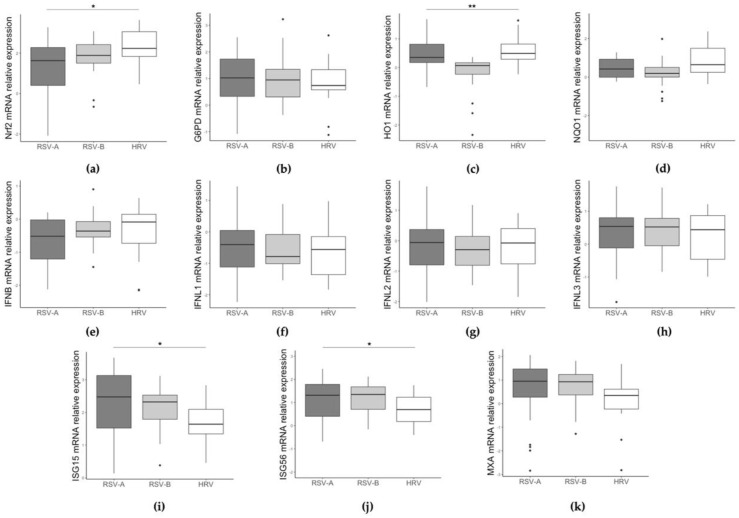
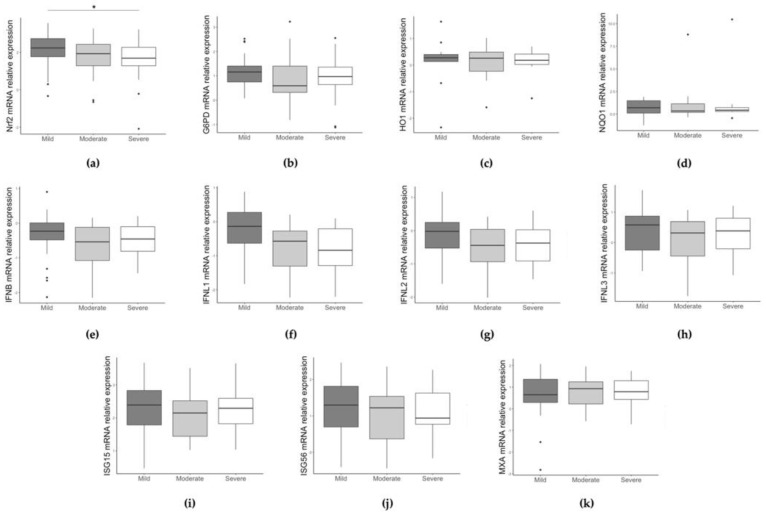
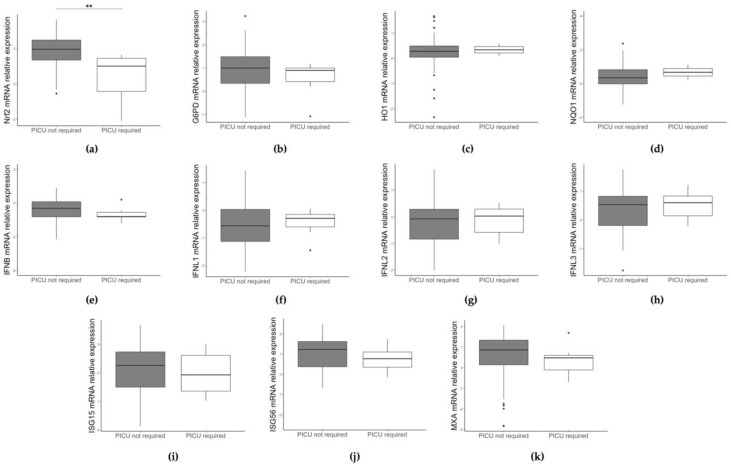
Respiratory diseases caused by respiratory syncytial virus (RSV) and human rhinovirus (HRV) are frequent causes of the hospitalization of children; nonetheless, RSV is responsible for the most severe and life-threatening illnesses. Viral infection triggers an inflammatory response, activating interferon (IFN)-mediated responses, including IFN-stimulated genes (ISG) expression with antiviral and immunomodulatory activities. In parallel, the reactive oxygen species (ROS) production activates nuclear factor erythroid 2-related factor 2 (NRF2), whose antioxidant activity can reduce inflammation by interacting with the NF-kB pathway and the IFN response. To clarify how the interplay of IFN and NRF2 may impact on clinical severity, we enrolled children hospitalized for bronchiolitis and pneumonia, and measured gene expression of type-I and III IFNs, of several ISGs, of NRF2 and antioxidant-related genes, i.e., glucose-6-phosphate dehydrogenase (G6PD), heme oxygenase 1 (HO1), and NAD(P)H dehydrogenase [Quinone] 1 (NQO1) in RSV- (RSV-A N = 33 and RSV-B N = 30) and HRV (N = 22)-positive respiratory samples. NRF2 and HO1 expression is significantly elevated in children with HRV infection compared to RSV ( = 0.012 and = 0.007, respectively), whereas ISG15 and ISG56 expression is higher in RSV-infected children ( = 0.016 and = 0.049, respectively). Children admitted to a pediatric intensive care unit (PICU) had reduced NRF2 expression ( = 0.002). These data suggest, for the first time, that lower activation of the NRF2 antioxidant response in RSV-infected infants may contribute to bronchiolitis severity.
呼吸道合胞病毒(RSV)和人鼻病毒(HRV)引起的呼吸道疾病是儿童住院的常见原因;尽管如此,RSV仍是导致最严重和危及生命疾病的罪魁祸首。病毒感染引发炎症反应,激活干扰素(IFN)介导的反应,包括具有抗病毒和免疫调节活性的干扰素刺激基因(ISG)表达。同时,活性氧(ROS)的产生激活核因子红细胞2相关因子2(NRF2),其抗氧化活性可通过与NF-κB途径和IFN反应相互作用来减轻炎症。为了阐明IFN和NRF2的相互作用如何影响临床严重程度,我们招募了因细支气管炎和肺炎住院的儿童,并测量了I型和III型IFN、几种ISG、NRF2以及抗氧化相关基因(即葡萄糖-6-磷酸脱氢酶(G6PD)、血红素加氧酶1(HO1)和NAD(P)H脱氢酶[醌]1(NQO1))在RSV(RSV-A N = 33,RSV-B N = 30)和HRV(N = 22)阳性呼吸道样本中的基因表达。与RSV感染儿童相比,HRV感染儿童的NRF2和HO1表达显著升高(分别为P = 0.012和P = 0.007),而RSV感染儿童的ISG15和ISG56表达更高(分别为P = 0.016和P = 0.049)。入住儿科重症监护病房(PICU)的儿童NRF2表达降低(P = 0.002)。这些数据首次表明,RSV感染婴儿中NRF2抗氧化反应的较低激活可能导致细支气管炎的严重程度。