Department of Public Health and Infectious Diseases, Sapienza University, Rome, Italy.
Laboratory of Virology, Department of Molecular Medicine, Sapienza University, Rome, Italy.
Virol J. 2023 Oct 18;20(1):239. doi: 10.1186/s12985-023-02208-7.
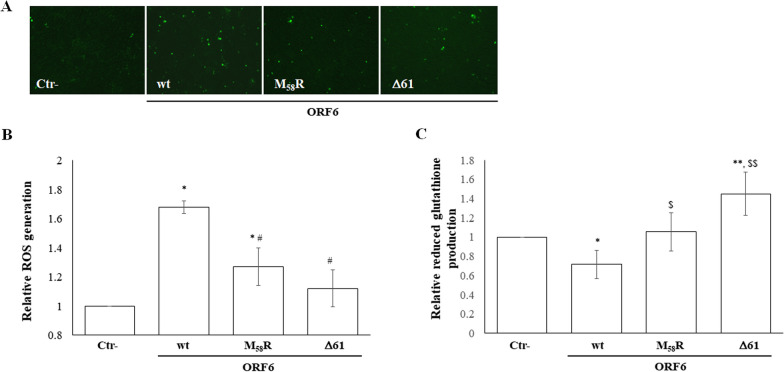
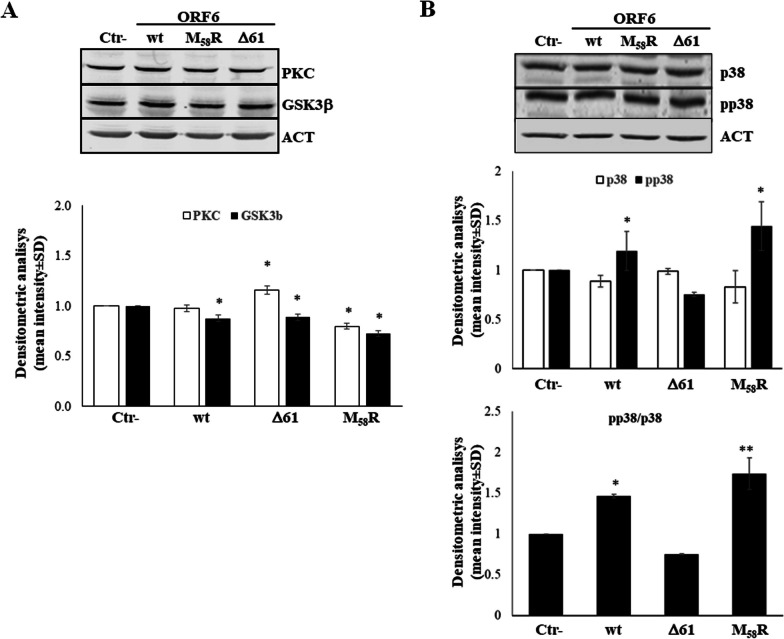
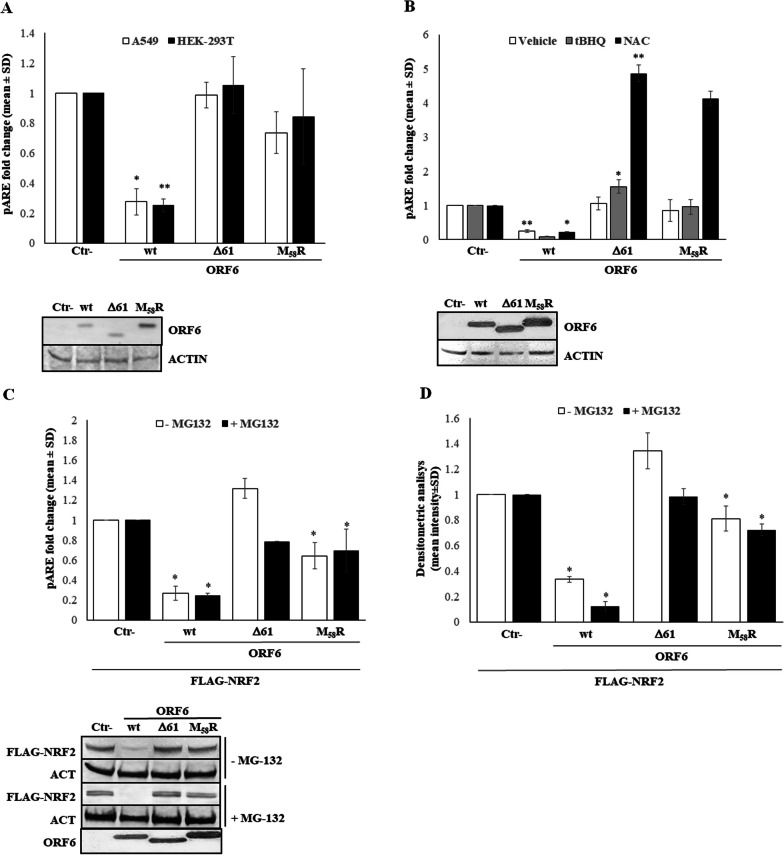
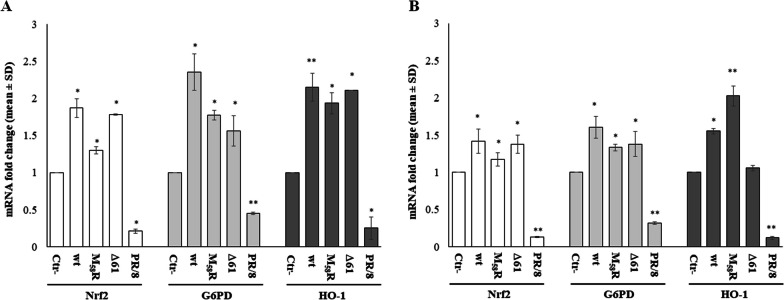
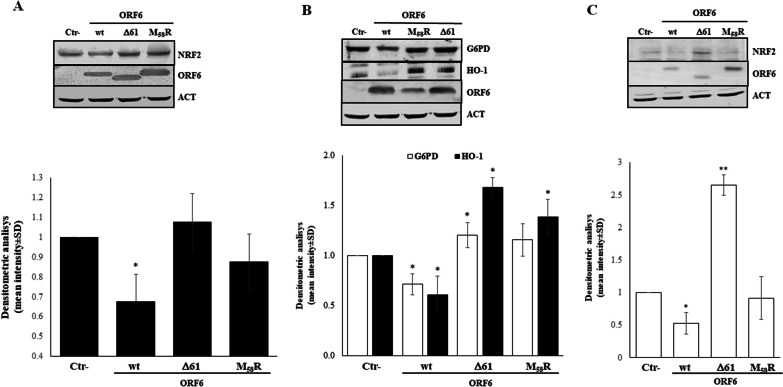
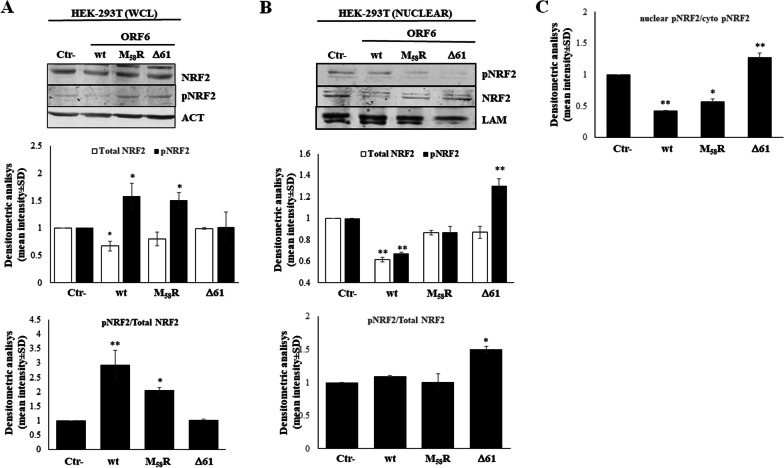
SARS-CoV-2 has evolved several strategies to overcome host cell defenses by inducing cell injury to favour its replication. Many viruses have been reported to modulate the intracellular redox balance, affecting the Nuclear factor erythroid 2-Related Factor 2 (NRF2) signaling pathway. Although antioxidant modulation by SARS-CoV-2 infection has already been described, the viral factors involved in modulating the NRF2 pathway are still elusive. Given the antagonistic activity of ORF6 on several cellular pathways, we investigated the role of the viral protein towards NRF2-mediated antioxidant response. The ectopic expression of the wt-ORF6 protein negatively impacts redox cell homeostasis, leading to an increase in ROS production, along with a decrease in NRF2 protein and its downstream controlled genes. Moreover, when investigating the Δ61 mutant, previously described as an inactive nucleopore proteins binding mutant, we prove that the oxidative stress induced by ORF6 is substantially related to its C-terminal domain, speculating that ORF6 mechanism of action is associated with the inhibition of nuclear mRNA export processes. In addition, activation by phosphorylation of the serine residue at position 40 of NRF2 is increased in the cytoplasm of wt-ORF6-expressing cells, supporting the presence of an altered redox state, although NRF2 nuclear translocation is hindered by the viral protein to fully antagonize the cell response. Furthermore, wt-ORF6 leads to phosphorylation of a stress-activated serine/threonine protein kinase, p38 MAPK, suggesting a role of the viral protein in regulating p38 activation. These findings strengthen the important role of oxidative stress in the pathogenesis of SARS-CoV-2 and identify ORF6 as an important viral accessory protein hypothetically involved in modulating the antioxidant response during viral infection.
SARS-CoV-2 通过诱导细胞损伤来促进自身复制,从而进化出几种克服宿主细胞防御的策略。据报道,许多病毒都能调节细胞内的氧化还原平衡,影响核因子红细胞 2 相关因子 2(NRF2)信号通路。尽管 SARS-CoV-2 感染对氧化还原平衡的调节作用已有描述,但参与调节 NRF2 途径的病毒因子仍不清楚。鉴于 ORF6 对多种细胞途径具有拮抗活性,我们研究了病毒蛋白在 NRF2 介导的抗氧化反应中的作用。wt-ORF6 蛋白的异位表达对氧化还原细胞稳态产生负面影响,导致 ROS 产生增加,同时 NRF2 蛋白及其下游受控制基因减少。此外,当研究之前被描述为无活性核孔蛋白结合突变体的 Δ61 突变体时,我们证明 ORF6 诱导的氧化应激与它的 C 末端结构域密切相关,推测 ORF6 的作用机制与核 mRNA 输出过程的抑制有关。此外,wt-ORF6 表达细胞的细胞质中 NRF2 第 40 位丝氨酸残基的磷酸化激活增加,支持存在改变的氧化还原状态,尽管病毒蛋白阻止了 NRF2 的核易位,从而无法完全拮抗细胞反应。此外,wt-ORF6 导致应激激活的丝氨酸/苏氨酸蛋白激酶 p38 MAPK 的磷酸化,表明病毒蛋白在调节 p38 激活中起作用。这些发现强调了氧化应激在 SARS-CoV-2 发病机制中的重要作用,并确定 ORF6 作为一种重要的病毒辅助蛋白,假设其参与调节病毒感染期间的抗氧化反应。