Ghousein Amani, Tutagata Jordan, Schrieke Hans, Etienne Manuel, Chaumeau Victor, Boyer Sebastien, Pages Nonito, Roiz David, Eren A Murat, Cambray Guillaume, Reveillaud Julie
MIVEGEC, University of Montpellier, INRAE, CNRS, IRD, Montpellier, France.
Centre de Biologie Structurale (CBS), University of Montpellier, INSERM U1054, CNRS UMR5048, Montpellier, France.
ISME Commun. 2023 Apr 28;3(1):40. doi: 10.1038/s43705-023-00248-2.
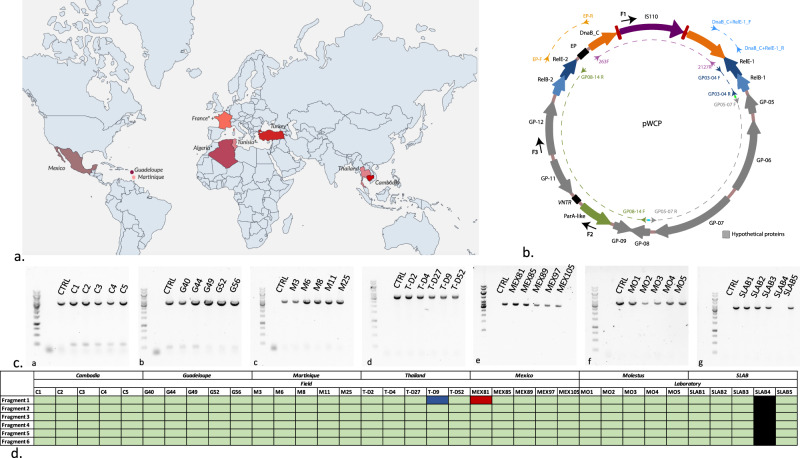
Mosquitoes represent the most important pathogen vectors and are responsible for the spread of a wide variety of poorly treatable diseases. Wolbachia are obligate intracellular bacteria that are widely distributed among arthropods and collectively represents one of the most promising solutions for vector control. In particular, Wolbachia has been shown to limit the transmission of pathogens, and to dramatically affect the reproductive behavior of their host through its phage WO. While much research has focused on deciphering and exploring the biocontrol applications of these WO-related phenotypes, the extent and potential impact of the Wolbachia mobilome remain poorly appreciated. Notably, several Wolbachia plasmids, carrying WO-like genes and Insertion Sequences (IS), thus possibly interrelated to other genetic units of the endosymbiont, have been recently discovered. Here we investigated the diversity and biogeography of the first described plasmid of Wolbachia in Culex pipiens (pWCP) in several islands and continental countries around the world-including Cambodia, Guadeloupe, Martinique, Thailand, and Mexico-together with mosquito strains from colonies that evolved for 2 to 30 years in the laboratory. We used PCR and qPCR to determine the presence and copy number of pWCP in individual mosquitoes, and highly accurate Sanger sequencing to evaluate potential variations. Together with earlier observation, our results show that pWCP is omnipresent and strikingly conserved among Wolbachia populations within mosquitoes from distant geographies and environmental conditions. These data suggest a critical role for the plasmid in Wolbachia ecology and evolution, and the potential of a great tool for further genetic dissection and possible manipulation of this endosymbiont.
蚊子是最重要的病原体传播媒介,负责传播多种难以治疗的疾病。沃尔巴克氏体是专性细胞内细菌,广泛分布于节肢动物中,是最有前景的病媒控制解决方案之一。特别是,沃尔巴克氏体已被证明能限制病原体的传播,并通过其噬菌体WO显著影响宿主的生殖行为。虽然许多研究都集中在解读和探索这些与WO相关表型的生物防治应用,但沃尔巴克氏体可移动基因组的范围和潜在影响仍未得到充分认识。值得注意的是,最近发现了几种携带类WO基因和插入序列(IS)的沃尔巴克氏体质粒,因此可能与内共生体的其他遗传单位相关。在这里,我们研究了世界上几个岛屿和大陆国家(包括柬埔寨、瓜德罗普岛、马提尼克岛、泰国和墨西哥)的致倦库蚊中首次描述的沃尔巴克氏体质粒(pWCP)的多样性和生物地理学,以及实验室中进化了2至30年的蚊群菌株。我们使用PCR和qPCR来确定单个蚊子中pWCP的存在和拷贝数,并使用高度准确的桑格测序来评估潜在变异。与早期观察结果一起,我们的结果表明,pWCP在来自遥远地理区域和环境条件的蚊子中的沃尔巴克氏体种群中无处不在且极为保守。这些数据表明该质粒在沃尔巴克氏体生态学和进化中起关键作用,并且是进一步进行该内共生体基因剖析和可能操作的有力工具。