Non Public Health Care Unit - Department of Pathology (NZOZ Zakład Patologii Spółka z o.o.), Kielce, Poland;
Rom J Morphol Embryol. 2023 Jan-Mar;64(1):95-99. doi: 10.47162/RJME.64.1.12.
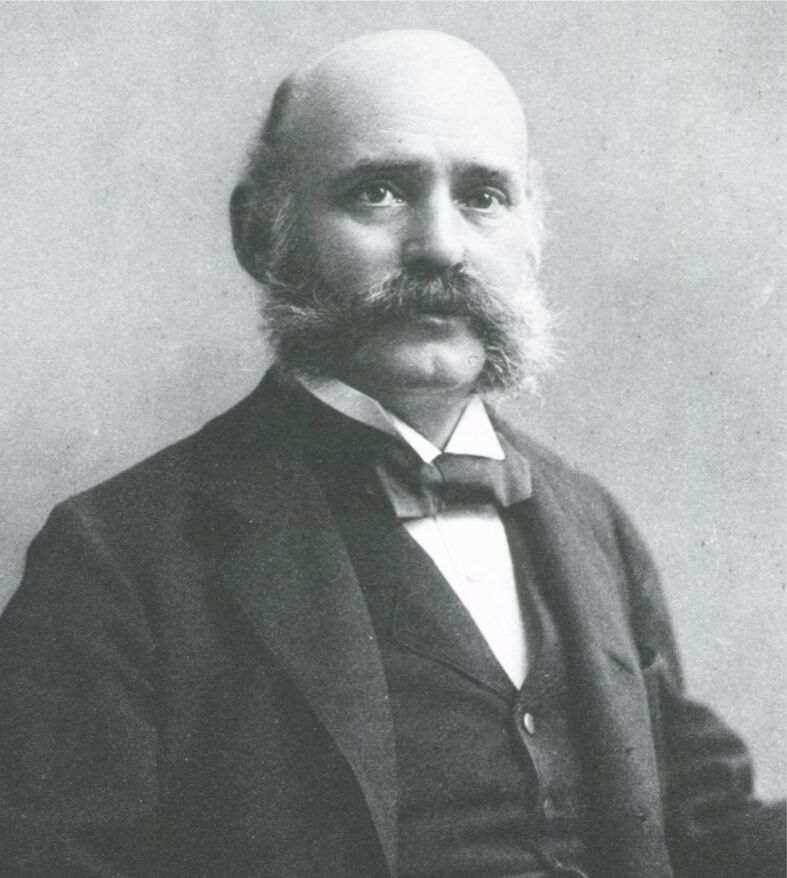
In 1880, a German Jewish Professor of Pathology, Carl Weigert (1845-1904) first defined heart infarction as myocardial, coagulative necrosis ("Coagulationsnekrose") due to obliteration of atherosclerotic coronary arteries thanks, at least, partially to his great diligence in vascular staining methods. Histochemical techniques made his name eponymic as Weigert's Hematoxylin or Weigert's and Van Gieson's elastic stains are still used in routine practice to visualize, e.g., the framework of vessels. However, his discovery has been overshadowed by far more frequently cited in recent decades, subsequent but secondary, 214-page-long book dated on 1896 and titled "L'infarctus du myocarde et ses conséquences - ruptures, plaques fibreuses, anévrismes du coeur", in which René Marie repeated Carl Weigert's words that dead cardiomyocytes lost their cellular nuclei. Weigert introduced the term "die Infarcte des Herzmuskels", in 1880, in his paper titled "Über die pathologischen Gerinnungsvorgänge", in Virchows Archiv. According to Weigert, occlusions were caused by white thrombi ("weissen Thromben") on the ground of atheromatous changes of the coronary arteries. In following manner, he gave macroscopic description of heart infarction: "If a blood supply is very roughly (German: brüsk), completely cut off in individual parts of the heart muscle, yellowish dry masses are formed that resemble coagulated fibrin". "If examined microscopically, one usually does not find any fibrinous material exudate, but often a delusively normal tissue (sometimes you can even see cross striation of the muscle fibers): but all muscle fibers (...) are anucleate". Paradoxically, coronary thrombosis was also a cause of Carl Weigert's death.
1880 年,一位德国犹太病理学教授卡尔·魏格特(Carl Weigert,1845-1904 年)首次将由于动脉粥样硬化性冠状动脉阻塞导致的心肌凝固性坏死定义为“心肌梗死”(myocardial, coagulative necrosis)。这至少部分归功于他在血管染色方法上的巨大努力。组织化学技术使他的名字具有了纪念意义,因为魏格特苏木精(Weigert's Hematoxylin)或魏格特氏和范吉森氏弹性染色法(Weigert's and Van Gieson's elastic stains)至今仍在常规实践中用于可视化,例如,血管的框架。然而,他的发现被近几十年来更为频繁引用的后续研究所掩盖,后者是一本长达 214 页的著作,题为《心肌梗死及其后果-破裂、纤维斑块、心脏动脉瘤》,作者是雷内·玛丽(René Marie),书中重复了卡尔·魏格特(Carl Weigert)的话,即死亡的心肌细胞失去了细胞核。魏格特于 1880 年在题为《关于病理凝结过程》(Über die pathologischen Gerinnungsvorgänge)的论文中首次提出了“心肌梗死”(die Infarcte des Herzmuskels)一词。根据魏格特的说法,阻塞是由于冠状动脉粥样硬化变化导致的白色血栓(“weissen Thromben”)引起的。他以这种方式对心肌梗死进行了宏观描述:“如果心脏肌肉的个别部位的血液供应非常突然(德语:brüsk)完全切断,就会形成类似于凝固纤维蛋白的黄棕色干燥物质。”“如果进行显微镜检查,通常不会发现任何纤维蛋白渗出物,但通常会看到一种看似正常的组织(有时甚至可以看到肌肉纤维的横纹:但所有的肌肉纤维(...)都是无核的”。具有讽刺意味的是,冠状动脉血栓形成也是卡尔·魏格特(Carl Weigert)死亡的原因。