Kitamura Masahiro, Izawa Kazuhiro P, Ishihara Kodai, Brubaker Peter H, Matsuda Hiroaki, Okamura Soichiro, Fujioka Koji
School of Physical Therapy, Faculty of Rehabilitation, Reiwa Health Sciences University, 2-1-12 Wajirogaoka, Fukuoka 811-0213, Japan.
Department of Public Health, Graduate School of Health Sciences, Kobe University, 7-10-2 Tomogaoka, Kobe 654-0142, Japan.
Eur J Investig Health Psychol Educ. 2022 May 26;12(6):536-548. doi: 10.3390/ejihpe12060040.
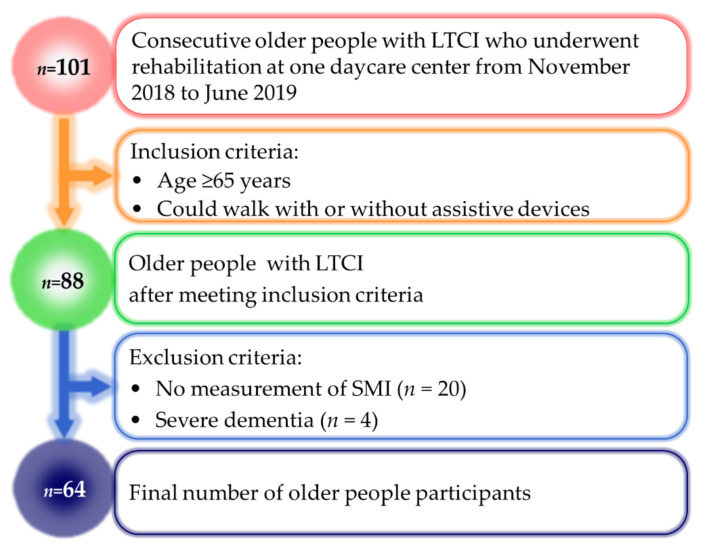
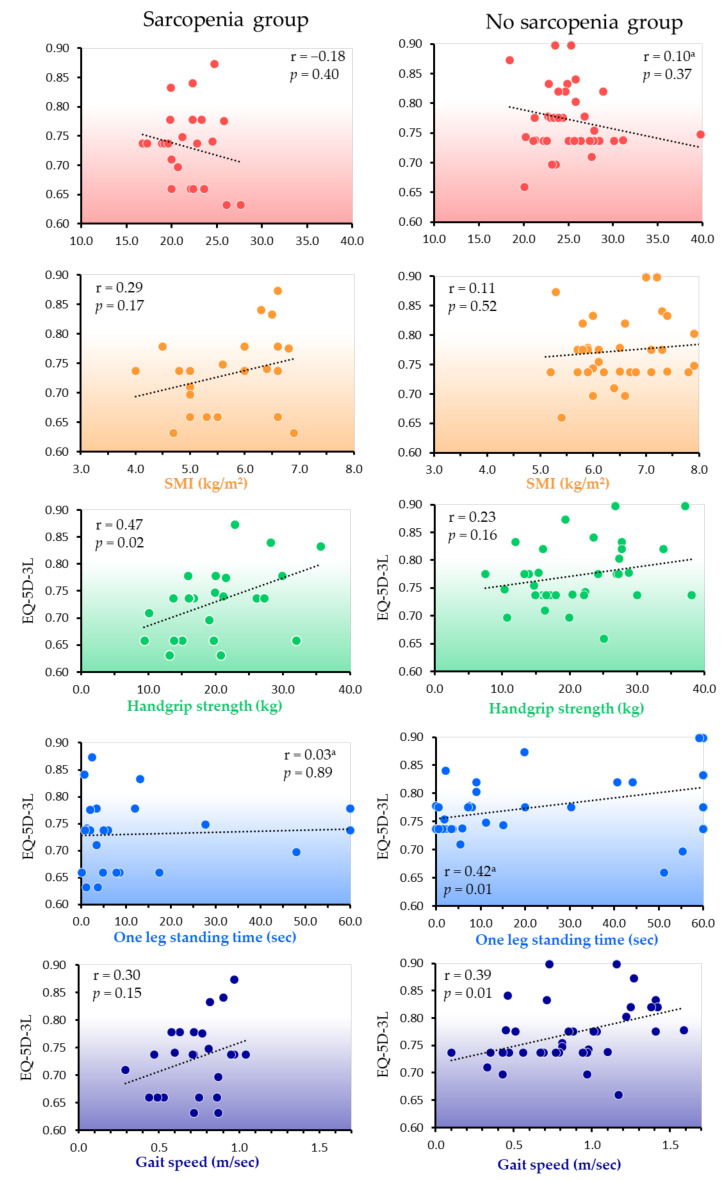
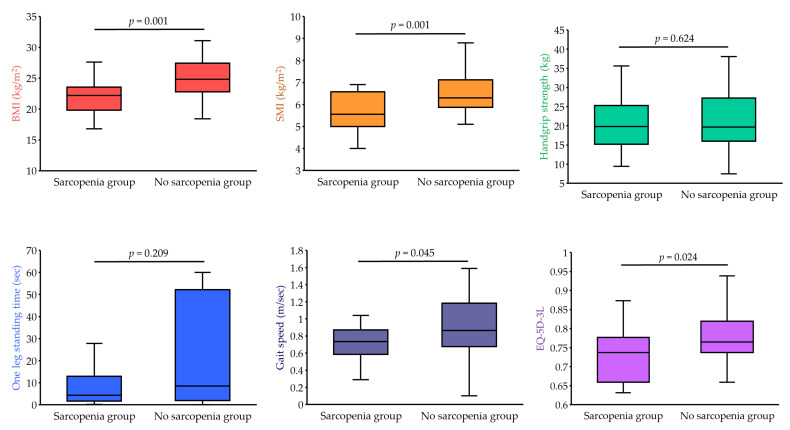
Background: As a result of the increase in older people covered by long-term care insurance (LTCI), prevention of sarcopenia and maintenance and improvement of health-related quality of life (HRQOL) have become important themes. This study aimed to clarify both the differences in HRQOL in older people with and without sarcopenia covered by LTCI and the correlation between HRQOL and physical function. Methods: Participants were 101 older people with LTCI at a daycare center in Japan. We investigated clinical factors using the EuroQol five-dimension three-level questionnaire (EQ-5D-3L). Analysis was by unpaired t-test, Mann−Whitney U test, chi-square test, analysis of covariance, Pearson’s correlation coefficient, and Spearman’s rank correlation coefficient. Results: Compared to the no sarcopenia group (n = 40), the sarcopenia group (n = 24) had significantly lower body mass index, skeletal muscle mass index, gait speed, EQ-5D-3L, and adjusted EQ-5D-3L (p < 0.05). The EQ-5D-3L showed a significant correlation with handgrip strength in the sarcopenia group (p = 0.02) and significant correlations with gait speed and one-leg standing time (both, p = 0.01) in the no sarcopenia group. Conclusion: We clarified differences in HRQOL in older people with and without sarcopenia covered by LTCI. This information on the interrelationship between HRQOL and physical function may help maintain and improve HRQOL in these people.
由于长期护理保险(LTCI)覆盖的老年人数量增加,预防肌肉减少症以及维持和改善健康相关生活质量(HRQOL)已成为重要主题。本研究旨在阐明LTCI覆盖的有和无肌肉减少症的老年人在HRQOL方面的差异以及HRQOL与身体功能之间的相关性。方法:参与者为日本一家日托中心的101名LTCI覆盖的老年人。我们使用欧洲五维健康量表(EQ-5D-3L)调查临床因素。分析采用非配对t检验、曼-惠特尼U检验、卡方检验、协方差分析、皮尔逊相关系数和斯皮尔曼等级相关系数。结果:与无肌肉减少症组(n = 40)相比,肌肉减少症组(n = 24)的体重指数、骨骼肌质量指数、步速、EQ-5D-3L和调整后的EQ-5D-3L显著更低(p < 0.05)。EQ-5D-3L在肌肉减少症组中与握力显著相关(p = 0.02),在无肌肉减少症组中与步速和单腿站立时间均显著相关(均为p = 0.01)。结论:我们阐明了LTCI覆盖的有和无肌肉减少症的老年人在HRQOL方面的差异。这些关于HRQOL与身体功能之间相互关系的信息可能有助于维持和改善这些人的HRQOL。