Chand Siddharth, Kumar Naresh, Mawari Govind, Sarkar Sayan, Daga Mradul Kumar, Raghu R V, Aarthi J, Fatima Arisha
Department of Internal Medicine, Maulana Azad Medical College, New Delhi, India.
Centre for Occupational and Environment Health (COEH), Maulana Azad Medical College, New Delhi, India.
Lung India. 2023 May-Jun;40(3):200-204. doi: 10.4103/lungindia.lungindia_400_22.
Sepsis is a major cause of death in hospitalised patients worldwide. Most studies for assessing outcomes in sepsis are from the western literature. Sparse data from Indian settings are available comparing the systemic inflammatory response syndrome (SIRS), Sequential Organ Failure Assessment (SOFA) and quick SOFA (qSOFA) (sepsis 3 criteria) for assessing outcomes in sepsis. In this study, we aimed to compare the SIRS criteria and sepsis 3 criteria to assess disease outcome at day 28 (recovery/mortality) in a North Indian tertiary care teaching hospital.
A prospective observational study was performed in the Department of Medicine from 2019 to early 2020. Patients admitted to the medical emergency with clinical suspicion of sepsis were included. Systemic inflammatory response syndrome, qSOFA and SOFA scores were calculated at the time of presentation to the hospital. Patients were followed through the course of their hospital stay.
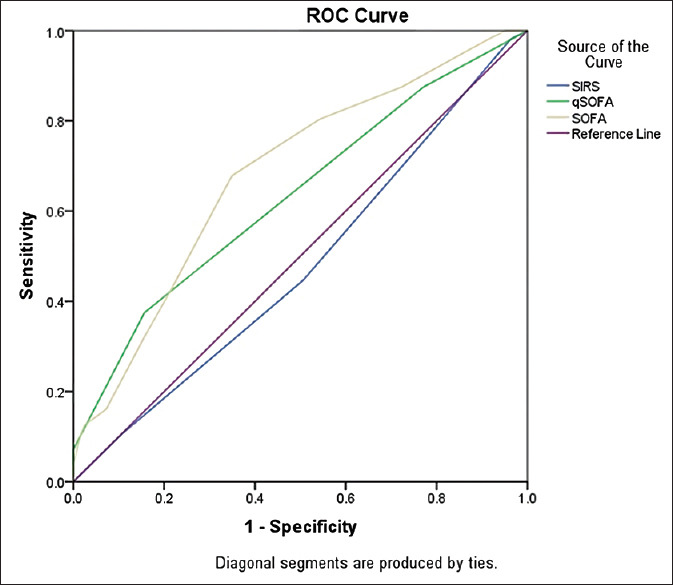
Out of 149 patients, 139 were included in the analysis. Patients who died had significantly higher mean SOFA, qSOFA scores and mean change in SOFA score than patients who survived (P value <0.01). There was no statistical difference between recovery and deaths at similar SIRS scores. A 40.30% fatality rate was recorded. Systemic inflammatory response syndrome had low Area Under Curve (AUC) (0.47) with low sensitivity (76.8) and specificity (21.7). SOFA had the maximum AUC (0.68) compared to qSOFA (0.63) and SIRS (0.47). SOFA also had the maximum sensitivity (98.1) while the qSOFA score had the maximum specificity (84.3).
SOFA and qSOFA scores had superior predictive ability as compared to the SIRS score in assessing mortality in sepsis patients.
脓毒症是全球住院患者死亡的主要原因。大多数评估脓毒症预后的研究来自西方文献。印度关于比较全身炎症反应综合征(SIRS)、序贯器官衰竭评估(SOFA)和快速SOFA(qSOFA)(脓毒症3标准)以评估脓毒症预后的数据稀少。在本研究中,我们旨在比较SIRS标准和脓毒症3标准,以评估北印度一家三级医疗教学医院中患者在第28天的疾病预后(康复/死亡)。
2019年至2020年初在医学科进行了一项前瞻性观察研究。纳入因临床怀疑脓毒症而入住医疗急救科的患者。在患者入院时计算全身炎症反应综合征、qSOFA和SOFA评分。对患者的住院过程进行随访。
149例患者中,139例纳入分析。死亡患者的平均SOFA、qSOFA评分及SOFA评分的平均变化显著高于存活患者(P值<0.01)。在相似的SIRS评分下,康复组与死亡组之间无统计学差异。记录的病死率为40.30%。全身炎症反应综合征的曲线下面积(AUC)较低(0.47),敏感性(76.8)和特异性(21.7)较低。与qSOFA(0.63)和SIRS(0.47)相比,SOFA的AUC最大(0.68)。SOFA的敏感性也最高(98.1),而qSOFA评分的特异性最高(84.3)。
在评估脓毒症患者的死亡率方面,SOFA和qSOFA评分比SIRS评分具有更好的预测能力。