
机器人辅助立体脑电图与硬脑膜下电极在颞叶癫痫评估中的比较。
Robot-assisted stereoencephalography vs subdural electrodes in the evaluation of temporal lobe epilepsy.
机构信息
Neurosurgical Clinic, Department of Neurosurgery and Neurotechnology, Eberhard Karls University, Tuebingen, Germany.
出版信息
Epilepsia Open. 2023 Sep;8(3):888-897. doi: 10.1002/epi4.12756. Epub 2023 May 14.
OBJECTIVE
Invasive video-electroencephalography (iVEEG) is the gold standard for evaluation of refractory temporal lobe epilepsy before second stage resective surgery (SSRS). Traditionally, the presumed seizure onset zone (SOZ) has been covered with subdural electrodes (SDE), a very invasive procedure prone to complications. Temporal stereoelectroencephalography (SEEG) with conventional frame-based stereotaxy is time-consuming and impeded by the geometry of the frame. The introduction of robotic assistance promised a simplification of temporal SEEG implantation. However, the efficacy of temporal SEEG in iVEEG remains unclear. The aim of this study was therefore to describe the efficiency and efficacy of SEEG in iVEEG of temporal lobe epilepsy.
METHODS
This retrospective study enrolled 60 consecutive patients with medically intractable epilepsy who underwent iVEEG of a potential temporal SOZ by SDE (n = 40) or SEEG (n = 20). Surgical time efficiency was analyzed by the skin-to-skin time (STS) and the total procedure time (TPT) and compared between groups (SDE vs SEEG). Surgical risk was depicted by the 90-day complication rate. Temporal SOZ were treated by SSRS. Favorable outcome (Engel°1) was assessed after 1 year of follow-up.
RESULTS
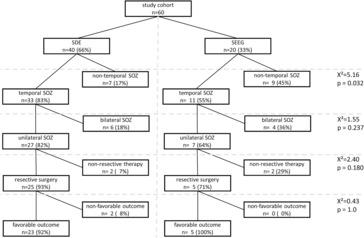
Robot-assisted SEEG significantly reduced the duration of surgery (STS and TPT) compared to SDE implantations. There was no significant difference in complication rates. Notably, all surgical revisions in this study were attributed to SDE. Unilateral temporal SOZ was detected in 34/60 cases. Of the 34 patients, 30 underwent second stage SSRS. Both SDE and SEEG had a good predictive value for the outcome of temporal SSRS with no significant group difference.
SIGNIFICANCE
Robot-assisted SEEG improves the accessibility of the temporal lobe for iVEEG by increasing surgical time efficiency and by simplifying trajectory selection without losing its predictive value for SSRS.
目的
在进行第二阶段切除性手术(SSRS)之前,侵入性视频脑电图(iVEEG)是评估难治性颞叶癫痫的金标准。传统上,假定的起始区(SOZ)已被覆盖有硬膜下电极(SDE),这是一种非常容易发生并发症的侵入性手术。使用传统的基于框架的立体定向的颞叶立体脑电图(SEEG)既费时又受到框架几何形状的阻碍。机器人辅助技术的引入有望简化颞叶 SEEG 的植入。然而,颞叶 SEEG 在 iVEEG 中的有效性尚不清楚。因此,本研究旨在描述颞叶癫痫 iVEEG 中 SEEG 的效率和效果。
方法
这项回顾性研究纳入了 60 例连续的药物难治性癫痫患者,他们接受了潜在颞叶 SOZ 的 iVEEG,其中 40 例患者接受了 SDE,20 例患者接受了 SEEG。通过皮肤到皮肤时间(STS)和总手术时间(TPT)分析手术时间效率,并在 SDE 与 SEEG 之间进行比较。通过 90 天并发症发生率来描述手术风险。通过 SSRS 治疗颞叶 SOZ。术后 1 年随访评估预后(Engel°1)。
结果
与 SDE 植入相比,机器人辅助的 SEEG 显著缩短了手术时间(STS 和 TPT)。并发症发生率无显著差异。值得注意的是,本研究中的所有手术修正都归因于 SDE。60 例患者中有 34 例单侧颞叶 SOZ。34 例患者中有 30 例行第二阶段 SSRS。SDE 和 SEEG 对颞叶 SSRS 的结果均具有良好的预测价值,组间无显著差异。
意义
机器人辅助的 SEEG 通过提高手术时间效率和简化轨迹选择来提高 iVEEG 对颞叶的可及性,同时不影响其对 SSRS 的预测价值。


 Zotero 插件