
NCKAP1 在快速进展型散发性肌萎缩侧索硬化症衍生的小胶质细胞样细胞中缺陷吞噬功能中的作用。
Role of NCKAP1 in the Defective Phagocytic Function of Microglia-Like Cells Derived from Rapidly Progressing Sporadic ALS.
机构信息
Department of Neurology, College of Medicine, Hanyang University, Wangsimniro 222-1, Seoul, 04763, Republic of Korea.
Department of Pharmacology, Research Institute of Basic Medical Science, School of Medicine, CHA University, CHA Bio Complex, 335 Pangyo, Gyeonggi-Do, 13488, Republic of Korea.
出版信息
Mol Neurobiol. 2023 Aug;60(8):4761-4777. doi: 10.1007/s12035-023-03339-2. Epub 2023 May 8.
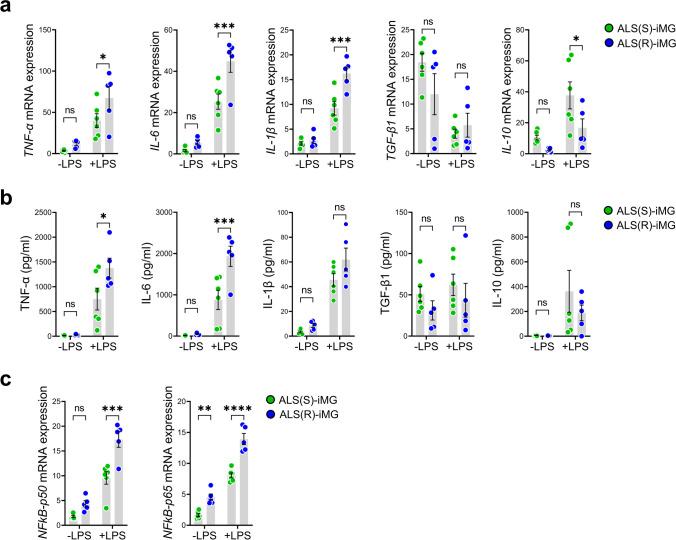
Microglia plays a key role in determining the progression of amyotrophic lateral sclerosis (ALS), yet their precise role in ALS has not been identified in humans. This study aimed to identify a key factor related to the functional characteristics of microglia in rapidly progressing sporadic ALS patients using the induced microglia model, although it is not identical to brain resident microglia. After confirming that microglia-like cells (iMGs) induced by human monocytes could recapitulate the main signatures of brain microglia, step-by-step comparative studies were conducted to delineate functional differences using iMGs from patients with slowly progressive ALS [ALS(S), n = 14] versus rapidly progressive ALS [ALS(R), n = 15]. Despite an absence of significant differences in the expression of microglial homeostatic genes, ALS(R)-iMGs preferentially showed defective phagocytosis and an exaggerated pro-inflammatory response to LPS stimuli compared to ALS(S)-iMGs. Transcriptome analysis revealed that the perturbed phagocytosis seen in ALS(R)-iMGs was closely associated with decreased NCKAP1 (NCK-associated protein 1)-mediated abnormal actin polymerization. NCKAP1 overexpression was sufficient to rescue impaired phagocytosis in ALS(R)-iMGs. Post-hoc analysis indicated that decreased NCKAP1 expression in iMGs was correlated with the progression of ALS. Our data suggest that microglial NCKAP1 may be an alternative therapeutic target in rapidly progressive sporadic ALS.
小胶质细胞在决定肌萎缩侧索硬化症 (ALS) 的进展中起着关键作用,但它们在人类 ALS 中的确切作用尚未确定。本研究旨在使用诱导的小胶质细胞模型鉴定与快速进展性散发性 ALS 患者小胶质细胞功能特征相关的关键因素,尽管该模型与脑驻留小胶质细胞不完全相同。在确认由人单核细胞诱导的小胶质样细胞 (iMGs) 可以重现脑小胶质细胞的主要特征后,使用来自缓慢进展性 ALS 患者 [ALS(S),n = 14] 和快速进展性 ALS 患者 [ALS(R),n = 15] 的 iMGs 进行逐步比较研究,以描绘功能差异。尽管小胶质细胞稳态基因的表达没有明显差异,但与 ALS(S)-iMGs 相比,ALS(R)-iMGs 优先表现出吞噬作用缺陷和对 LPS 刺激的过度促炎反应。转录组分析显示,在 ALS(R)-iMGs 中观察到的受损吞噬作用与 NCKAP1 (NCK 相关蛋白 1) 介导的异常肌动蛋白聚合减少密切相关。NCKAP1 的过表达足以挽救 ALS(R)-iMGs 中受损的吞噬作用。事后分析表明,iMGs 中 NCKAP1 的表达减少与 ALS 的进展相关。我们的数据表明,小胶质细胞 NCKAP1 可能是快速进展性散发性 ALS 的另一个治疗靶点。


 Zotero 插件