Bond Silvano, Saxena Smita, Sierra-Delgado Julieth A
Department of Physical Medicine and Rehabilitation, University of Missouri School of Medicine, Columbia, MO 65211, USA.
NextGen Precision Health, University of Missouri, Columbia, MO 65211, USA.
Cells. 2025 Mar 12;14(6):421. doi: 10.3390/cells14060421.
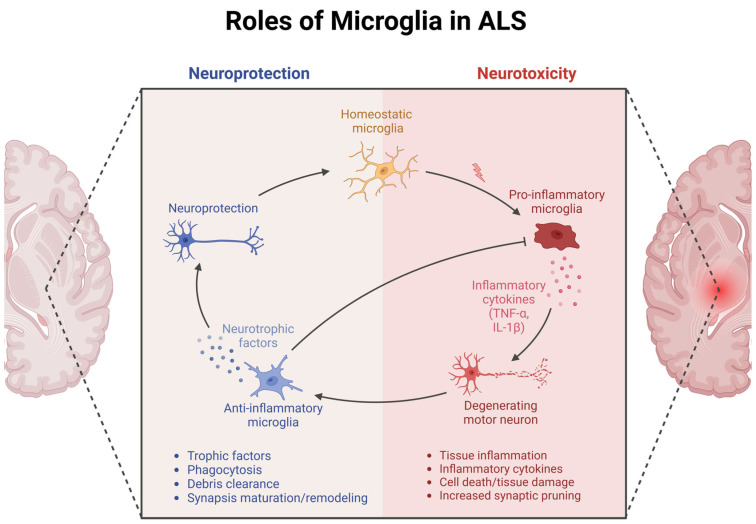
Amyotrophic lateral sclerosis (ALS) is a progressive neurodegenerative disease characterized by the loss of motor neurons, leading to escalating muscle weakness, atrophy, and eventually paralysis. While neurons are the most visibly affected, emerging data highlight microglia-the brain's resident immune cells-as key contributors to disease onset and progression. Rather than existing in a simple beneficial or harmful duality, microglia can adopt multiple functional states shaped by internal and external factors, including those in ALS. Collectively, these disease-specific forms are called disease-associated microglia (DAM). Research using rodent models, patient-derived cells, and human postmortem tissue shows that microglia can transition into DAM phenotypes, driving inflammation and neuronal injury. However, these cells can also fulfill protective roles under certain conditions, revealing their adaptable nature. This review explores recent discoveries regarding the multifaceted behavior of microglia in ALS, highlights important findings that link these immune cells to motor neuron deterioration, and discusses emerging therapies-some already used in clinical trials-that aim to recalibrate microglial functions and potentially slow disease progression.
肌萎缩侧索硬化症(ALS)是一种进行性神经退行性疾病,其特征是运动神经元丧失,导致肌肉无力、萎缩加剧,最终发展为瘫痪。虽然神经元是受影响最明显的细胞,但新出现的数据表明,小胶质细胞——大脑中的常驻免疫细胞——是疾病发生和进展的关键因素。小胶质细胞并非简单地处于有益或有害的二元状态,而是可以根据包括ALS在内的内部和外部因素呈现多种功能状态。总体而言,这些疾病特异性形式被称为疾病相关小胶质细胞(DAM)。使用啮齿动物模型、患者来源的细胞和人类尸检组织进行的研究表明,小胶质细胞可以转变为DAM表型,引发炎症和神经元损伤。然而,这些细胞在某些条件下也可以发挥保护作用,这显示了它们的适应性。这篇综述探讨了关于小胶质细胞在ALS中多方面行为的最新发现,强调了将这些免疫细胞与运动神经元退化联系起来的重要发现,并讨论了一些已经在临床试验中使用的新兴疗法,这些疗法旨在重新校准小胶质细胞功能并可能减缓疾病进展。