College of Agriculture and Biotechnology, Zhejiang University, Hangzhou, China.
ZJU-Hangzhou Global Scientific and Technological Innovation Center, Zhejiang University, Hangzhou, China.
Plant Biotechnol J. 2023 Aug;21(8):1671-1681. doi: 10.1111/pbi.14068. Epub 2023 May 8.
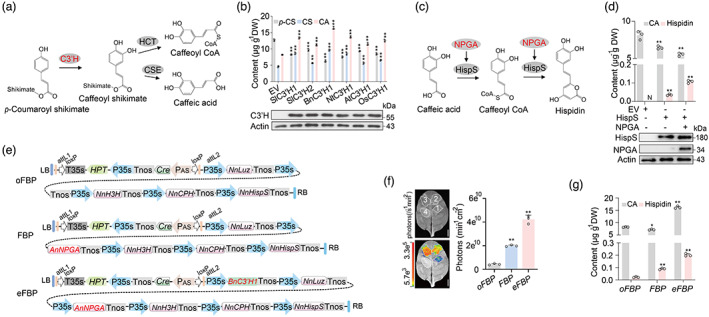
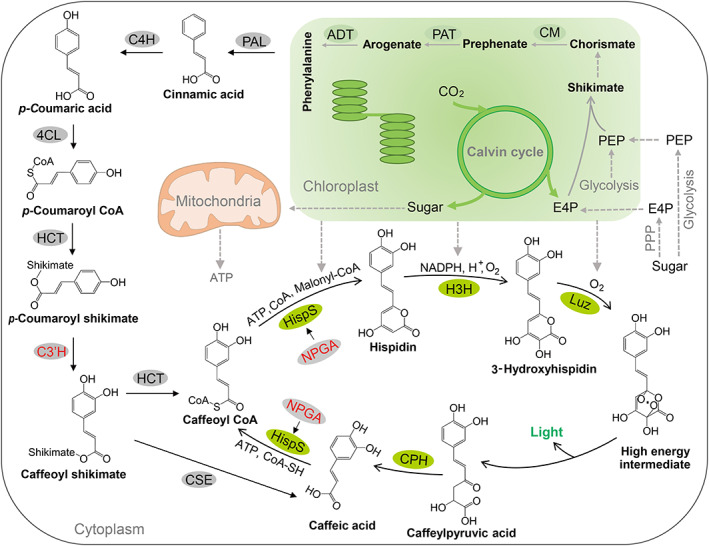
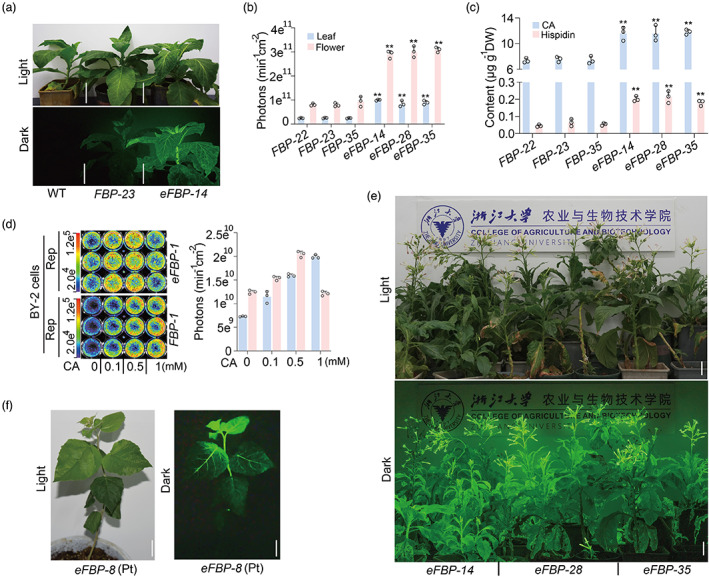
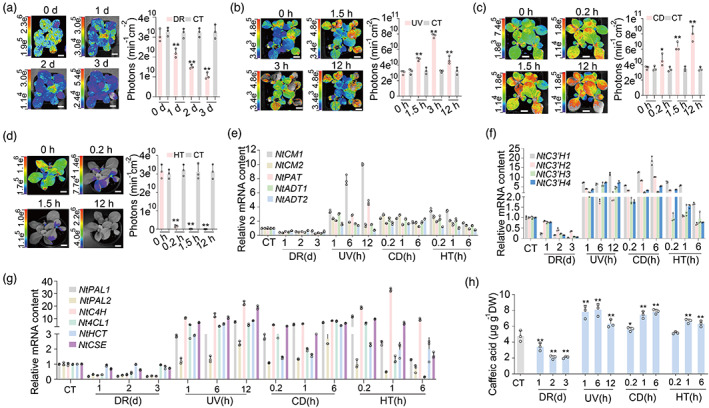
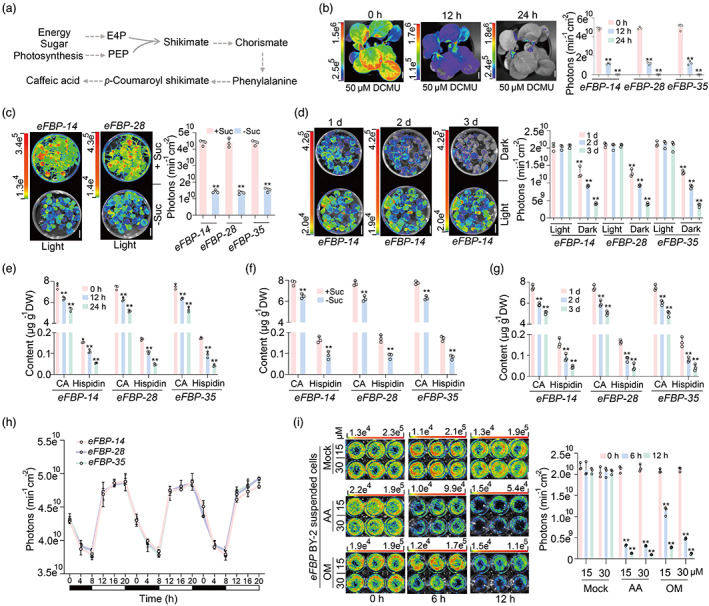
The fungal bioluminescence pathway (FBP) was identified from glowing fungi, which releases self-sustained visible green luminescence. However, weak bioluminescence limits the potential application of the bioluminescence system. Here, we screened and characterized a C3'H1 (4-coumaroyl shikimate/quinate 3'-hydroxylase) gene from Brassica napus, which efficiently converts p-coumaroyl shikimate to caffeic acid and hispidin. Simultaneous expression of BnC3'H1 and NPGA (null-pigment mutant in A. nidulans) produces more caffeic acid and hispidin as the natural precursor of luciferin and significantly intensifies the original fungal bioluminescence pathway (oFBP). Thus, we successfully created enhanced FBP (eFBP) plants emitting 3 × 10 photons/min/cm , sufficient to illuminate its surroundings and visualize words clearly in the dark. The glowing plants provide sustainable and bio-renewable illumination for the naked eyes, and manifest distinct responses to diverse environmental conditions via caffeic acid biosynthesis pathway. Importantly, we revealed that the biosynthesis of caffeic acid and hispidin in eFBP plants derived from the sugar pathway, and the inhibitors of the energy production system significantly reduced the luminescence signal rapidly from eFBP plants, suggesting that the FBP system coupled with the luciferin metabolic flux functions in an energy-driven way. These findings lay the groundwork for genetically creating stronger eFBP plants and developing more powerful biological tools with the FBP system.
真菌生物发光途径(FBP)源自发光真菌,其会释放持续的可见绿光。然而,微弱的生物发光限制了生物发光系统的潜在应用。在这里,我们从油菜中筛选并鉴定了一个 C3'H1(4-香豆酰莽草酸/奎宁酸 3'-羟化酶)基因,它能有效地将 p-香豆酰莽草酸转化为咖啡酸和千里光苷。同时表达 BnC3'H1 和 NPGA(在 A. nidulans 中的无色素突变体)会产生更多的咖啡酸和千里光苷,作为荧光素的天然前体,并显著增强原始真菌生物发光途径(oFBP)。因此,我们成功地创建了增强型 FBP(eFBP)植物,其发光强度为 3×10 个光子/分钟/平方厘米,足以照亮周围环境,并在黑暗中清晰地显示文字。发光植物为肉眼提供了可持续和可再生的照明,并且通过咖啡酸生物合成途径对各种环境条件表现出明显的响应。重要的是,我们揭示了 eFBP 植物中咖啡酸和千里光苷的生物合成源自糖途径,并且能量产生系统的抑制剂会迅速降低 eFBP 植物的发光信号,这表明 FBP 系统与荧光素代谢通量以能量驱动的方式耦合。这些发现为利用 FBP 系统创建更强的 eFBP 植物和开发更强大的生物工具奠定了基础。