• 文献检索
  • 文档翻译
  • 深度研究
  • 学术资讯
  • Suppr Zotero 插件Zotero 插件
  • 邀请有礼
  • 套餐&价格
  • 历史记录
应用&插件
Suppr Zotero 插件Zotero 插件浏览器插件Mac 客户端Windows 客户端微信小程序
定价
高级版会员购买积分包购买API积分包
服务
文献检索文档翻译深度研究API 文档MCP 服务
关于我们
关于 Suppr公司介绍联系我们用户协议隐私条款
关注我们

Suppr 超能文献

核心技术专利:CN118964589B侵权必究
粤ICP备2023148730 号-1Suppr @ 2026

文献检索

告别复杂PubMed语法,用中文像聊天一样搜索,搜遍4000万医学文献。AI智能推荐,让科研检索更轻松。

立即免费搜索

文件翻译

保留排版,准确专业,支持PDF/Word/PPT等文件格式,支持 12+语言互译。

免费翻译文档

深度研究

AI帮你快速写综述,25分钟生成高质量综述,智能提取关键信息,辅助科研写作。

立即免费体验

回顾性研究糖尿病患病率的空间聚集性及其决定因素:扫描统计和地理加权回归建模方法。

A retrospective investigation of spatial clusters and determinants of diabetes prevalence: scan statistics and geographically weighted regression modeling approaches.

机构信息

Biomedical and Diagnostic Sciences, University of Tennessee, Knoxville, United States of America.

Florida Department of Health, Tallahassee, United States of America.

出版信息

PeerJ. 2023 Apr 20;11:e15107. doi: 10.7717/peerj.15107. eCollection 2023.

DOI:10.7717/peerj.15107
PMID:37155464
原文链接:https://pmc.ncbi.nlm.nih.gov/articles/PMC10122841/
Abstract

BACKGROUND

Diabetes and its complications represent a significant public health burden in the United States. Some communities have disproportionately high risks of the disease. Identification of these disparities is critical for guiding policy and control efforts to reduce/eliminate the inequities and improve population health. Thus, the objectives of this study were to investigate geographic high-prevalence clusters, temporal changes, and predictors of diabetes prevalence in Florida.

METHODS

Behavioral Risk Factor Surveillance System data for 2013 and 2016 were provided by the Florida Department of Health. Tests for equality of proportions were used to identify counties with significant changes in the prevalence of diabetes between 2013 and 2016. The Simes method was used to adjust for multiple comparisons. Significant spatial clusters of counties with high diabetes prevalence were identified using Tango's flexible spatial scan statistic. A global multivariable regression model was fit to identify predictors of diabetes prevalence. A geographically weighted regression model was fit to assess for spatial non-stationarity of the regression coefficients and fit a local model.

RESULTS

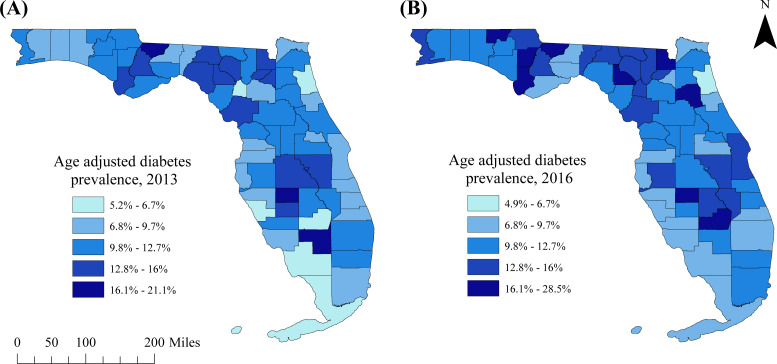
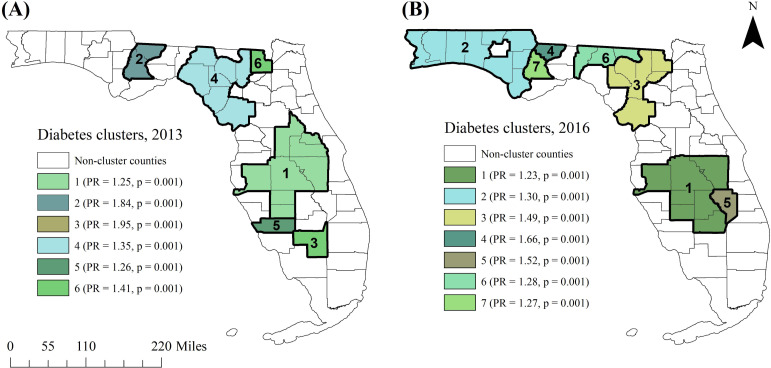
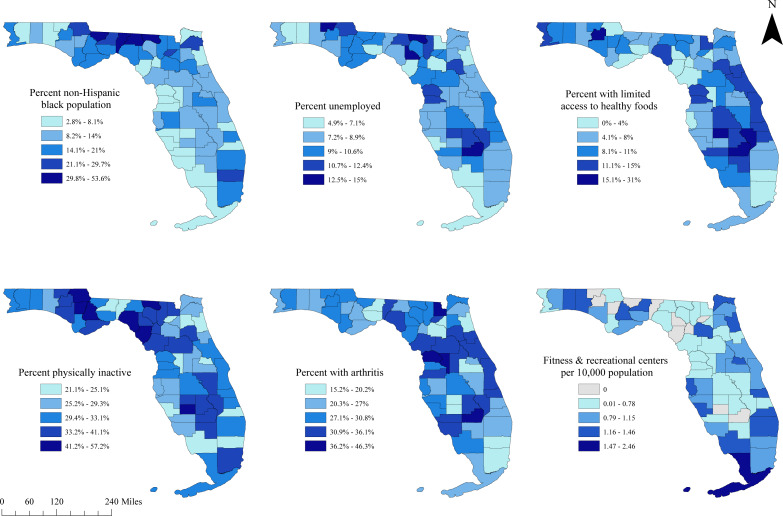
There was a small but significant increase in the prevalence of diabetes in Florida (10.1% in 2013 to 10.4% in 2016), and statistically significant increases in prevalence occurred in 61% (41/67) of counties in the state. Significant, high-prevalence clusters of diabetes were identified. Counties with a high burden of the condition tended to have high proportions of the population that were non-Hispanic Black, had limited access to healthy foods, were unemployed, physically inactive, and had arthritis. Significant non-stationarity of regression coefficients was observed for the following variables: proportion of the population physically inactive, proportion with limited access to healthy foods, proportion unemployed, and proportion with arthritis. However, density of fitness and recreational facilities had a confounding effect on the association between diabetes prevalence and levels of unemployment, physical inactivity, and arthritis. Inclusion of this variable decreased the strength of these relationships in the global model, and reduced the number of counties with statistically significant associations in the local model.

CONCLUSIONS

The persistent geographic disparities of diabetes prevalence and temporal increases identified in this study are concerning. There is evidence that the impacts of the determinants on diabetes risk vary by geographical location. This implies that a one-size-fits-all approach to disease control/prevention would be inadequate to curb the problem. Therefore, health programs will need to use evidence-based approaches to guide health programs and resource allocation to reduce disparities and improve population health.
https://cdn.ncbi.nlm.nih.gov/pmc/blobs/b498/10122841/843d2222126e/peerj-11-15107-g007.jpg
https://cdn.ncbi.nlm.nih.gov/pmc/blobs/b498/10122841/90f17156ea88/peerj-11-15107-g001.jpg
https://cdn.ncbi.nlm.nih.gov/pmc/blobs/b498/10122841/fd0db6a397c3/peerj-11-15107-g002.jpg
https://cdn.ncbi.nlm.nih.gov/pmc/blobs/b498/10122841/19b34660b70a/peerj-11-15107-g003.jpg
https://cdn.ncbi.nlm.nih.gov/pmc/blobs/b498/10122841/ac4dc80c2466/peerj-11-15107-g004.jpg
https://cdn.ncbi.nlm.nih.gov/pmc/blobs/b498/10122841/f0b6b31a8acb/peerj-11-15107-g005.jpg
https://cdn.ncbi.nlm.nih.gov/pmc/blobs/b498/10122841/8dce049572d1/peerj-11-15107-g006.jpg
https://cdn.ncbi.nlm.nih.gov/pmc/blobs/b498/10122841/843d2222126e/peerj-11-15107-g007.jpg
https://cdn.ncbi.nlm.nih.gov/pmc/blobs/b498/10122841/90f17156ea88/peerj-11-15107-g001.jpg
https://cdn.ncbi.nlm.nih.gov/pmc/blobs/b498/10122841/fd0db6a397c3/peerj-11-15107-g002.jpg
https://cdn.ncbi.nlm.nih.gov/pmc/blobs/b498/10122841/19b34660b70a/peerj-11-15107-g003.jpg
https://cdn.ncbi.nlm.nih.gov/pmc/blobs/b498/10122841/ac4dc80c2466/peerj-11-15107-g004.jpg
https://cdn.ncbi.nlm.nih.gov/pmc/blobs/b498/10122841/f0b6b31a8acb/peerj-11-15107-g005.jpg
https://cdn.ncbi.nlm.nih.gov/pmc/blobs/b498/10122841/8dce049572d1/peerj-11-15107-g006.jpg
https://cdn.ncbi.nlm.nih.gov/pmc/blobs/b498/10122841/843d2222126e/peerj-11-15107-g007.jpg
摘要

背景

在美国,糖尿病及其并发症是一个重大的公共卫生负担。一些社区患这种疾病的风险过高。发现这些差异对于指导政策和控制工作以减少/消除不平等现象和改善人口健康状况至关重要。因此,本研究的目的是调查佛罗里达州糖尿病流行的地理高发集群、时间变化和预测因素。

方法

佛罗里达州卫生署提供了 2013 年和 2016 年行为风险因素监测系统的数据。使用比例相等性检验来确定 2013 年至 2016 年期间糖尿病患病率发生显著变化的县。使用 Simes 方法对多个比较进行调整。使用 Tango 的灵活空间扫描统计数据识别具有高糖尿病流行率的县的显著空间聚类。拟合全局多变量回归模型以确定糖尿病患病率的预测因素。拟合地理加权回归模型以评估回归系数的空间非平稳性并拟合局部模型。

结果

佛罗里达州的糖尿病患病率略有但呈上升趋势(2013 年为 10.1%,2016 年为 10.4%),并且该州 61%(41/67)的县的患病率呈统计学显著上升。确定了显著的高流行率糖尿病集群。该疾病负担沉重的县往往具有高比例的非西班牙裔黑人人口、获得健康食品的机会有限、失业、身体不活跃和患有关节炎。观察到以下变量的回归系数存在显著的非平稳性:身体不活跃的人口比例、获得健康食品机会有限的比例、失业比例和患关节炎比例。然而,健身和娱乐设施的密度对糖尿病患病率与失业率、身体不活动和关节炎水平之间的关联有混杂作用。在全球模型中包含此变量会降低这些关系的强度,并减少局部模型中具有统计学意义关联的县的数量。

结论

本研究中确定的糖尿病流行的持续地理差异和时间增加令人担忧。有证据表明,这些决定因素对糖尿病风险的影响因地理位置而异。这意味着一刀切的疾病控制/预防方法不足以遏制这个问题。因此,健康计划将需要使用基于证据的方法来指导健康计划和资源分配,以减少不平等现象并改善人口健康状况。

相似文献

1
A retrospective investigation of spatial clusters and determinants of diabetes prevalence: scan statistics and geographically weighted regression modeling approaches.回顾性研究糖尿病患病率的空间聚集性及其决定因素:扫描统计和地理加权回归建模方法。
PeerJ. 2023 Apr 20;11:e15107. doi: 10.7717/peerj.15107. eCollection 2023.
2
Geographic disparities, determinants, and temporal changes in the prevalence of pre-diabetes in Florida.佛罗里达州糖尿病前期患病率的地理差异、决定因素及时间变化
PeerJ. 2021 Jan 13;9:e10443. doi: 10.7717/peerj.10443. eCollection 2021.
3
Geographic disparities and temporal changes of diabetes-related mortality risks in Florida: a retrospective study.佛罗里达州糖尿病相关死亡率的地理差异和时间变化:一项回顾性研究。
PeerJ. 2024 Jun 27;12:e17408. doi: 10.7717/peerj.17408. eCollection 2024.
4
Determinants of disparities of diabetes-related hospitalization rates in Florida: a retrospective ecological study using a multiscale geographically weighted regression approach.佛罗里达州糖尿病相关住院率差异的决定因素:使用多尺度地理加权回归方法的回顾性生态研究。
Int J Health Geogr. 2024 Jan 6;23(1):1. doi: 10.1186/s12942-023-00360-5.
5
Investigation of geographic disparities of pre-diabetes and diabetes in Florida.佛罗里达州糖尿病前期和糖尿病的地域差异研究。
BMC Public Health. 2020 Aug 12;20(1):1226. doi: 10.1186/s12889-020-09311-2.
6
Geographic disparities and temporal changes of diabetes prevalence and diabetes self-management education program participation in Florida.佛罗里达州糖尿病患病率及糖尿病自我管理教育项目参与的地域差异和时间变化。
PLoS One. 2021 Jul 16;16(7):e0254579. doi: 10.1371/journal.pone.0254579. eCollection 2021.
7
Investigation of geographic disparities of diabetes-related hospitalizations in Florida using flexible spatial scan statistics: An ecological study.利用灵活空间扫描统计调查佛罗里达州糖尿病住院相关的地理差异:一项生态研究。
PLoS One. 2024 Jun 4;19(6):e0298182. doi: 10.1371/journal.pone.0298182. eCollection 2024.
8
Spatial patterns and sociodemographic predictors of chronic obstructive pulmonary disease in Florida.佛罗里达州慢性阻塞性肺疾病的空间模式和社会人口学预测因素。
PeerJ. 2024 Aug 2;12:e17771. doi: 10.7717/peerj.17771. eCollection 2024.
9
An exploratory investigation of geographic disparities of stroke prevalence in Florida using circular and flexible spatial scan statistics.利用圆形和灵活的空间扫描统计方法探索佛罗里达州中风患病率的地理差异。
PLoS One. 2019 Aug 30;14(8):e0218708. doi: 10.1371/journal.pone.0218708. eCollection 2019.
10
Geographic disparities and temporal changes in risk of death from myocardial infarction in Florida, 2000-2014.2000-2014 年佛罗里达州心肌梗死死亡风险的地理差异和时间变化。
BMC Public Health. 2019 May 3;19(1):505. doi: 10.1186/s12889-019-6850-x.

引用本文的文献

1
Predictors of county-level diabetes-related mortality risks in Florida, USA: a retrospective ecological study.美国佛罗里达州县级糖尿病相关死亡风险的预测因素:一项回顾性生态研究。
PeerJ. 2025 Jan 16;13:e18537. doi: 10.7717/peerj.18537. eCollection 2025.
2
Investigation of geographic disparities of diabetes-related hospitalizations in Florida using flexible spatial scan statistics: An ecological study.利用灵活空间扫描统计调查佛罗里达州糖尿病住院相关的地理差异:一项生态研究。
PLoS One. 2024 Jun 4;19(6):e0298182. doi: 10.1371/journal.pone.0298182. eCollection 2024.
3
Determinants of disparities of diabetes-related hospitalization rates in Florida: a retrospective ecological study using a multiscale geographically weighted regression approach.

本文引用的文献

1
Prevalence of Arthritis and Arthritis-Attributable Activity Limitation - United States, 2016-2018.关节炎和与关节炎相关的活动受限的流行率-美国,2016-2018 年。
MMWR Morb Mortal Wkly Rep. 2021 Oct 8;70(40):1401-1407. doi: 10.15585/mmwr.mm7040a2.
2
Geographic disparities, determinants, and temporal changes in the prevalence of pre-diabetes in Florida.佛罗里达州糖尿病前期患病率的地理差异、决定因素及时间变化
PeerJ. 2021 Jan 13;9:e10443. doi: 10.7717/peerj.10443. eCollection 2021.
3
Investigation of geographic disparities of pre-diabetes and diabetes in Florida.
佛罗里达州糖尿病相关住院率差异的决定因素:使用多尺度地理加权回归方法的回顾性生态研究。
Int J Health Geogr. 2024 Jan 6;23(1):1. doi: 10.1186/s12942-023-00360-5.
佛罗里达州糖尿病前期和糖尿病的地域差异研究。
BMC Public Health. 2020 Aug 12;20(1):1226. doi: 10.1186/s12889-020-09311-2.
4
Deaths: Final Data for 2017.死亡:2017年最终数据。
Natl Vital Stat Rep. 2019 Jun;68(9):1-77.
5
Economic Costs of Diabetes in the U.S. in 2017.2017 年美国糖尿病的经济成本。
Diabetes Care. 2018 May;41(5):917-928. doi: 10.2337/dci18-0007. Epub 2018 Mar 22.
6
Risk factors for type 2 diabetes mellitus: An exposure-wide umbrella review of meta-analyses.2 型糖尿病的危险因素:荟萃分析的暴露范围伞式综述。
PLoS One. 2018 Mar 20;13(3):e0194127. doi: 10.1371/journal.pone.0194127. eCollection 2018.
7
County-level contextual factors associated with diabetes incidence in the United States.与美国糖尿病发病率相关的县级背景因素。
Ann Epidemiol. 2018 Jan;28(1):20-25.e2. doi: 10.1016/j.annepidem.2017.11.002. Epub 2017 Nov 23.
8
Diabetes prevalence is associated with different community factors in the diabetes belt versus the rest of the United States.与美国其他地区相比,糖尿病带的糖尿病患病率与不同的社区因素相关。
Obesity (Silver Spring). 2017 Feb;25(2):452-459. doi: 10.1002/oby.21725. Epub 2016 Dec 23.
9
2013 NCHS Urban-Rural Classification Scheme for Counties.2013年国家卫生统计中心县域城乡分类方案
Vital Health Stat 2. 2014 Apr(166):1-73.
10
Trends in prevalence and control of diabetes in the United States, 1988-1994 and 1999-2010.美国 1988-1994 年和 1999-2010 年糖尿病患病率和控制率的变化趋势。
Ann Intern Med. 2014 Apr 15;160(8):517-25. doi: 10.7326/M13-2411.