Servicio de Medicina de Aparato Digestivo, Hospital General Universitario Gregorio Marañón, Instituto de Investigación Sanitaria Gregorio Marañón, Madrid, Spain.
Universidad Complutense de Madrid, Madrid, Spain.
Adv Ther. 2023 Jul;40(7):3006-3020. doi: 10.1007/s12325-023-02517-x. Epub 2023 May 9.
The primary aim is to estimate the cost-effectiveness of transjugular intrahepatic portosystemic stent shunt (TIPSS) in two indications from a Spanish perspective. Firstly, as pre-emptive treatment for patients with acute variceal bleeding (indication 1) compared with endoscopic band ligation plus drug therapy. Secondly, to treat refractory ascites (indication 2) compared with large volume paracentesis.
A two-state (alive and dead) Markov model was developed to capture the costs and health impact for the two indications over a 2-year time horizon with monthly cycles. In the alive state, patients could experience adverse event(s), associated with costs and disutility, such as recurrent variceal bleeding, ascites, and hepatic encephalopathy. Discount rates of 3% for utilities and costs and a cost-effectiveness threshold of €25,000 per QALY were applied.
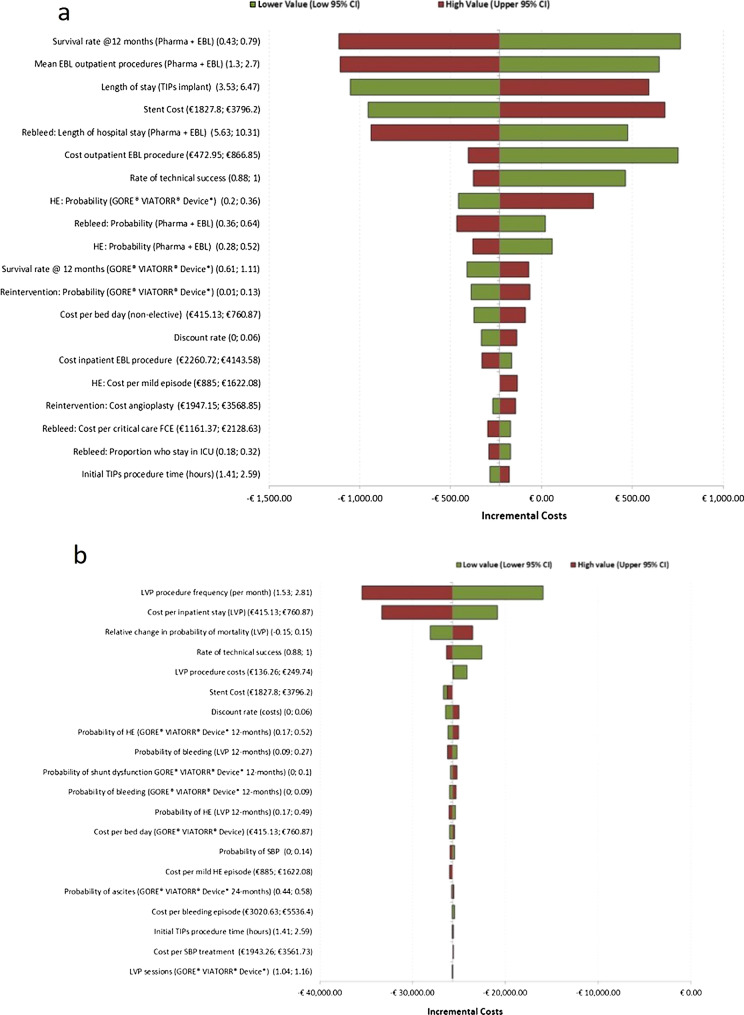
In the base case analysis, TIPSS was estimated to be cost-effective as a pre-emptive treatment for indication 1 (incremental cost and QALYs of - €230 and 0.211, respectively). TIPSS also remained cost-effective (€16,819/QALY) in a conservative scenario analysis, conducted with an alternate source for clinical parameters. The key drivers of the outcomes were survival for the comparator arm, mean band ligation outpatient procedures, and TIPSS treatment costs. TIPSS was estimated to dominate the comparator for indication 2 (incremental cost and QALYs of - €25,687 and 0.531, respectively). The key drivers of the outcomes were monthly paracentesis sessions and cost per inpatient stay for those undergoing paracentesis.
TIPSS is likely to be a cost-effective and a cost-saving treatment in patients with cirrhosis in indications 1 and 2, compared with standard treatments. The analyses estimate clinical benefits along with reduced healthcare costs from avoided downstream resource consumption.
本研究旨在从西班牙角度评估经颈静脉肝内门体分流术(TIPSS)在两种适应证中的成本效益。首先,将 TIPSS 作为急性静脉曲张出血(适应证 1)患者的预防性治疗,与内镜套扎加药物治疗相比。其次,将 TIPSS 用于治疗难治性腹水(适应证 2),与大量腹腔穿刺相比。
建立了两状态(存活和死亡)马尔可夫模型,以在 2 年时间范围内,每月为两个适应证捕获成本和健康影响。在存活状态下,患者可能会经历与成本和效用相关的不良事件,如复发性静脉曲张出血、腹水和肝性脑病。应用了 3%的效用和成本折扣率和 25,000 欧元/QALY 的成本效益阈值。
在基础案例分析中,TIPSS 作为适应证 1 的预防性治疗被估计为具有成本效益(增量成本和 QALY 分别为-230 欧元和 0.211)。在保守情景分析中,TIPSS 也具有成本效益(16,819 欧元/QALY),该分析使用了临床参数的替代来源。结果的关键驱动因素是对照组的生存率、平均套扎门诊程序和 TIPSS 治疗成本。TIPSS 被估计在适应证 2 中优于对照组(增量成本和 QALY 分别为-25,687 欧元和 0.531)。结果的关键驱动因素是每月腹腔穿刺次数和接受腹腔穿刺的患者每次住院的费用。
与标准治疗相比,TIPSS 可能是肝硬化患者在适应证 1 和 2 中具有成本效益和节省成本的治疗方法。分析估计了临床效益以及避免下游资源消耗带来的医疗成本降低。