Zhu Xiao, Zhou Ying, Zhong Wansi, Li Yifei, Wang Junjun, Chen Yuping, Zhang Ruoxia, Sun Jianzhong, Sun Yu, Lou Min
Department of Neurology, the Second Affiliated Hospital of Zhejiang University, School of Medicine, Hangzhou, China.
Department of Neurology, Zhejiang Hospital, Hangzhou, China.
Aging Dis. 2023 Aug 1;14(4):1472-1482. doi: 10.14336/AD.2022.1206.
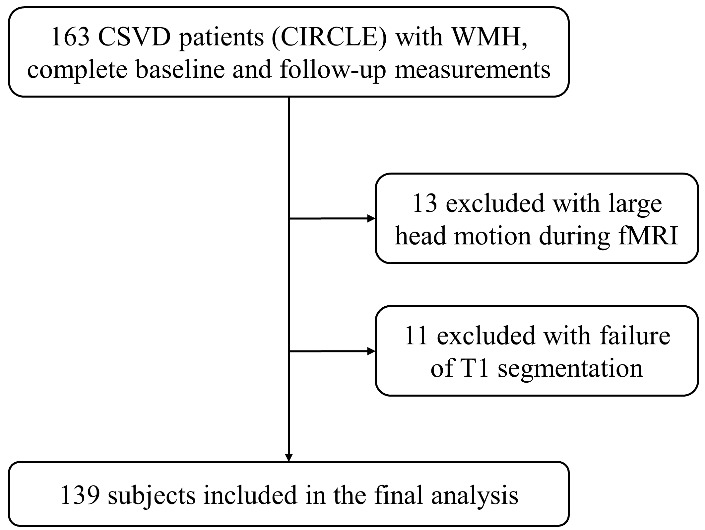
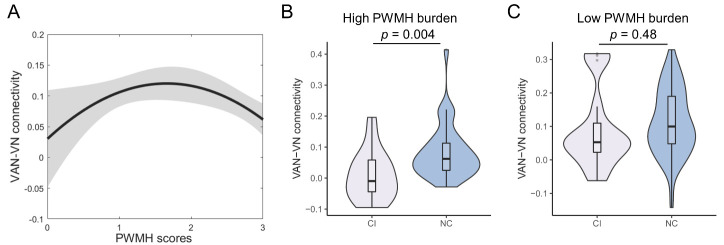
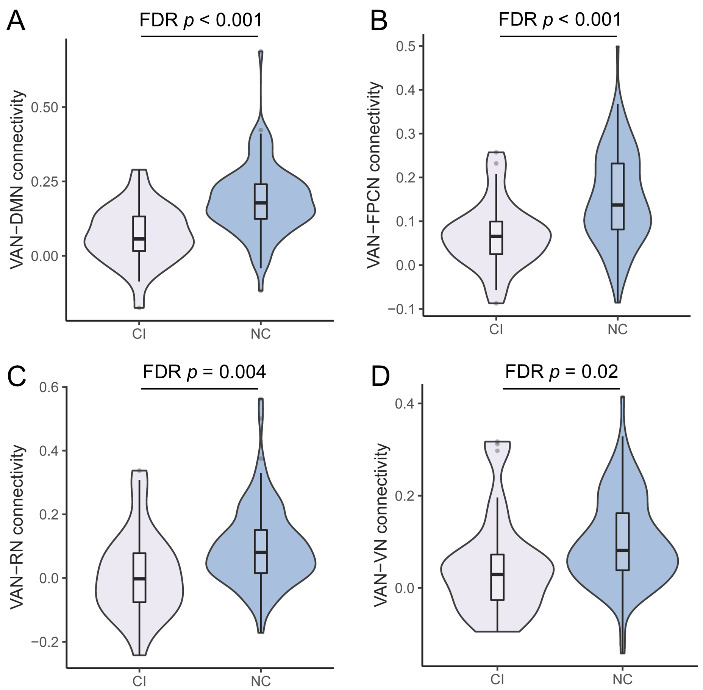
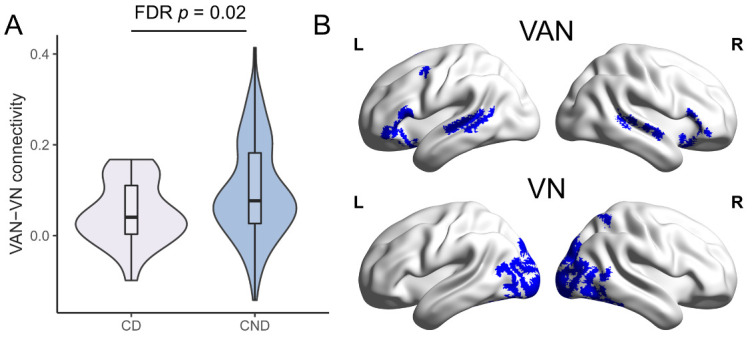
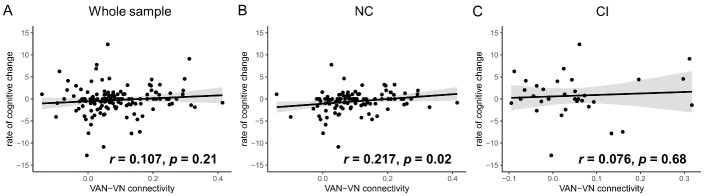
Ventral attention network (VAN), associated with cognitive performance, is one of the functional networks that are most vulnerable in white matter hyperintensity (WMH). Considering the global interaction of networks for cognitive performance, we hypothesized that VAN-related between-network connectivity might play a role in maintaining cognition in patients with WMH. We included 139 participants for both cross-sectional and longitudinal analysis from CIRCLE study (ClinicalTrials.gov ID: NCT03542734) between January 2014 and January 2021. Differences of VAN-related between-network connectivity were compared between normal-cognition (NC) and cognitive-impairment (CI) groups cross-sectionally, and between cognitive-decline (CD) and cognitive non-decline (CND) groups longitudinally by using t-test. False Discovery Rate was used for multiple comparison correction. The relationship between the network connectivity and WMH was tested on linear and quadratic models. Subgroup analysis of different WMH burdens were performed to test the difference of network connectivity between NC and CI groups. Among VAN-related between-network connectivity, only VAN-Visual Network (VN) connectivity was higher both in NC (n = 106) and CND (n = 113) groups versus CI (n = 33) and CD groups (n = 26), respectively. There was an inverted U-shaped relation between periventricular WMH (PWMH) burden and VAN-VN connectivity. Normal-cognition participants had higher VAN-VN connectivity among high, but not low PWMH burden subgroups. These findings suggest that the VAN-VN connectivity plays an important role in maintaining cognitive performance in WMH patients. It may serve as a unique marker for cognitive prediction and a potential target for intervention to prevent cognitive decline in WMH patients.
腹侧注意网络(VAN)与认知表现相关,是在白质高信号(WMH)中最易受损的功能网络之一。考虑到认知表现网络的全局交互作用,我们假设与VAN相关的网络间连接性可能在维持WMH患者的认知方面发挥作用。我们纳入了2014年1月至2021年1月期间CIRCLE研究(ClinicalTrials.gov标识符:NCT03542734)中的139名参与者进行横断面和纵向分析。通过t检验,横断面比较了正常认知(NC)组和认知障碍(CI)组之间与VAN相关的网络间连接性差异,纵向比较了认知衰退(CD)组和认知非衰退(CND)组之间的差异。采用错误发现率进行多重比较校正。在线性和二次模型上测试了网络连接性与WMH之间的关系。进行了不同WMH负担的亚组分析,以测试NC组和CI组之间网络连接性的差异。在与VAN相关的网络间连接性中,仅VAN-视觉网络(VN)连接性在NC组(n = 106)和CND组(n = 113)中分别高于CI组(n = 33)和CD组(n = 26)。脑室周围WMH(PWMH)负担与VAN-VN连接性之间存在倒U形关系。正常认知参与者在高PWMH负担亚组中具有较高的VAN-VN连接性,但在低PWMH负担亚组中则不然。这些发现表明,VAN-VN连接性在维持WMH患者的认知表现中起重要作用。它可能作为认知预测的独特标志物以及预防WMH患者认知衰退的潜在干预靶点。